Chiesa di San Gregorio Magno: A Historic Parish Church in Ferrara
Site at a Glance
- Rating
- 4.2
- Popularity
- Very Low
- Country
- Italy
- Primary era
- Medieval
- External website
- Open
- Eras represented
- Medieval, Early Modern, Modern
- Civilizations
- Italian
- Site type
- Religious
- Remains
- Church
On this page13 sections
History
Chiesa di San Gregorio Magno is a historic parish church in Ferrara, Italy, with Romanesque origins and a first written record from 964. It stands within Ferrara’s earliest urban settlement, the Byzantine castrum, a fortified settlement or military-founded urban center, also known as the Castello dei Curtensi. A marble inscription inside the church confirms that it was already a parish in the tenth century, making it one of Ferrara’s oldest parishes.
Medieval Parish History
The church’s early history belongs to the formation of Ferrara’s first urban community. Its earliest surviving documentary record dates to the reign of Otto I of Saxony, a tenth-century German king and emperor. In 1278, the parish priest Bonus joined other priests in founding the city’s association of parish priests, linking San Gregorio to the organization of Ferrara’s medieval clergy.
Over the following centuries, the parish rectors Giovanni Battista Bertazzoli and Melchiorre Sacrati directed substantial restoration and embellishment. These interventions contributed to the church’s changing appearance, which combined its Romanesque origins with a fifteenth-century restoration in the Gothic style and later Baroque alterations.
Rebuilding and Nineteenth-Century Devotion
Between the eighteenth and nineteenth centuries, Don Antonio Ughi found the church almost ruined and its rectory unsafe. He carried out a radical restoration of the church and completely rebuilt the rectory. The structural changes were extensive, and Cardinal Alessandro Mattei reconsecrated the church on 13 April 1788.
According to testimony given in 1932 by the parish priest Don Eugenio Melloni, the earlier works had lengthened the church and created a new presbytery, the area around the high altar reserved for the liturgy, together with a choir and transept, the cross-arm extending across the main axis of the church. These changes gave the interior greater spaciousness.
The church is dedicated to Pope Gregory the Great, a sixth- and seventh-century pope and theologian venerated as a saint in the Catholic Church. His liturgical feast on 3 September has not been solemnly celebrated there for a long time. From the second half of the nineteenth century, celebrations connected with Our Lady of Lourdes took its place. Lourdes, a French pilgrimage center associated with reported apparitions of the Virgin Mary to Bernadette Soubirous in 1858, became part of the church’s religious life in 1864, six years after the apparitions. San Gregorio became the first Lourdes shrine in the diocese of Ferrara, and worshippers traditionally gather there on 11 February.
Twentieth-Century Conservation
In 1932, the facade was restored through the efforts of Pietro Niccolini, whose nearby residence is commemorated by a plaque. The work was entrusted to the historical-artistic section of Ferrariae Decus, a Ferrara association devoted to protecting the city’s cultural heritage, after approval by the relevant Italian monument and fine-arts authorities. Lasting approximately one year, the restoration sought to recover part of the facade’s earlier appearance, including its Gothic elements.
The parish administration also includes the church of Sant’Antonio Abate at the junction of Via Saraceno and Via Cavedone. San Gregorio’s bell tower survived both the earthquake sequence that struck Ferrara from November 1570 and the earthquakes of 2012 without particular damage. It has received several restorations, generally limited to ordinary maintenance, while the bell chamber underwent repairs in autumn 1907, especially at its upper masonry corners and terracotta decoration. Four new bells were installed there in 1890. Made by the Bolognese founder Clemente Brighenti, they were mounted with the traditional double Bolognese system, a bell-mounting and ringing method associated with Bologna’s mechanical and musical traditions.
Remains
Chiesa di San Gregorio Magno occupies the corner of Via Cammello, Via Carmelino, and Vicolo del Granchio, within the area of Ferrara’s early Byzantine settlement. Its surviving fabric brings together a Romanesque brick facade, fifteenth-century terracotta ornament, Gothic alterations recovered in the twentieth century, a medieval bell tower, and an interior shaped by later rebuilding and restoration.
Facade and Bell Tower
Romanesque and Gothic Facade
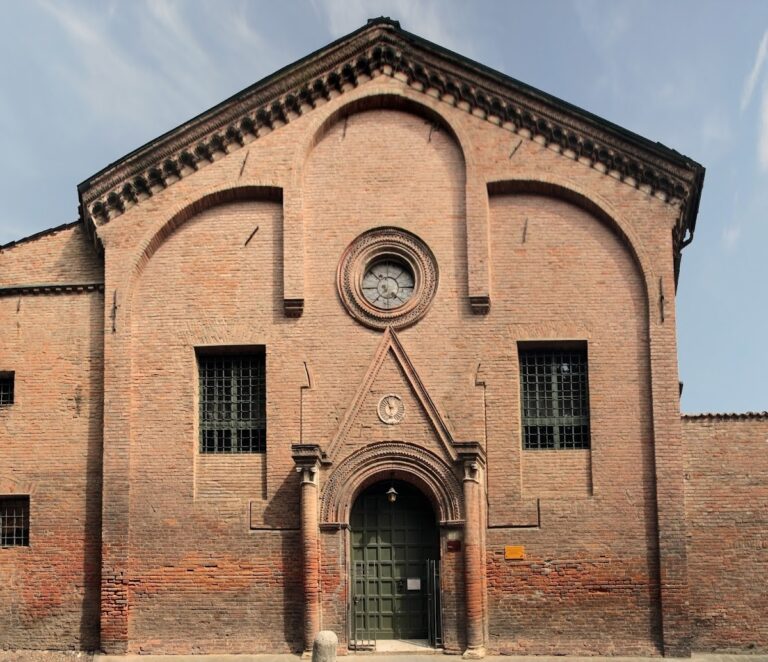
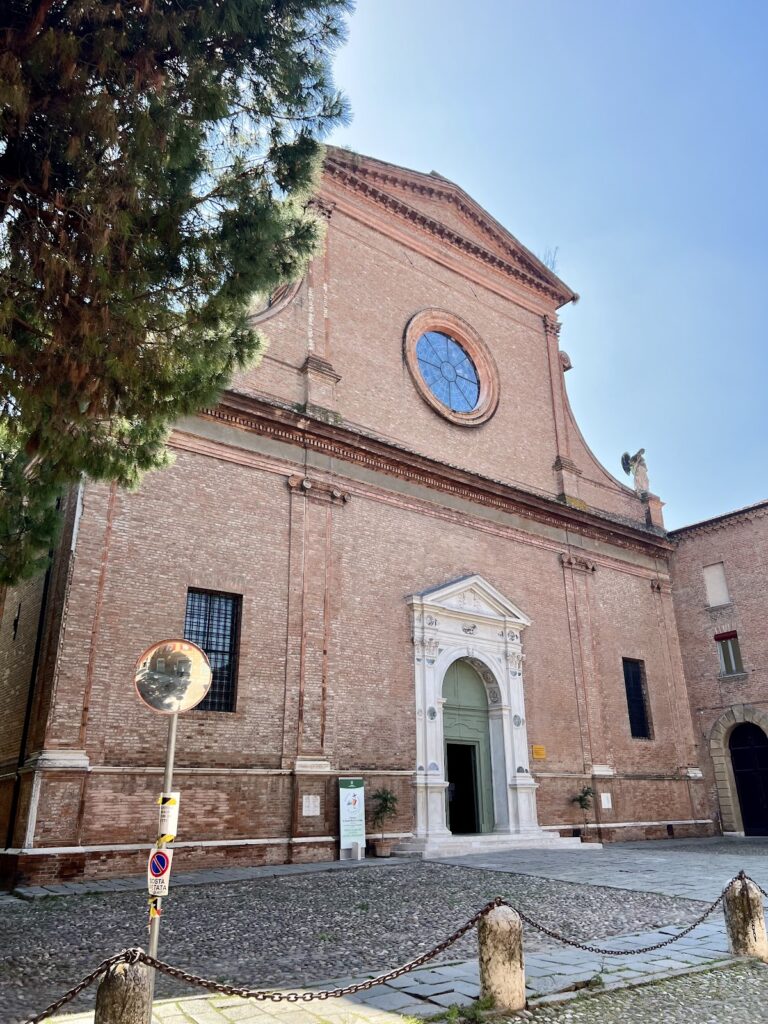
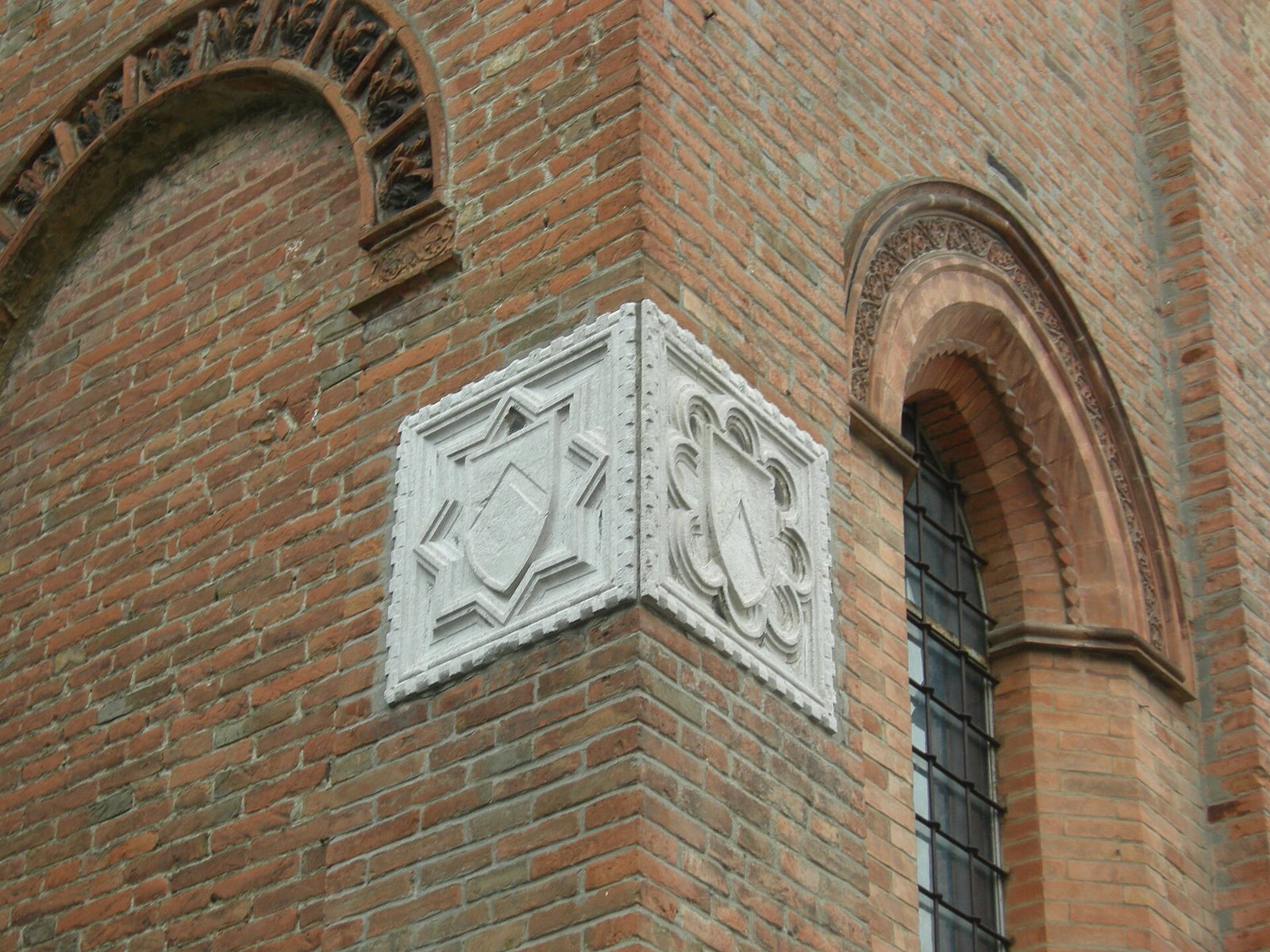
The facade originated in the Romanesque period and now ends in a gabled roof. Brickwork is divided by four pilasters that support three arches formed from projecting terracotta mouldings. Together, these elements create a single arched composition divided into three units. A marble slab bearing a noble coat of arms is set into the pilaster at the left corner.
The central portal combines marble and terracotta and has a pointed arch. During the eighteenth century, its earlier pointed form was altered when two rectangular windows were opened beside it and a third was placed above. The 1932 restoration reinstated the pointed portal and added decorated terracotta elements. The windows in the facade bays were changed into elongated pointed openings, while the upper window became a circular rose window. Abundant terracotta ornament and fifteenth-century decorative friezes remain visible despite the later Baroque changes.
Romanesque Bell Tower
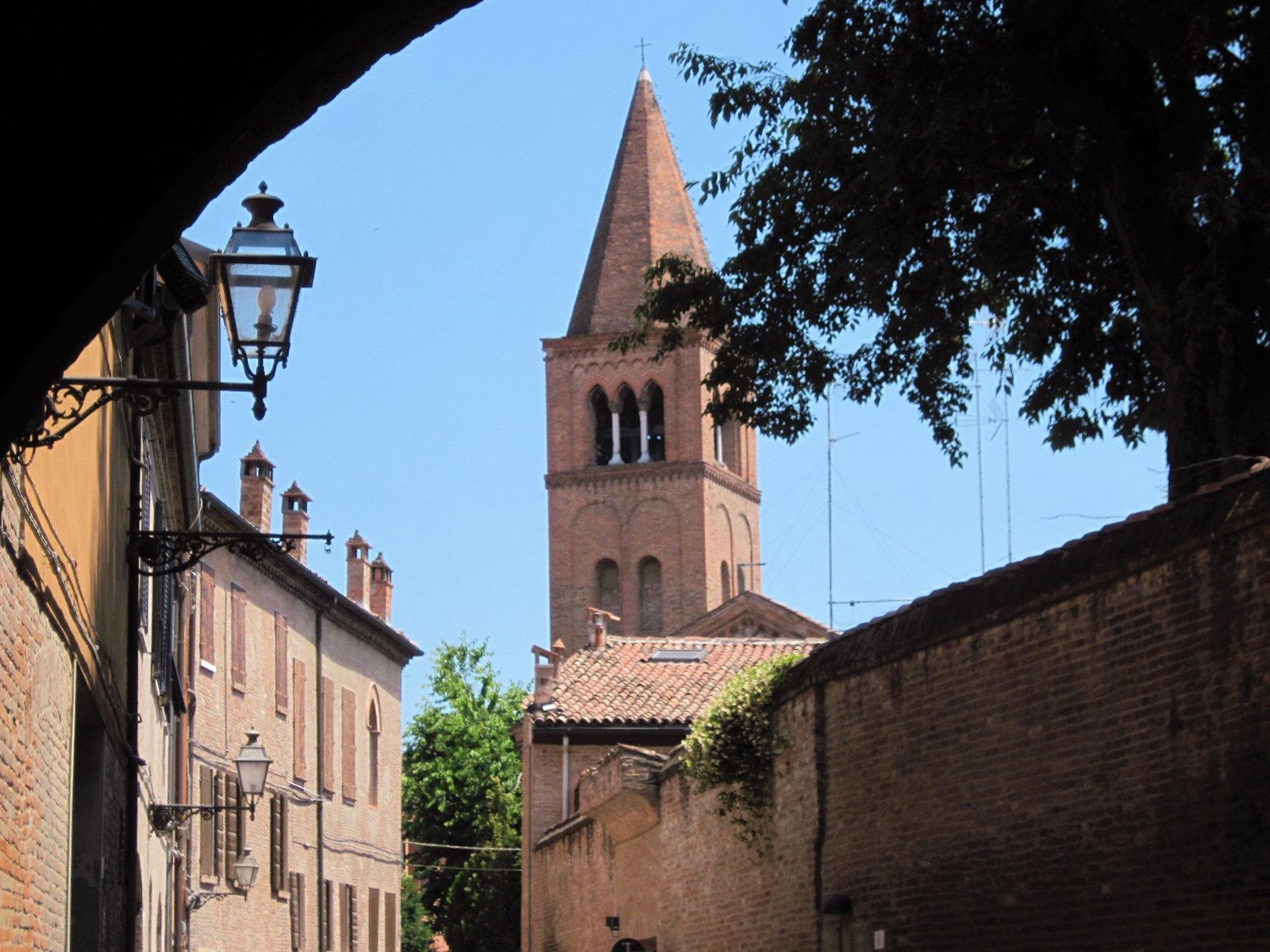
Standing beside the church, the bell tower dates from 1092 and is regarded as the oldest in Ferrara. A historical tradition associated with Marco Antonio Guarini attributes its construction to the support of a Ferrarese noblewoman whose family had burial places in the area. The tower is Romanesque up to the bell chamber and is crowned by a pyramid with an octagonal base.
The bell chamber has pointed-arch three-light windows, meaning openings divided into three sections, which recall the church’s entrance portal and date at least from the thirteenth century. Elegant terracotta elements arranged in arches appear above and below the windows. This decorative pattern was widespread in Ferrara from the late fourteenth century through the early sixteenth century.
Chapels and Liturgical Interior
Chapel of Saint Gregory the Great
The right chapel is dedicated to Saint Gregory the Great. It contains a canvas by Alberto Mucchiati showing the saint receiving an apparition of Saint Clement, a major early Christian saint traditionally associated with the early Roman Church. During Holy Week, the chapel’s altar houses the Blessed Sacrament, while during the Christmas season it holds the Nativity scene.
Chapel of Saint John Nepomuk
The left chapel is dedicated to Saint John Nepomuk, a fourteenth-century Bohemian priest and martyr traditionally associated with protection of the confessional seal. The chapel contains a painting attributed to Giuseppe Ghedini.
Baptismal Font
The baptismal font in the left chapel consists of a sixteenth-century marble basin set on a base that once stood on the quay of the port of Classe. In the time of Augustus, the base served as a point for mooring ships, giving the font a material history that predates its use in the church.
Statues and Lourdes Grotto
The arch leading toward the transept and presbytery is flanked by two niches. The right niche contains a statue of Saint John the Baptist, and the left contains a statue of Saint John the Apostle and Evangelist. Both works were made by Antonio Magnani, a prominent seventeenth-century Ferrarese sculptor, and came from the former church of San Romano.
Above the high altar, a stylized stone grotto installed in 1958 houses a statue of Our Lady of Lourdes. Federico Monti, a sculptor from Bologna, made the statue in 1884; it had previously stood elsewhere in the church. The interior walls were restored in the 1950s and stripped of excessive colored decoration, leaving them white.