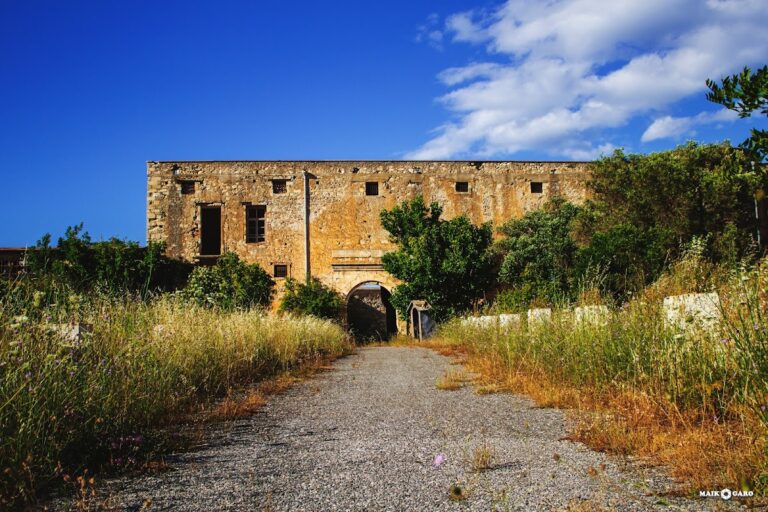
Mosque of Sultan Ibrahim Han, Rethymno: An Ottoman Prayer Hall in the Fortezza


Site at a Glance
- Rating
- 4.3
- Popularity
- Low
- Country
- Greece
- Primary era
- Early Modern
- External website
- Open
- Eras represented
- Early Modern
- Civilizations
- Ottoman, Venetian
- Site type
- Religious
- Remains
- Mosque
On this page7 sections
History
Venetian Cathedral
The Mosque of Sultan Ibrahim Han, Rethymno, is an Ottoman mosque in Greece, built in 1648 within the Fortezza, the Venetian fortress of Rethymno. It occupies the site of a Latin cathedral constructed between 1583 and 1585, during the period when Venice governed the city and the Western Catholic tradition shaped its religious institutions.
The Venetian cathedral was dedicated to Saint Nicholas. Its construction followed the destruction of an earlier church during the 1571 invasion led by Uluç Ali Pasha, an Ottoman admiral and military commander. The Venetians moved the cathedral seat into the Fortezza, where the new building also served the defensive requirements of the fortified complex. In 1585, Bishop Carrara refused to celebrate Mass there because he considered the cathedral inadequately equipped and too narrow for the Venetian elite living inside the fortress.
Ottoman Mosque
Rethymno was conquered by the Ottomans in 1646 after a siege of approximately two months. The cathedral was then demolished, and a mosque dedicated to Sultan Ibrahim I replaced it. Ibrahim I ruled the Ottoman Empire from 1640 to 1648, placing the mosque’s completion at the end of his reign.
Under Ottoman rule, the building served as the principal prayer hall for the military garrison and residents of the Fortezza. It was affiliated with Sunni Islam, distinguishing its function from that of the earlier Latin cathedral. After the Ottoman withdrawal from Crete during the compulsory Greek-Turkish population exchange of the 1920s, the building remained an Islamic landmark.
Abandonment and Restoration
The mosque officially ceased to function as a place of worship in 1971, when the complex became property of the Municipality of Rethymno. The Ephorate of Byzantine Antiquities, the Greek archaeological authority responsible for the work, directed restoration between 2002 and 2004. The building was subsequently repurposed as an exhibition center. Its successive functions reflect the transformation of the site from Venetian cathedral to Ottoman mosque and later to an archaeological monument and exhibition venue.
Remains
Structure and Setting
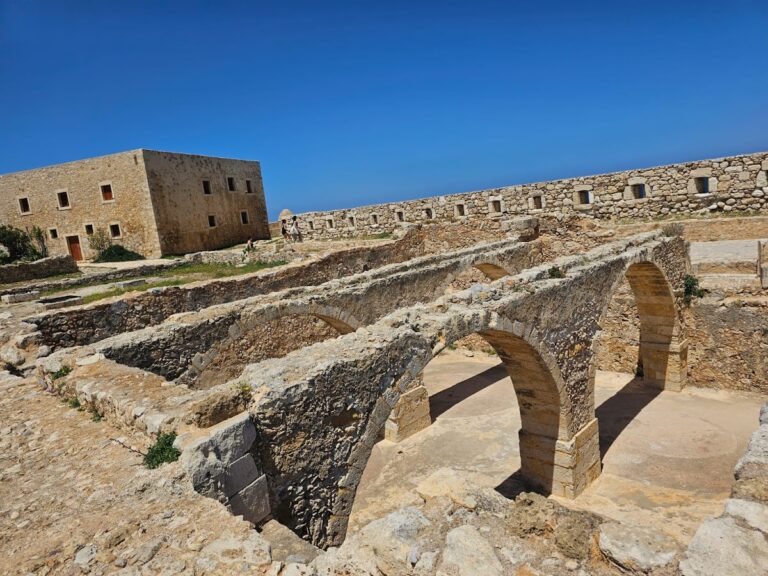
The former mosque occupies a central position within the Fortezza, which stands on a hill overlooking the sea. Its large square plan is built of stone and brick, combining elements inherited from Venetian Renaissance construction with Ottoman religious design. A hemispherical dome rises above the prayer hall. Its external diameter is 11 meters, placing it among the largest historic domes on Crete.
The dome is carried by eight massive stone arches. In the four corners, curved triangular supports, commonly called pendentives, transfer the weight of the circular dome to the thick side walls. The high dome admits natural light, illuminating surviving stone details and the results of the modern restoration.
Religious and Venetian Features
A preserved mihrab, the prayer niche indicating the direction of Mecca, is set into the southeastern wall. Its carefully carved surface has elaborate relief decoration and geometric designs characteristic of seventeenth-century Ottoman carving.
The square base of the minaret survives at the northwestern corner. The minaret collapsed at the beginning of the twentieth century because of earthquakes and weathering, and it was never rebuilt. The northern facade also retains parts of the Venetian cathedral, including window arches and the original entrance arch. Earlier carved stones were incorporated into the mosque, leaving a visible combination of Renaissance and classical Islamic architectural elements.