Villa Monastero: A Historic Villa, Museum, and Botanical Garden in Italy


Site at a Glance
- Rating
- 4.6
- Popularity
- Medium
- Country
- Italy
- Primary era
- Modern
- External website
- Open
- Eras represented
- Early Modern, Modern
- Civilizations
- Duchy of Milan, Holy Roman Empire, Italian, Spanish
- Site type
- Domestic
- Remains
- Elite Residence
On this page14 sections
History
Villa Monastero is a historic villa in Varenna, Italy, developed from a Cistercian women’s monastery founded at the end of the twelfth century and transformed into an eclectic residence with a Nordic character. The monastery was established by nuns displaced from Isola Comacina, a small island in Lake Como, and the complex later became a museum, botanical garden, and conference center.
The Cistercian monastery
The monastery grew in importance and wealth as it acquired properties, especially around Lierna. Over time, however, its community declined to six nuns. In 1566, Carlo Borromeo, the cardinal and archbishop of Milan who helped implement Catholic reform in northern Italy, transferred them to another monastery they had founded in Lecco. Pope Pius V, who was associated with the Catholic reforms following the Council of Trent, suppressed the monastic order in 1567.
Paolo Mornico of Cortenova bought the estate in 1569 with wealth gained from iron mining in Valsassina. The Mornico family reshaped the former religious complex as a prestigious residence and carried out major alterations in the early seventeenth century. The sale excluded the Oratory of Santa Maria, which remained open to the public until 1896. In that year, the oratory was moved to the church of Santa Maria Maddalena, which was renamed Santa Maria delle Grazie for the occasion.
Nineteenth-century owners
Pietro Genazzi, who owned the villa from 1862, began another phase of restoration. In 1869, ownership passed to Carolina Maumary, the sister-in-law of Massimo d’Azeglio, an Italian writer, painter, and statesman who served as prime minister of the Kingdom of Sardinia from 1849 to 1852. Maumary ordered the reorganization of the boat landings.
The transformation under Walter Kees
Walter Erich Jacob Kees of Leipzig acquired the villa in the 1890s and directed its principal transformation between 1897 and 1909. The work gave the building its eclectic Nordic character, meaning a design that combined elements from different historical styles with a northern European appearance, and enlarged the garden. Emilio Alemagna, Achille Majnoni, and Enrico Citterio were among the architects involved. Construction was supervised by G. Bertarini of Varenna, while Enrico Achler of Menaggio collaborated on the garden.
Kees also acquired the Oratory of Santa Maria in Monastero and the former gatehouse. The gatehouse had been converted into a silk-spinning mill after the Mornico family sold it. These acquisitions brought additional parts of the former monastic complex into the estate.
From confiscation to public institution
During the First World War, the villa was confiscated as German-owned property and entrusted to the Opera Nazionale Combattenti. Marco De Marchi, a Milanese naturalist of Swiss origin, purchased it in 1925. In 1936, through his wife, he bequeathed the villa to the Italian state to create a museum and an institute for hydrogeological studies, the study of water and groundwater in the earth. Giuseppe Bottai inaugurated the institute in 1940, when the garden also opened to the public.
A center for scientific congresses was established at the villa in 1953. The complex later hosted the International School of Physics “Enrico Fermi,” organized by the Italian Physical Society. The school included lectures by more than thirty-four Nobel Prize winners, among them Enrico Fermi, the Italian physicist whose work in nuclear physics and the first controlled nuclear chain reaction earned him the 1938 Nobel Prize in Physics.
Management and recent renewal
During the 1970s, the complex passed to Italy’s National Research Council, the country’s principal public research institution, and was managed by the Province of Como. Management transferred to the Province of Lecco in 1996 after new provincial boundaries were created. The provincial administration established the house museum, whose monumental section had already been completed that year. The house museum opened to the public in 2003 and received official recognition from the Lombardy Region in 2005. The Province of Lecco acquired the entire complex in 2009.
In 2022, the Province of Lecco began a program to recover and enhance the botanical garden’s architecture and vegetation through Italy’s National Recovery and Resilience Plan, an investment and reform program supported by European Union post-pandemic recovery funding. The renewal was completed in 2025 under landscape architect Valerio Cozzi, who restored Kees’s original garden concept, removed unsuitable species, and introduced limited new plantings.
Remains
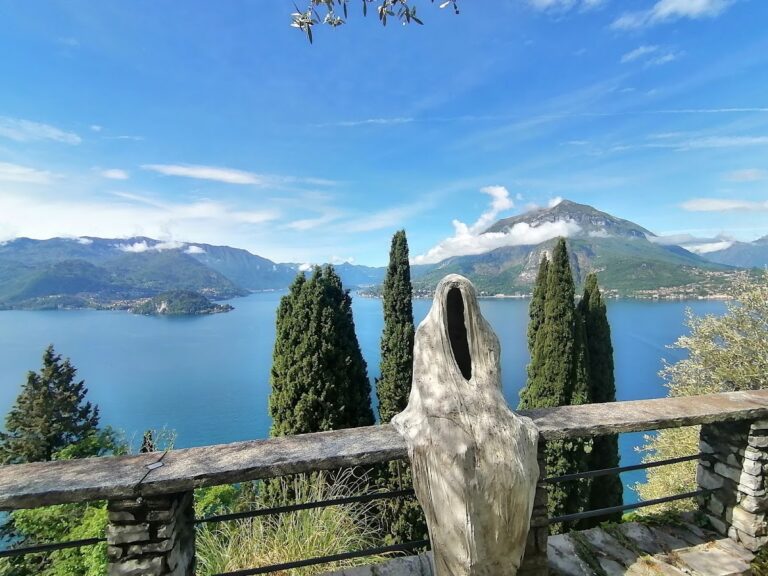
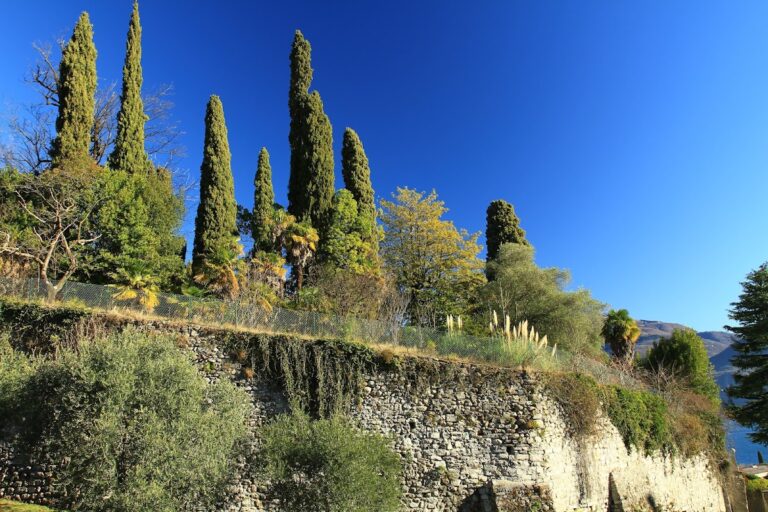
Villa Monastero is an eclectic building in a Nordic style, with the original monastery surviving beneath the modern structure. The complex is formed by three principal parts: a church, a body attached to the church’s north side, and the main building. Its grounds extend toward Fiumelatte, a hamlet and watercourse on Lake Como’s eastern shore near Varenna, and include a botanical garden and park with paths overlooking the lake, tall cypresses, and many exotic plant species.
Villa and former monastic structures
Main building and loggias
The early seventeenth-century Mornico alterations shaped the principal residence. Two symmetrical loggias were added to the façade, while a rural farmhouse was converted into the present guesthouse. The house museum occupies fourteen rooms retaining original decorations and furnishings associated with the villa’s different owners.
Church, oratory, and gatehouse
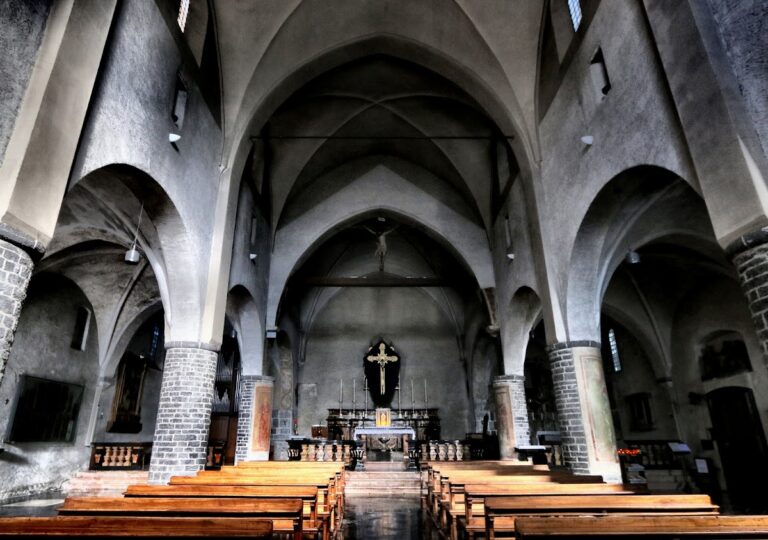
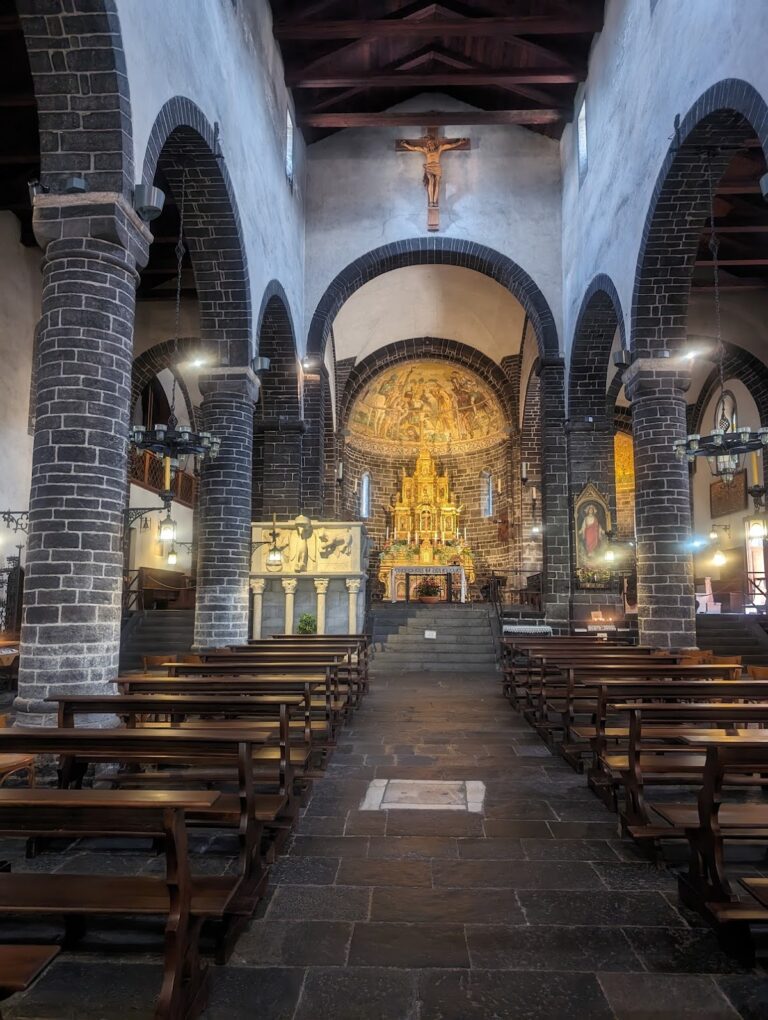
The church forms one of the three structural parts of the complex, alongside the section attached to its north side and the principal building. The Oratory of Santa Maria in Monastero and the former gatehouse also belong to the estate. The gatehouse preserves the history of a building that was later used as a silk-spinning mill before Kees acquired it.
Botanical garden and park
Garden structures
The park contains a small semicircular Neoclassical temple dated 1904, reached by a Rococo-style staircase. It also includes a fountain inspired by the fountain at the Poldi Pezzoli Palace, a historic art museum in Milan, and a Neo-Romanesque well. Together, these features form part of the garden’s architectural arrangement created and developed during the villa’s later transformation.
Sculpture and planting
A marble sculptural group titled The Clemency of Titus stands in the park. Giovan Battista Comolli made it in 1830 for the garden of Villa Bagatti-Valsecchi, whose subsequent owners later sold the work to Walter Erich Jacob Kees. The renovated botanical garden also contains a rare young specimen of Dracaena cinnabari, donated by Luciano Mauro, director of the Garden of Minerva in Salerno. Valerio Cozzi planted it on 11 April 2025.
Collections and scientific heritage
The house museum preserves the interiors, decorations, and furnishings associated with the villa’s successive owners. It also contains Giovanni Polvani’s collection of scientific instruments, including optical, electronic, and mechanical examples. Polvani was an Italian physicist who served as president of both the Italian Physical Society and the National Research Council.