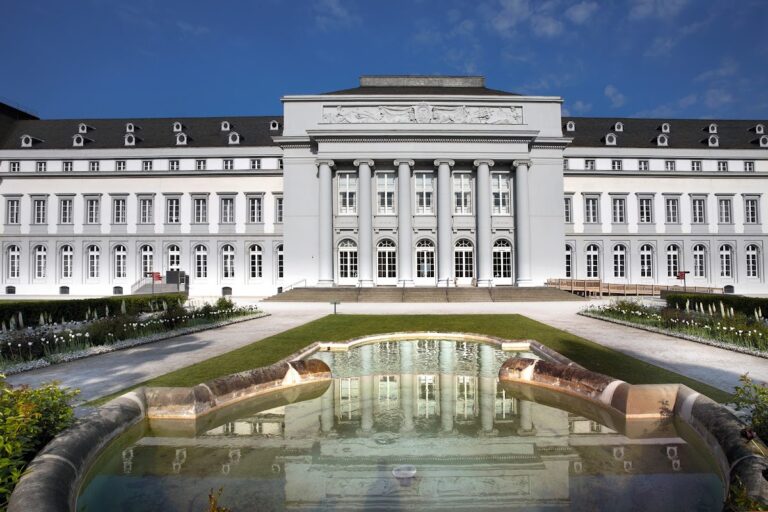
Deutschordenskommende Koblenz: A Teutonic Order Commandery on the Rhine


Site at a Glance
- Rating
- 4.4
- Popularity
- Low
- Country
- Germany
- Primary era
- Medieval
- External website
- Open
- Eras represented
- Medieval, Modern
- Civilizations
- Crusader, Holy Roman Empire, Kingdom of Prussia, Teutonic Order
- Site type
- Religious
On this page16 sections
History
Deutschordenskommende Koblenz is a former Teutonic Order commandery in Germany, founded in 1216 at the confluence of the Moselle and Rhine. The Teutonic Order was a medieval religious and military organization that also operated hospitals and administered estates. The Koblenz establishment was the order’s first foundation in the Rhineland and developed into one of its most important western centers.
Foundation and expansion
Archbishop Theoderic of Wied brought the Teutonic Knights to Koblenz in 1216. He granted them part of the precinct of St. Kastor Church, together with the St. Nicholas Hospital, which had previously been associated with Florin Collegiate Church. The hospital was later transferred to St. Kastor. The order’s experience in nursing was one reason for its settlement at Koblenz.
The commandery grew from the middle of the thirteenth century with the support of the archbishops of Trier. It was first known as “Deutscher Ordt” and later as “Deutsches Eck.” After the Kaiser Wilhelm I Monument was erected in 1897, the name Deutsches Eck became associated mainly with the monument area rather than with the commandery grounds.
The Bailiwick of Koblenz
In the fifteenth century, Koblenz became the seat of the Bailiwick of Koblenz. A bailiwick was a larger territorial administration comprising several commanderies, and this one was a chamber bailiwick directly subordinate to the grand master of the Teutonic Order. Its land commander governed scattered possessions in the Rhineland and the Netherlands, including vineyards and estates. The delivery of wine to the grand master was regarded as an important responsibility.
The bailiwick included the village and church of Elsen from 1263, as well as commanderies at Beeck, Berk, Dieren, Ibersheim, Judenrode, Herrenstrunden, Koblenz, Muffendorf, Rheinberg, Waldbreitbach, and other locations. It also included Cologne’s St. Catherine commandery and Mechelen’s Pitsenburg. Ibersheim belonged to the bailiwick from approximately 1250 until it was sold in 1465. Vier Ambachten was associated with it from 1235 to 1241, while Waldbreitbach joined it in 1602.
Elsen was the bailiwick’s only imperial-immediate territory. Imperial immediacy meant that it was subject directly to the emperor rather than to an intermediate territorial ruler, giving the land commander a voice in the institutions of the Holy Roman Empire. The parish of Waldbreitbach, donated by Countess Mechthild, widow of Count Henry III of Sayn, remained under the Bailiwick of Koblenz until its dissolution. After 1313, however, the commandery of Breitbach came under the commander of Horneck.
Rival authority and relocation
In 1520, the grand master pawned the Bailiwick of Koblenz to the German master, the order’s senior official for its German territories. Erik of Brunswick, the land commander and formerly commander of Memel, resisted submission to the German master. The dispute ended with Erik’s death in 1531.
Around 1600, the land commander moved his residence from Koblenz to the Teutonic Order’s St. Catherine commandery in Cologne. Morsbroich Castle came into the order’s possession in 1619 and became the land commander’s sole seat after 1794.
Secularization and modern transformation
French troops captured Koblenz in 1794, and France annexed the left bank of the Rhine in 1797. Secularization, the transfer of ecclesiastical property into secular ownership, began in 1802 and ended ecclesiastical rule. The commandery was dissolved in 1809, and its property was sold privately.
After the French period and the construction of the Prussian fortress of Koblenz, the former commandery buildings housed a military provisions magazine from 1821. From 1897 to 1941, the complex also accommodated the Prussian State Archives of Koblenz. Air raids in 1944 largely destroyed the buildings, although the archive holdings had already been evacuated.
Only the Rheinbau was reconstructed between 1952 and 1954. Its exterior was restored to resemble the earlier building, while its interior was modernized. The City of Koblenz purchased it from the state of Rhineland-Palatinate in 1988 and converted it into the Ludwig Museum between 1990 and 1992. The museum opened on 18 September 1992 with the exhibition “Atelier de France” and focuses on twentieth-century French art, particularly developments after 1945 and contemporary positions.
A modern building was erected in 2002 on the ruins of the former archive servant’s house. Preparations for the 2011 Federal Horticultural Show led to the discovery and securing of further remains of the Teutonic Order establishment. The former commandery is protected as a cultural monument under the monument-protection law of Rhineland-Palatinate and has been part of the UNESCO World Heritage site of the Upper Middle Rhine Valley since 2002.
Remains
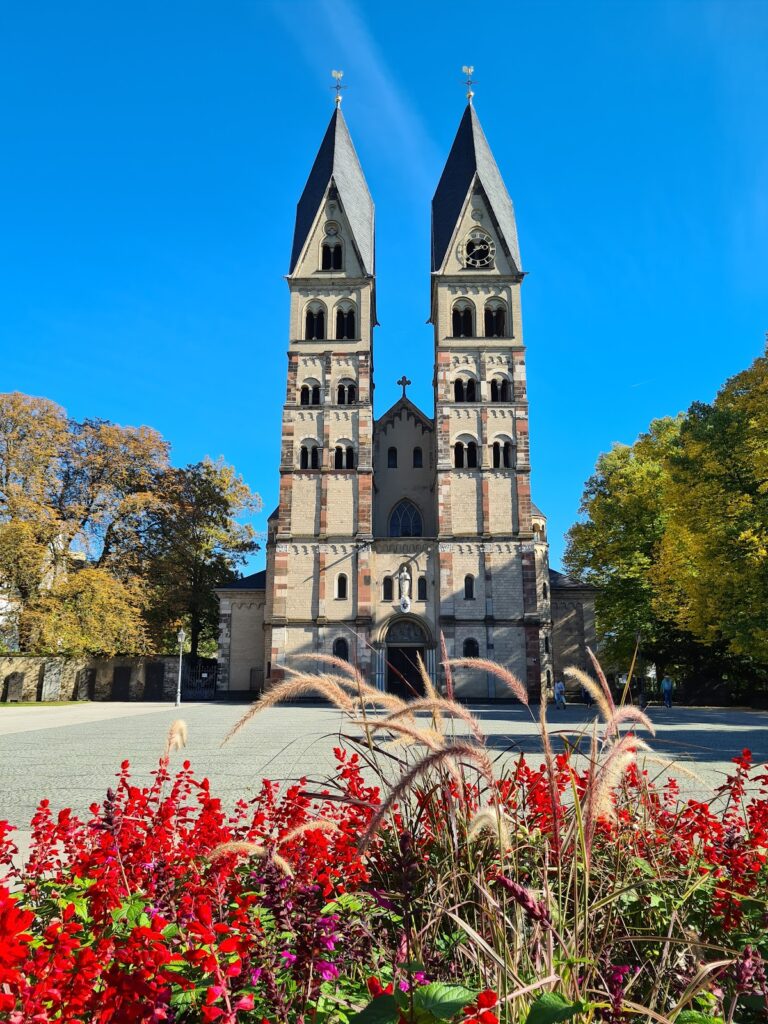
The complex stood directly where the Moselle flows into the Rhine, between the Kaiser Wilhelm I Monument and the Basilica of St. Kastor. Its buildings were assembled gradually after 1216, with older structures remodeled and joined to later construction. Particularly important earlier fabric survived in the Westbau and the Moselle Wing. In its final historical form, the commandery comprised the principal Rheinbau and ancillary buildings arranged in a horseshoe around a courtyard open to the south.
Principal buildings and surviving wings
Rheinbau and Blumenhof
The Rheinbau, now called the Deutschherrenhaus, was erected in 1279 as the principal building of the commandery. It is the main reconstructed survivor and houses the Ludwig Museum, whose exhibition spaces occupy four floors. The adjoining Blumenhof, a garden area that already existed during the Teutonic Order period, is also used by the museum for large three-dimensional works. These include César’s “Thumb” and “Place of Memory and Oblivion,” an installation by Anne and Patrick Poirier created specifically for the museum’s foundation at this location.
East Wing
The rebuilt East Wing stands on the Rhine side of the complex. This three-storey rectangular building formerly served as the commander’s residence. Its steep shield gables belong to its architectural character, while a polygonal stair tower at the southwest corner was added during the nineteenth century.
West Wing and Moselle Wing
Only the vaulted ground floor of the West Wing’s so-called Trotzenburg survives. The Westbau also preserves earlier building fabric, while the attached Teutonic Order church retained part of its south wall. The Moselle Wing likewise contains particularly important earlier fabric from the gradually developed complex.
Religious and boundary features
Teutonic Order church
The Teutonic Order church attached to the Westbau was consecrated in 1306. It was demolished in 1811, but its south wall remains, including elaborate supports for the former vaults.
Gothic chapel
A small Gothic chapel was built immediately south of the church in 1354 and 1355. The chapel was destroyed during the Second World War. Traces of wall paintings and parts of its exterior walls remained on the ruin in the 1960s, although most of the paintings later weathered away because protective measures were not taken.
Western boundary wall
The western boundary wall beside the Basilica of St. Kastor contains a portal from a former orphanage. Elector Franz Ludwig of the Palatinate had the orphanage built on the site later occupied by the Prussian government building. That government building was destroyed by fire in 1901.
Fortifications at the Moselle
Casemate building
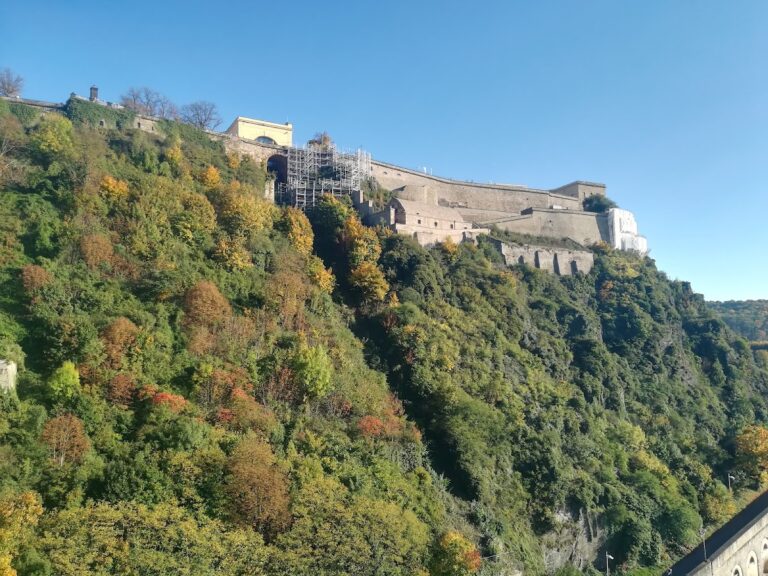
A casemate building was constructed at the mouth of the Moselle during the nineteenth-century expansion of Koblenz’s fortifications. It still bears the cross of the Teutonic Order, linking the later defensive works with the history of the former commandery.