Dieleghem Abbey: A Premonstratensian Abbey in Jette, Belgium


Site at a Glance
- Rating
- 4.3
- Popularity
- Low
- Country
- Belgium
- Primary era
- Early Modern
- External website
- Open
- Eras represented
- Early Modern
- Civilizations
- Habsburg, Holy Roman Empire
- Site type
- Religious
- Remains
- Palace
On this page9 sections
History
Dieleghem Abbey is a former religious complex in Jette, Belgium, whose history began with a community of secular canons in the eleventh century. A priory of Augustinian canons was formally founded in 1095, and the institution became an abbey in 1106. The community later adopted the Premonstratensian reform, a movement founded by Saint Norbert that combined communal religious life with pastoral work.
From Wolvertem to Dieleghem
The foundation of the priory was set out in a charter issued by Gaucher, bishop of Cambrai. Onulfus of Wolvertem supported the foundation by donating land, a brewery, the freehold of a watermill, the tithe of Melsbroek, and half the tithe of Wolvertem. The early community was associated with the farm of Auwderheyden, also called Hof Taleghem. Although the canons later moved to Dieleghem, the farm remained abbey property until the end of the old regime.
The move to Dieleghem took place in the mid-twelfth century, probably because of the Wars of Grimbergen, a prolonged conflict fought from 1142 to 1179 between the dukes of Brabant and the Berthout lords. The community’s incorporation into the Premonstratensian reform occurred in 1140 and received episcopal confirmation in 1145. By the early thirteenth century, the abbey was using the name Dieleghem. Around 1210, Henri, lord of Zottegem, transferred his lands at Jette, known as Dieleghem, to the abbey.
The new location provided cultivable alluvial land, access to a road linking Brussels with Wemmel and Merchtem, nearby stone quarries, and a relatively secure setting. The abbey eventually controlled nearly half of Jette, between the Roman Road and the Molenbeek. This territorial position continued until the end of the old regime.
Religious and economic influence
Dieleghem was devoted to Catholic religious life and combined pastoral, liturgical, charitable, and economic responsibilities. The canons welcomed poor people and pilgrims, preached, and administered parishes. From 1217, the abbey held the patronage of churches in Jette, Ganshoren, Denderleeuw, Wolvertem, Meise, Wemmel, Rossem, and Neder-Over-Heembeek. Land donations increased its holdings and supported its religious work.
The abbey’s property also sustained agriculture, forestry, quarrying, building maintenance, and domestic labor. Seasonal workers and other laborers were employed on its estates, linking the institution’s activities with the local economy and settlement. Marshes on the property were drained or turned into fishponds, and surplus fish was sold at market.
During the medieval period, the abbey received relics of Saint Blaise, an early Christian martyr traditionally regarded as a bishop and invoked against plague and skin diseases. The relics were traditionally associated with a gift from Margaret of York, the English-born duchess of Burgundy. Their presence attracted pilgrims, and shops and inns developed around the abbey.
Conflict and rebuilding
The Wars of Grimbergen repeatedly brought destruction and famine to Jette and the surrounding area. On several occasions, the community was forced to leave for its refuge in Brussels’s Saint-Géry district. The buildings were rebuilt after these disruptions. From the fourteenth century, the abbot sat in the States of Brabant, the duchy’s representative assembly of nobles, clergy, and commoners. In 1532, the abbot became a mitred prelate, meaning that he could wear a mitre and exercise certain episcopal privileges without being a bishop. During an abbot’s tenure, administrative work was often carried out by a prior.
In February 1489, troops commanded by the lord of Ravenstein burned the monastery and its dependencies during the conflict between the Brabant cities and Maximilian I of Habsburg. The canons had dispersed, and they returned six years later to a complex that required rebuilding.
Further damage came in 1578 during the Wars of Religion, the conflicts that divided western Europe along religious and political lines in the sixteenth and seventeenth centuries. Brabant rebels occupied Dieleghem to prevent Don Juan of Austria’s troops from using it as an advanced base. They damaged the abbey’s artistic heritage and converted the complex into a citadel. The occupation lasted seven years, ending after Alexander Farnese secured the capitulation of Brussels. Dieleghem then required a long period of recovery.
Baroque transformation and suppression
After communal life was restored, the abbey cleared its debts and rebuilt the nearby farm and the parish house at Wolvertem. Its principal buildings were then transformed in the Baroque style, a seventeenth- and eighteenth-century style associated in Catholic Europe with dramatic architectural forms and the Counter-Reformation. The new Baroque building was completed in 1721. Its façade was raised and given an octagonal carillon tower, a tower containing tuned bells played from a keyboard or mechanical system.
The eighteenth century brought further extensions and embellishments. In 1775, the chapter authorized an expansion of the conventual buildings, and the architect Laurent-Benoît Dewez directed the work from 1775 to 1791 under the abbots Ferdinand Valvekens and Jan-Baptist Van den Daele.
The annexation of the Austrian Netherlands to France on 1 October 1795 ended the building campaign. The abbey was suppressed under the law of 1 September 1796. The canons were expelled and deported to an island off the Breton coast, while the abbey’s properties were sold publicly. The principal buildings, including the church, were ordered to be demolished, and the complex was looted and largely destroyed.
Survival and municipal use
The abbey’s motto was Diligam te Domine. Its arms showed a pelican, a symbol of Christ’s sacrificial blood and the redemption of humanity. After suppression, the former abbatial residence passed through numerous owners and uses. Jean Capart and his family occupied it from 1898 to 1929. The building also served as a country house, a refuge for Portuguese Jesuits in exile, a municipal hospice of Brussels, a temporary parish, a home for children with intellectual disabilities, and accommodation for youth groups.
Jette municipality purchased the property in 1950, when it stood in ruins. It was protected as a historic monument in 1953 and restored under the architect Simon Brigode between 1967 and 1972. The building subsequently became the Municipal Museum of the County of Jette and also serves as a municipal marriage hall. New streets in the Saint-Joseph district removed the last surviving parts of the abbey apart from the former abbatial residence, although local street and place names continue to preserve the memory of Dieleghem Abbey.
Remains
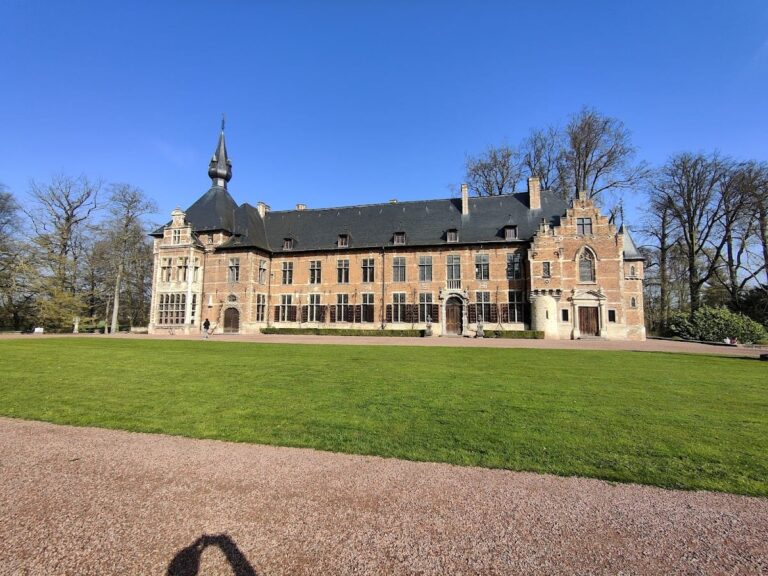
The surviving site is centered on the former abbatial residence, while the wider abbey landscape survives in wooded areas and in traces of its former quarries. The historic complex once occupied property containing marshes, cultivated land, fishponds, woodland, and limestone workings. Urban development removed the entrance porch and the remaining enclosure, leaving the residence as the principal surviving building.
Quarries and wooded property
The canons cleared and cultivated the surrounding land and worked local deposits of limestone and brick earth. Nearly ten open quarries produced a slightly brownish-grey Ledian limestone known as Baelegem stone. This material supplied the abbey and other religious buildings, including the north tower of the Cathedral of Saints Michael and Gudula, the former Jesuit church in Justice Square, and Our Lady beyond the Dyle in Mechelen.
After quarrying ended in the late eighteenth century, the workings became wooded. Springs filled the quarry galleries and trenches with water, and collapses altered the excavated ground. The monks planted trees on land unsuitable for cultivation, probably favoring beech in keeping with the model used by the Austrians in the nearby Sonian Forest. Three wooded areas associated with the former abbey property survive as Laerbeek Wood, Poelbosch, and Dieleghem Wood, connected by avenues in King Baudouin Park.
Former abbatial residence
The former abbatial residence was erected during the late eighteenth-century building campaign directed by Laurent-Benoît Dewez under Jan-Baptist Van den Daele. It is a rectangular building with numerous openings, constructed in white Brabant stone or Dieleghem sandstone and covered by a Mansard roof, whose lower slopes are steeper than the upper ones. The residence stands at 14 Jan Tiebackx Street.
The large state room on the upper floor retains Louis XVI decoration, a restrained classicizing style associated with the reign of Louis XVI. It has a balustraded ceiling and a cupola, and its acoustics have supported classical music concerts and temporary exhibitions. The ground floor served as a temporary church from 1929 to 1954, with Premonstratensian canons from Grimbergen providing pastoral service. Following restoration, the residence became the Municipal Museum of the County of Jette.