Vreta Abbey: Sweden’s First Nunnery and a Royal Monastic Foundation


Site at a Glance
- Rating
- 4.5
- Popularity
- Low
- Country
- Sweden
- Primary era
- Medieval
- Eras represented
- Medieval
- Civilizations
- Swedish
- Site type
- Religious
- Remains
- Monastery
On this page12 sections
History
Vreta Abbey is a medieval monastic foundation in Sweden, in present-day Linköping Municipality in Östergötland. Founded for Benedictine nuns at the beginning of the twelfth century, probably around 1099–1105, it was Sweden’s first nunnery and one of the oldest in Scandinavia. King Inge the Elder and Queen Helena established it at the request of Pope Paschal II, whose pontificate lasted from 1099 to 1118. The abbey’s architecture later combined Romanesque forms, marked by substantial masonry and rounded arches, with Gothic elements that developed in the later medieval period.
Benedictine foundation and royal patronage
After King Inge the Elder died, Queen Helena entered Vreta as a nun and was buried there. During the following decade, King Inge the Younger and Queen Ulvhild gave substantial donations to the community. These early royal connections helped establish Vreta as a foundation closely associated with Sweden’s ruling families.
In 1162, King Karl Sverkersson transferred Vreta from the Benedictine order to the Cistercians, a Western Christian monastic order that developed from the Benedictine tradition and pursued stricter religious discipline. The king donated a royal estate so that the church and monastery could be enlarged. His sister Ingegerd became the first Cistercian abbess, the female head of the abbey. Another sister, Helena, entered Vreta after the death of her husband, King Canute V of Denmark, in 1157.
A royal Cistercian house
Vreta remained a prestigious royal foundation and received gifts from Swedish kings and nobles. Members of the Swedish and Danish royal families joined the community, while the abbey also served as a school for daughters of ruling families and aristocrats. Princess Helena Sverkersdotter, daughter of Sverker II, was among its abbesses in the thirteenth century.
The abbey became the mother house of Askeby Abbey near Linköping, Riseberga Abbey in Närke, and Solberga Abbey on Gotland. Its prominence later declined in relation to Vadstena Abbey and the developing cult of Saint Bridget, the fourteenth-century Swedish religious figure whose following centered on Vadstena. Vreta nevertheless retained considerable wealth and influence until the Reformation.
The abbey church served as a burial place for the kings Inge the Elder, Philip, Inge the Younger, and Magnus Henriksson. Princes Ragnvald, son of Inge the Elder, and Sune were also buried there. An older tradition additionally places two young nephews of Sune among those interred at Vreta. Medieval folklore associated the abbey with several alleged thirteenth-century abductions of girls whose families opposed their intended marriages, although the historical status of these stories is uncertain.
Fire, rebuilding, and Reformation
The original church and monastic buildings were destroyed by fire in the early thirteenth century. Following reconstruction, the church was consecrated on 13 June 1289 by Bengt, Bishop of Linköping, in the presence of King Magnus Ladulås and Queen Helvig of Holstein.
After the 1520s, Reformation restrictions prevented Vreta from accepting new novices. The community continued, however, as a school for noble girls and as a retirement place for elderly noblewomen. In 1529, King Gustav I, also known as Gustav Vasa, allowed the last abbess, Sigrid Botholfsdotter, to acquire the abbey and maintain its activities. He assigned its revenues to her on the condition that 300 marks went to Vreta and Askeby.
Vreta received nuns from Askeby after that abbey closed in 1529 and from Skänninge Abbey after its closure in 1544. In 1536, Gustav I gave Vreta and its estates to his Catholic mother-in-law, Ebba Eriksdotter Vasa. She spent her final years there and died in 1549. Nuns were still present in 1562, and the last two, Brita Gisledotter and Kirstin Månsdotter, died in 1582.
After the community ended, the church continued as a parish church of the Church of Sweden, while the abandoned monastic buildings gradually fell into ruin. The church and remaining ruins now have protected ecclesiastical-monument status under Chapter 4 of Sweden’s Cultural Heritage Act. Restoration work in the 1910s and 1920s led to investigations of the church and monastic complex. Excavations continued from 1916 to 1926, followed by renewed archaeological work by the Swedish National Heritage Board in 2005 and 2006. The Swedish History Museum later organized and digitized records from the earlier excavations. Small textile fragments from the church may help identify people buried there and clarify whether Inge the Elder and Queen Helena were among them.
Remains
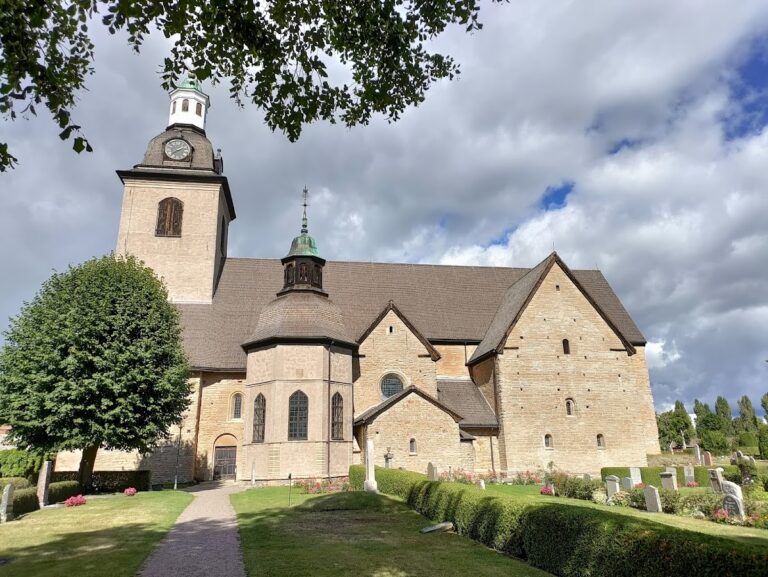
The former abbey precinct covers approximately 140 by 140 metres. Its principal surviving elements are the abbey church, the monastic ruins north of it, a barn, and a storehouse. Limestone was the principal building material, and the surviving architecture brings together Romanesque and Gothic features.
Church and liturgical spaces
Abbey church
The abbey church is the principal surviving structure and remains in use as a parish church. Its medieval fabric includes a hagioscope, a small opening in a church wall that provided a view towards the altar or sanctuary from another part of the building. The eastern end was enlarged for the Cistercian nuns, with a new section built beyond the earlier presbytery. The presbytery was the area reserved for the clergy around the high altar, while the nave served the laity, meaning people outside the clergy and religious community.
Burials and textile evidence
The church’s role as a royal burial place is also reflected in material recovered during archaeological investigations. Small textile fragments found inside the building may provide evidence for identifying individuals buried there and for examining whether the remains of Inge the Elder and Helena are among those interred at Vreta.
Monastic precinct and outbuildings
Monastic ruins
The monastic ruins occupy approximately 55 by 55 metres immediately north of the church. They consist mainly of low wall fragments and surviving window openings, with some walls reconstructed during the twentieth century. The buildings represent the remains of the community’s residential and working complex, although much of the former monastery is now ruinous.
Barn and storehouse
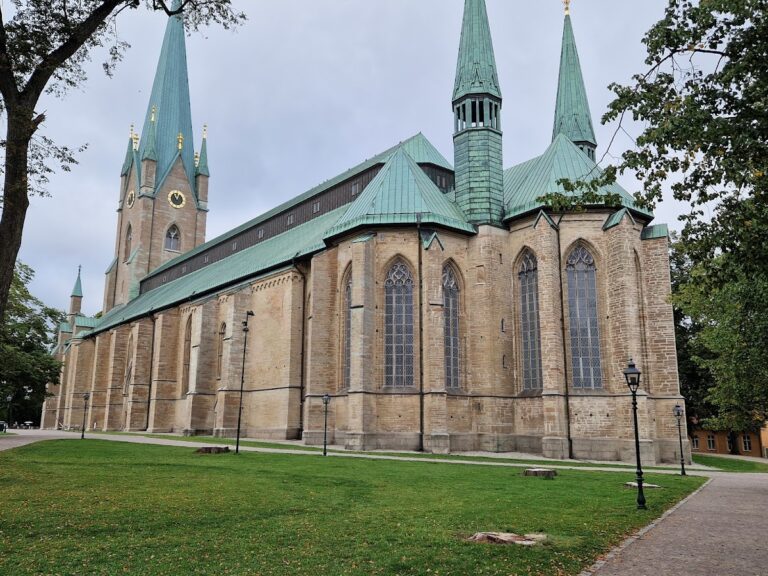
A barn and a storehouse survive within the wider precinct. The barn is the only monastic building besides the church described as completely preserved. Stones from the former refectory, the monastery’s communal dining hall, were reused in the construction of the tower of Linköping Cathedral.
Archaeological discoveries
Excavations across the church and monastic complex revealed archaeological material connected with the abbey’s construction and use. Among the finds is an unusual wooden water pipe. Objects recovered from the excavations are displayed in the adjoining museum, while the textile fragments from the church contribute to the continuing study of the abbey’s burials.