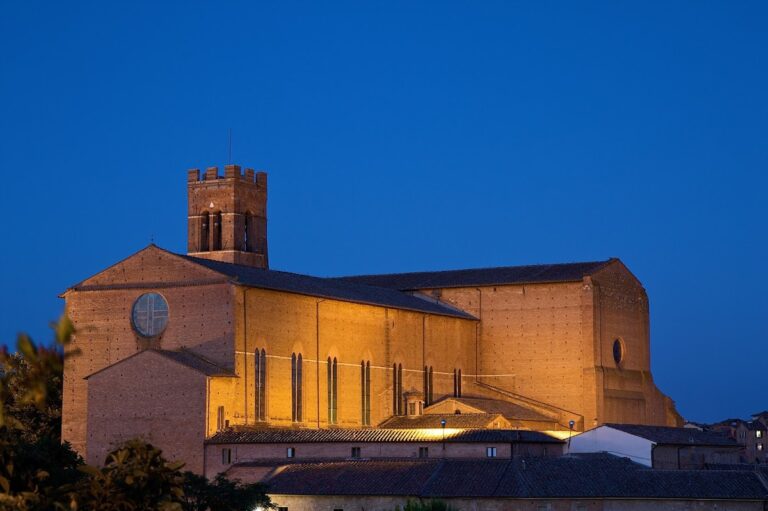
Oratory of San Bernardino: A Renaissance Confraternity Church in Siena
Site at a Glance
- Rating
- 4
- Popularity
- Very Low
- Country
- Italy
- Primary era
- Medieval
- Eras represented
- Medieval, Early Modern
- Civilizations
- Grand Duchy of Tuscany, Republic of Siena
- Site type
- Religious
- Remains
- Basilica
On this page17 sections
History
The Oratory of San Bernardino is a Catholic place of worship in Siena, Italy, beside the Basilica of San Francesco and the former Franciscan complex. Built for a confraternity associated with Saint Bernardino of Siena, a fifteenth-century Franciscan preacher and religious reformer, it took shape during the second half of the fifteenth century and was completed by the end of that century. Its decoration continued into the early seventeenth century, making the building a record of Sienese religious art across several generations.
From medieval confraternity to Oratory of San Bernardino
The confraternity connected with the oratory was recorded in 1273 under the joint dedication of the Virgin Mary and Saint Francis of Assisi. During the fourteenth century it was known as the confraternity of the Black-Robed Madonna of Saint Francis. A confraternity was a lay religious association formed for worship, charity, or devotional practice. In 1450, the year of Bernardino’s canonization, the association adopted his name.
Bernardino was associated with the site as a preacher. After the confraternity took his title, its members began constructing and decorating the oratory. Building work was completed before the close of the fifteenth century. Stucco and wood decoration followed between 1496 and 1512, while the upper level received its frescoes from 1518 to 1532. Work on the lower level continued from the late sixteenth century into the early seventeenth century.
Later status and museum use
In 1925, Pope Pius XI elevated the oratory to the status of a minor basilica, a church granted special papal recognition for its religious, historical, or devotional importance. The adjoining rooms were arranged as the Diocesan Museum of Sacred Art in 1999. The museum presents Sienese works dating approximately from the thirteenth through the eighteenth century, brought together from churches, diocesan institutions, and religious houses within the patrimony of the Archdiocese of Siena-Colle di Val d’Elsa-Montalcino.
Remains
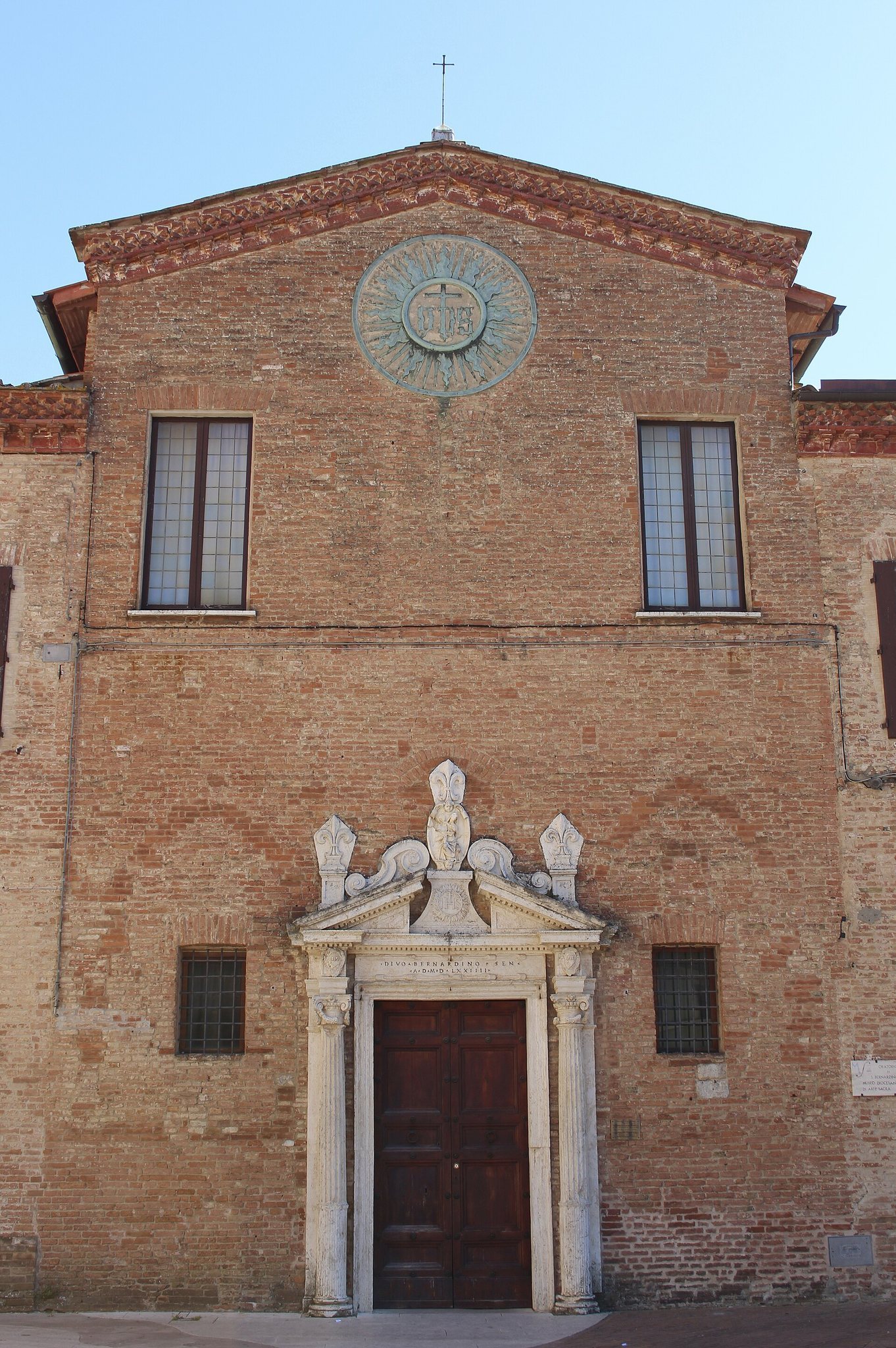
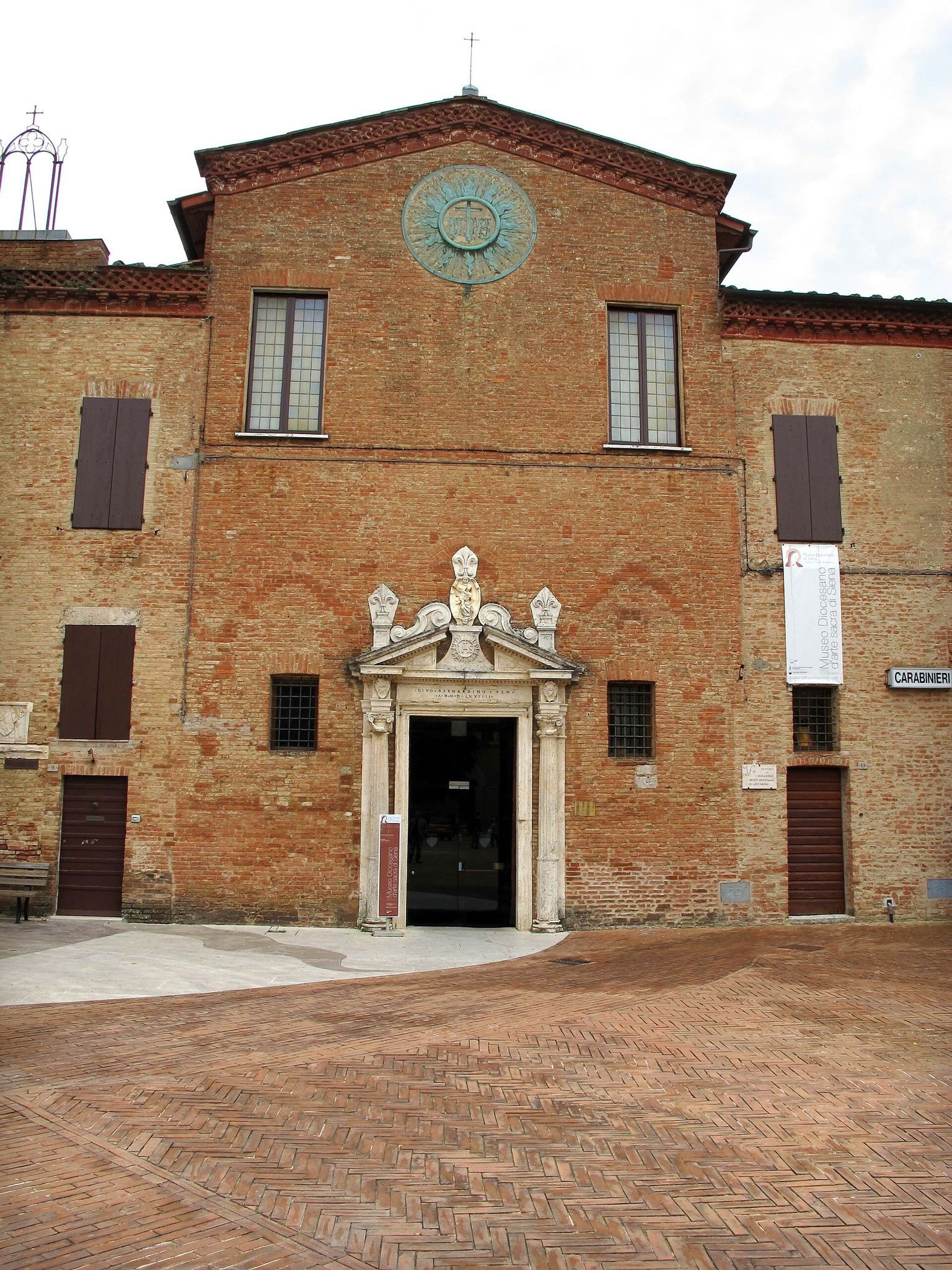
The building has a gabled brick facade and a two-level interior. A travertine portal dated 1574 marks the entrance, above which is a rayed disk bearing the IHS monogram. IHS is a Christological emblem strongly associated with Saint Bernardino’s preaching. The older upper level contains the principal Renaissance fresco cycle, while the lower level preserves later devotional paintings, sculpture, and scenes from the saint’s life.
Facade, vestibule, and connecting spaces
Entrance and vestibule
The vestibule is reached through an arch and contains a processional gonfalon, a ceremonial banner used in religious processions, painted on both sides by Francesco Vanni. It also holds painted panels by Sano di Pietro and three carved marble panels. The oldest is a fourteenth-century Madonna among Angels by Giovanni di Agostino, dated 1341 and described as his only signed work. The other marble sculptures are by Antonio Federighi and Urbano da Cortona.
Madonna and Child
Above the arch leading to the vestibule is a polychrome terracotta Madonna and Child by Jacopo della Quercia, made around 1420. The vestibule also contains an eighteenth-century preparatory painting for a fresco created in the late seventeenth century by Antonio Nasini and Giuseppe Nicola Nasini for the Antiporto di Camollia. That original fresco was destroyed during the bombings of 1944.
Upper level
Fresco cycle of the Virgin
The upper level has a coffered ceiling decorated with cherub heads. Its wooden walls and pilasters carry stucco ornament produced by Ventura Turapilli between 1496 and 1512. The principal decoration is the Stories of the Virgin, a fresco cycle painted between 1518 and 1532 by Sodoma, Girolamo del Pacchia, and Domenico Beccafumi. Its design reflects the influence of Michelangelo’s Sistine Chapel ceiling and Raphael’s Vatican Rooms.
Girolamo del Pacchia painted the Nativity of the Virgin in 1518, a fresco measuring 295 by 317 centimetres. His work also includes the Archangel Gabriel as the announcing angel in a framed Annunciation. Beccafumi contributed the Betrothal of the Virgin and the Death of the Virgin, the latter dated 1518 to 1520 and measuring 280 by 300 centimetres. His Madonna and Child with Saints, dated 1535 to 1537, is a tempera painting on wood measuring 250 by 290 centimetres.
Sodoma’s scenes include the Presentation of Mary in the Temple, the Announced Virgin with the Archangel Gabriel, the Visitation, the Assumption, and the Coronation of the Virgin. He also painted individual figures of Saint Louis of Anjou, Saint Francis of Assisi, and Saint Anthony of Padua. Girolamo del Pacchia painted the figure of Saint Bernardino of Siena.
Altar works and devotional objects
Beside the upper altar is a small painted panel bearing the Bernardino monogram, traditionally believed to have belonged to the saint. The same area contains a thirteenth-century Byzantine icon of the Virgin and Child with its original goldsmith’s work. The icon came from the church of San Niccolò al Carmine.
Lower level
Vault and lunettes
The lower level is entered directly from the main entrance. Its blue, star-studded vault has stucco stars and contains the fresco Madonna Protecting Siena, with Saint Bernardino and Saint Catherine. Arcangelo Salimbeni began the work, and Francesco Vanni completed it in 1580. The lunettes, semicircular wall or ceiling surfaces, contain scenes from the life of Saint Bernardino painted chiefly by Ventura Salimbeni and Rutilio Manetti.
Altars and paintings
The lower level contains sixteenth-century glazed terracotta statues of Saint Bernardino and Saint Catherine of Siena. Near the small altar is a fifteenth-century Madonna and Child by Sano di Pietro. The altarpiece, by a painter of the second half of the sixteenth century associated with Andrea del Brescianino, shows the Madonna and Child with Saints Ansanus and Bartholomew. Other paintings include a Madonna and Child with Saint Catherine of Siena and Saint Francis of Assisi. Three canvases by Bernardino Mei are displayed along the staircase connecting the two levels.
Museum rooms and Sienese collection
Old sacristy
The old sacristy, now part of the museum, contains Domenico Beccafumi’s Christ Carrying the Cross and small painted panels once used as funeral biers by Sodoma and Riccio. Works by Ventura Salimbeni, Alessandro Casolani, Rutilio Manetti, Deifebo Burbarini, and Bernardino Mei are also preserved there.
Medieval panel paintings
The museum collection includes Sienese panel paintings from the thirteenth and fourteenth centuries. Among them are the Madonna of Tressa, made around 1235 and attributed to the Master of Tressa; the Madonna della Palla, attributed to Rinaldo da Siena; Guido di Graziano’s Madonna of the Capuchins; a Madonna and Child tondo by the Master of the Aringhieri; and Ambrogio Lorenzetti’s fourteenth-century Madonna of the Milk. Other fourteenth-century works are by Segna di Bonaventura, Naddo Ceccarelli, Bartolomeo Bulgarini, Bartolo di Fredi, Andrea di Bartolo, Niccolò di Buonaccorso, Taddeo di Bartolo, Andrea Vanni, Benedetto di Bindo, and Luca di Tommé.
Fifteenth-century works and relics
The fifteenth-century Sienese works include Sassetta’s Madonna of Molli, Matteo di Giovanni’s Annunciation, a painted wooden cross by Giovanni di Paolo, and two versions of the Pietà by the Vecchietta, one a fresco and the other a polychrome wooden sculpture. Works attributed to Sano di Pietro include Saint Christopher and Saint George and the Dragon.
A fifteenth-century polychrome terracotta Madonna and Child from the school of Brunelleschi is positioned above a casket reliquary. A reliquary is a container for relics or objects associated with a saint. The casket contains effects associated with Saint Bernardino and remains of his precordia, meaning the heart and adjoining internal organs preserved as relics. These remains were sent from L’Aquila, where Bernardino died and was buried.