Augustinerkloster Zürich: An Augustinian Priory and Fortified Monastery


Site at a Glance
- Rating
- 4.5
- Popularity
- Very Low
- Country
- Switzerland
- Primary era
- Medieval
- External website
- Open
- Eras represented
- Medieval, Early Modern
- Civilizations
- Holy Roman Empire
- Site type
- Religious
- Remains
- Fortified Monastery
On this page8 sections
History
Augustinerkloster Zürich was an Augustinian priory in Zürich, Switzerland, founded around 1270 as one of the eight monasteries within the medieval city. Its community followed the Rule of Saint Augustine and belonged to the mendicant orders, religious communities that relied substantially on alms, pastoral work, and charitable activity rather than on extensive landed estates. The monastery stood on the site of the present Augustinerkirche Zürich at Münzplatz and remained in existence until its abolition in 1524.
Foundation and civic defenses
Medieval Zürich supported mendicant communities by granting them free plots in suburban areas in exchange for help with building the city walls. The Augustinians settled in an area where the western fortifications had not yet been constructed in the late eleventh or twelfth century. Their monastery was subsequently incorporated into the city’s defensive system. The Augustinertor and Augustinerturm became parts of the important late-medieval fortifications along Zürich’s western side, close to the southern Fröschengraben moat.
The monastery’s religious and civic position changed over time. Until the fourteenth century, memorial masses in Zürich were held at the Grossmünster, providing the Augustinians with a basis for increased income through their religious services. By 1524, funeral income also had to be transferred to the Grossmünster. This reduced the Augustinians and other mendicant communities to the status of district pastors within the medieval city. The Augustinians supported Zürich’s Brun guild regime, a political system shaped by the city’s guilds, and may consequently have retained more influence within the city walls than some other religious houses, including the Predigerkloster.
Reformation and later religious use
The Reformation, the sixteenth-century movement that challenged Roman Catholic institutions and practices in Zürich and elsewhere in Europe, brought the monastery’s medieval history to an end. The convent was abolished in 1524, worship in the church was discontinued, and the monastery buildings and their income were assigned to an administrative office of the city government. A wine press was installed in 1525, while an alms institution was established in the former monastic complex. The administration was later incorporated into the Rütiamt, the city office associated with the former Rüti Abbey.
In 1841, Zürich’s Roman Catholic community planned a church commemorating the old Augustinian church. After most of the community rejected the decisions of the First Vatican Council of 1869–1870, it was expelled from the Roman Catholic Church and formed the Christian Catholic Church of Switzerland. The Augustinerkirche consequently remains the parish church of that community.
Chapter-house glazing
The monastery’s chapter house, the meeting room of a monastic community, also played a part in its later artistic history. In 1519, the Augustinian community petitioned the governments of the thirteen members of the Old Swiss Confederacy, the pre-modern confederation that preceded the modern Swiss federal state, for windows for the chapter house. Fribourg approved the request, and one window displayed a coat of arms associated with a foundation involving Basel, Fribourg, Solothurn, Schaffhausen, and Appenzell. Art dealer Martin Usteri acquired 32 of the monastery’s glass panes in 1796. They were sold from his estate in 1829 and later reached Gröditzberg in Silesia. Six were bought by the Gottfried Keller Foundation in 1894, exhibited in the cloister of Fraumünster Cathedral, and subsequently deposited with the Swiss National Museum.
Remains
Monastery precinct and defensive works
The former monastery stood on Münzplatz, west of St. Peterhofstatt and toward the former Fröschengraben moat. It occupied the lower slope of Lindenhof hill beside the small Kecinstürlin gate. The inner moat was reinforced by the Schanzengraben in the sixteenth century. Augustinergasse preserves the name of the former monastery, while Münzplatz takes its name from the later mint.
A wall separated the monastic precinct from the surrounding urban area. The Augustinians were responsible for constructing the section of the town wall that ran south of Lindenhof hill and St. Peterhofstatt toward the Fröschengraben moat. The defensive features were therefore integrated with the monastery’s wider enclosure and with Zürich’s western fortifications.
Church and monastery buildings
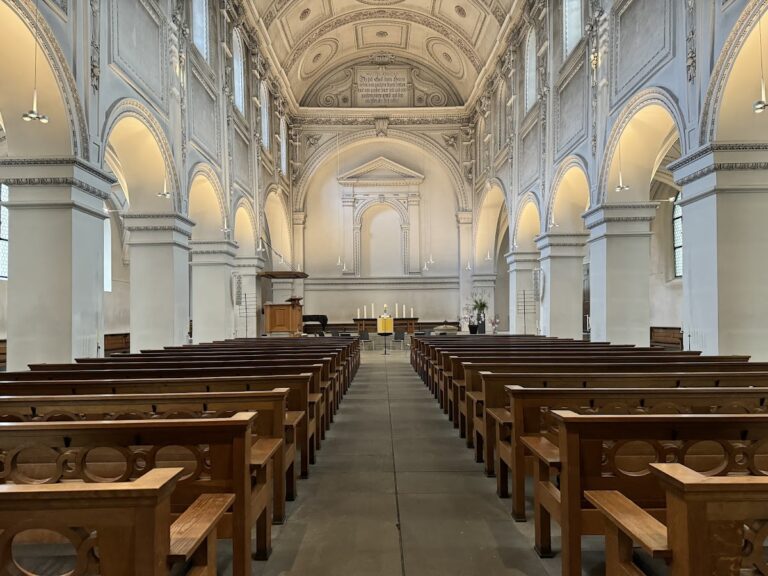
The surviving church is Romanesque and has a nave and chancel beneath a single roof. It occupies the northwestern, narrow end of the former monastery area. A building complex was attached to its north, including a rectangular wing divided into four bays. This wing later housed the Rütiamt. The Augustinerturm gate was erected there, with two wings of the 1524 Almosen office, an institution for alms administration, extending on both sides of the tower’s lower roof edge. A transverse wing served as the refectory, the monks’ communal dining hall.
The church contains a mural of Christophorus, or Saint Christopher, a Christian saint traditionally associated with carrying the Christ child across a river and whose image commonly served a protective devotional purpose. It also preserves remains of probably early sixteenth-century interior decoration. The roof skylights were removed in 1692 and rebuilt in 1936–1937.
Surviving glass panes
The former chapter-house glazing consisted of 32 glass panes. Six of these panes entered the collection of the Gottfried Keller Foundation in 1894. After exhibition in the cloister of Fraumünster Cathedral, they were placed on deposit with the Swiss National Museum, preserving part of the monastery’s early sixteenth-century visual record beyond the former chapter house.