Abbazia di Sant’Angelo de Frigillo: A Cistercian Abbey near Mesoraca


Site at a Glance
- Rating
- 4.6
- Popularity
- Very Low
- Country
- Italy
- Primary era
- Medieval
- Eras represented
- Medieval
- Civilizations
- Kingdom of Sicily
- Site type
- Religious
- Remains
- Monastery
On this page11 sections
History
Abbazia di Sant’Angelo de Frigillo is a ruined Cistercian abbey in Italy near Mesoraca, Calabria. Built in the Romanesque period, it stood on a high plateau near the Vergari River and Mount Petrara, close to the Sila mountains. The earliest recorded evidence dates to 1188, which is also given as the date of its consecration. A much earlier Benedictine foundation, perhaps as early as the sixth century, belongs to historical tradition, while the date of the Cistercian foundation has been placed variously around 1216–1217 or 1220. A papal reference as early as 1205 has also been proposed.
Name and Cistercian Foundation
The abbey’s original name was Sanctus Angelus in Fringillis. The meaning of the place-name is uncertain. It has been linked with the Latin word for “cold,” with the chaffinch, or with terms for the silkworm. The last interpretation has been connected with the Cistercians’ introduction of sericulture into Calabria during the reign of Frederick II.
The Cistercian community came from Santa Maria della Sambucina. Sant’Angelo therefore belonged to the Sambucina succession within the wider filiation of Clairvaux, a chain of institutional relationships connecting daughter monasteries with a mother abbey and ultimately with a principal foundation. In June 1202, Luca Campano, abbot of Sambucina and later bishop of Cosenza, reached an agreement with Bartolomeo, archbishop of Santa Severina, that raised Sant’Angelo to the status of a mother abbey.
The abbey subsequently incorporated the Greek-rite monasteries of Santo Stefano sul Vergari, Santa Maria de Archelao, and San Nicola di Pineto. The Greek rite was the Byzantine Christian liturgical tradition followed by local communities before the expansion of Latin-rite institutions. In this setting, the Cistercian community was associated with the gradual Latinization of populations that retained Greek religious and cultural traditions.
Growth and Regional Role
Sant’Angelo became a religious, economic, political, and cultural centre for a broad surrounding territory. Its scriptorium, the monastic centre for copying, decorating, and preserving manuscripts, produced and held illuminated books. Several codices from the abbey later entered the collection assembled for the Vatican Library.
The abbey enjoyed independence from diocesan jurisdiction and received protection from both Emperor Frederick II and the pope. Its cultivated lands and pastoral operations were managed by lay conversi, or lay brothers who carried out practical work under monastic discipline. They wore the Cistercian habit and followed the principle ora et labora, meaning “pray and work.” The surrounding granges, agricultural estates used for farming, livestock raising, and land management, continued in existence even though some were remodelled over the centuries.
A major earthquake in 1349 severely damaged the abbey and caused the monks to leave. They returned several decades later and restored the buildings. During the fifteenth century, Nicola de Liotta served as abbot. Tomaso Parentucelli, later Pope Nicholas V, removed him after accusations that he had taken the monastery’s possessions and appointed Giacomo Albarelli, a chaplain to Alfonso V of Aragon, as commendatory abbot. A commendatory abbot held the revenues and formal administration of a monastery without necessarily belonging to its resident community.
In 1570, Duke Carlo Caracciolo reached an agreement with the cardinal of Chiaravalle, procurator of the Cistercian Order, under papal instructions requiring financial support for the monastery. The arrangement provided an annual contribution of 320 ducats. In 1633, Sant’Angelo joined the Calabrian-Lucanian Cistercian Congregation.
Suppression and Decline
Pope Innocent X suppressed the abbey in 1652. Pope Alexander VII reopened it in 1658 as a grange of Santa Maria della Matina. In 1795, the former abbey became a rural church. The church collapsed during the earthquake of 1832 and was never rebuilt.
Until the end of the eighteenth century, the abbey held many highly venerated relics acquired over the centuries. After the monks abandoned the site, these relics were dispersed. They included remains associated with Saints Blaise, Nicholas of Tolentino, Mary Magdalene, Bartholomew the Apostle, Remigius, Leonard, Nicholas the Bishop, Stephen the Protomartyr, Cosmas and Damian, Pantaleon, the Holy Sepulchre, Lawrence, the Holy Innocents, Martin the Bishop, Vitellian, Vitus and Modestus, and Anastasia.
Remains
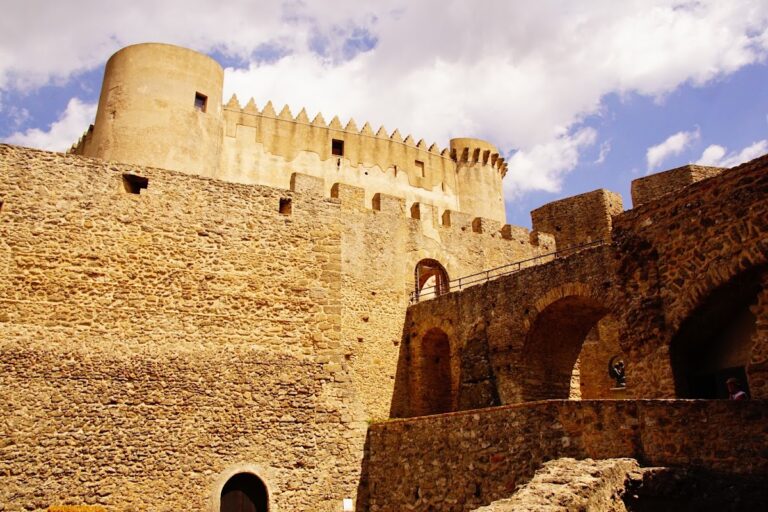
The ruins stand approximately three kilometres from Mesoraca, on a broad plateau at about 700–800 metres above sea level near the Vergari River, Mount Petrara, and the Sila National Park. The surviving Romanesque Cistercian complex is defined chiefly by extensive wall sections marking the church plan and by part of the crossing. Fragmentary decorative elements and two sections of stone ogival ribs, which are pointed-arch ribs used to support or frame a vaulted ceiling, survive within the crossing.
Church and Convent
Church
The former church measured approximately 115 palmi in length, with a proportionate width. In the eighteenth century, the monks restored part of the building over the ruins of the older structure. This restored section was approximately 36 palmi long and also had a proportionate width. The nave contained an altar surmounted by a painting of the Virgin Mary, the archangel Michael, and Saint Benedict. The church also housed the abbey’s collection of relics before they were dispersed after the community left.
Convent
The convent stood beside the church. After its restoration, it comprised a hall, four rooms, a kitchen, a pantry, and several workshops or service areas. An adjoining garden was enclosed by low walls and lay alongside an ancient medieval track that led from the Sila mountains toward the sea.
Agricultural Landscape
Granges
Several granges associated with the abbey remain near the ruins. One stands on a small hill among granite outcrops and retains an apparently intact small house and livestock enclosure. Other granges lie beside the medieval track and have been altered over the centuries. Together, these surviving agricultural estates reflect the landholding and pastoral network connected with the monastery.
Mulberry Trees
Centuries-old mulberry trees remain visible near the abbey. Their leaves served as food for silkworms, linking the surviving agricultural landscape with the tradition that associates the name Frigillo with filugello or filugillo, words connected with the silkworm.
Nearby sites