Petit Séminaire de Consolation: A Former Religious House and Seminary in France


Site at a Glance
- Rating
- 4.5
- Popularity
- Low
- Country
- France
- Primary era
- Early Modern
- Eras represented
- Medieval, Early Modern, Modern
- Civilizations
- French, Spanish
- Site type
- Religious
- Remains
- Monastery
On this page6 sections
History
Petit Séminaire de Consolation is a former religious house and seminary in Consolation-Maisonnettes, France. Its history began with a Catholic place of devotion to Notre-Dame de Consolation, a title for the Virgin Mary associated with the local shrine, and continued through the foundation of a Minim monastery, its conversion into a minor seminary, and its later cultural and religious use.
The Shrine and the Minim Foundation
An oratory dedicated to Notre-Dame de Consolation was erected in 1432–1433, after which hermits settled in the surrounding wilderness. In the seventeenth century, Ferdinand-François-Just de Rye, Marquis of Varambon and lord of the area, planned to establish a religious house of the Minims. Founded by Saint Francis of Paola, the order was known for a particularly rigorous form of Catholic observance. The project fulfilled a vow made by his mother. After the marquis died prematurely in 1657, he entrusted its completion to his wife, Marie-Henriette de Cusance, and expressed the wish to be buried in the chapel at Consolation.
Inheritance litigation delayed the foundation, as did the need for authorization from the king of Spain. At that time, the Spanish monarchy administered Franche-Comté, the historical region that was later incorporated into France. A new church was nevertheless built and consecrated in 1665. In 1669, the marquis’s remains were solemnly transferred there. Authorization from Charles II of Spain arrived in October of that year, and the first four Minims settled at Consolation in May 1670. Construction of the monastery began in spring 1671 and continued until 1673, using stone from Châtelneuf-en-Vennes Castle, destroyed during the Ten Years’ War, the seventeenth-century conflict that devastated parts of Franche-Comté. The church was built in 1682.
Revolution, Seminary, and Later Use
The monastery was largely deserted during the French Revolution. Only four monks remained when the property was sold as national property and converted into a fodder depot. It was later abandoned. After returning to Church ownership in 1827, the complex was converted into a minor seminary in 1833. Such an institution provided secondary education for boys who might enter the priesthood or missionary service.
The seminary closed in 1906 because it had too few pupils, but reopened in 1920 and trained future missionaries until its final closure in 1978. Since then, the Val de Consolation Foundation has administered the site and organized religious gatherings and cultural events. The chapel and its associated artistic furnishings, including the mausoleum of the lord of Rye, were protected as historic monuments in 1913. The mausoleum had already received protection as an object in 1910, while two paintings were registered as objects in 1987.
Remains
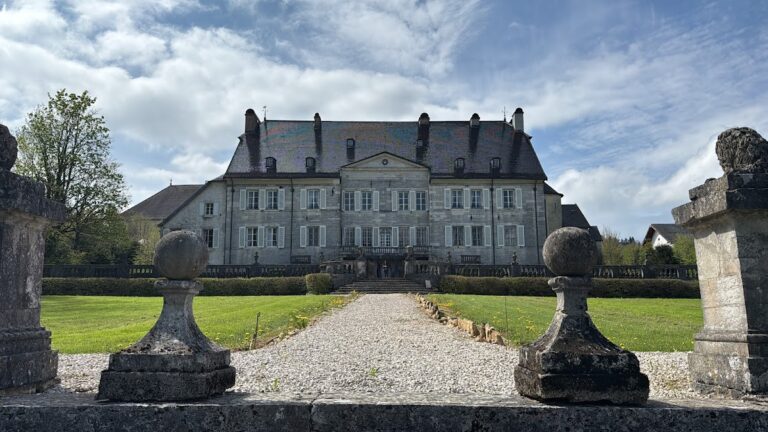
The monastery stands in the Consolation cirque on relatively level ground between the two branches formed where the Dessoubre and Lançot meet. Completed in 1673, it forms a square of about 40 metres on each side, with the buildings enclosing a central cloister, a covered walkway around an enclosed courtyard. The church stands perpendicular to the south-eastern building, while a garden of approximately 40 metres square adjoins the south-western building. The original upper floor contained 18 cells, and the ground floor held the kitchen and refectories. After the nineteenth-century conversion for seminary use, the buildings had two floors and could accommodate more than 100 pupils.
Chapel and Memorials
The chapel has a single nave articulated by Doric pilasters, which are flat wall-attached supports with the simple proportions associated with the Doric order. It contains two small chapels, one of them housing the mausoleum of Ferdinand-François-Just de Rye. Completed in 1682, the chapel is Neo-Romanesque in form. The mausoleum, damaged during the French Revolution and restored at the end of the nineteenth century, is made from black, white, and red marble. Four white-marble lions support its upper table. A small black-and-red marble altarpiece incorporates sculptures of women, heraldic arms, and a white-marble genius. Its Latin inscription mourns the loss of a hero and warns of the sudden disappearance of magnificent things.
The chapel’s eighteenth-century furnishings include carved wooden choir stalls, panelling across the choir, and a carved wooden pulpit. Two paintings represent a bishop saint and Saint Joseph. The church underwent various alterations during the nineteenth century, and its porch was restored in 1899.
Garden and Park
A building known as the Maison Basse extends from the garden and formerly housed the lay community. The botanical garden contains medicinal plants, traditionally called simples, together with ornamental plants. At its far end, an arc de triomphe, the surviving remnant of the former church gate, closes the garden and provides a passage into the park.
The park lies farther south in the cirque, whose valley is deeply cut by the Lançot and its two tributaries, the Tabourot and the Source Noire. The Pont des Tufs crosses the Lançot and is built of tufa, a porous limestone formed when calcium carbonate is deposited around springs and waterfalls. Within a rock recess reputed to have once sheltered a hermit, Abbé Guyot, a title for a priest in French Catholic usage, built the Grotto of Our Lady of Lourdes in 1888. Several waterfalls occupy the park, including the 46-metre Lançot waterfall and the lower part of the Tabourot waterfall.