Chiesa di Santa Maria in Vado: Renaissance Basilica in Ferrara


Site at a Glance
- Rating
- 4.7
- Popularity
- Low
- Country
- Italy
- Primary era
- Early Modern
- External website
- Open
- Eras represented
- Medieval, Early Modern, Modern
- Civilizations
- Duchy of Ferrara
- Site type
- Religious
- Remains
- Basilica
On this page9 sections
History
Early Church and Eucharistic Miracle
Chiesa di Santa Maria in Vado is a Roman Catholic basilica and parish church in Ferrara, Italy, dedicated to the Virgin Mary. Its Renaissance reconstruction began in 1495, replacing an earlier church on the site. The name Santa Maria in Vado refers to a nearby ford across the Po.
A small devotional shrine probably stood here from the fifth century, possibly containing an image of the Virgin associated with Saint Luke. By the tenth century, a small church known as Santa Maria Anteriore was documented at the site. It served worshippers who otherwise had to travel to a basilica on the southern bank of the Po.
On Easter Day in 1171, a Eucharistic miracle was traditionally believed to have taken place during Mass. When the consecrated host was broken, blood was said to have spurted from it and reached the altar vault. In Catholic theology, the consecrated host is understood to become the body of Christ. The event made the church a pilgrimage destination and became central to its religious identity.
Renaissance Reconstruction
By the late fifteenth century, Santa Maria Anteriore had fallen into poor condition. At the direction of Ercole I d’Este, the duke of Ferrara whose patronage shaped major Renaissance projects in the city, reconstruction began in 1495. The work followed designs by the Ferrarese court architect Biagio Rossetti, with the painter and architect Ercole de’ Roberti and the architect Bartolomeo Tristano also involved. The new basilica incorporated surviving parts of the earlier church.
The rebuilt church was consecrated on the Feast of the Annunciation in 1518. Its Renaissance reconstruction is attributed to Biagio Rossetti and includes work by Carlo Bononi, Camillo Filippi, Prospero Fontana, Giuseppe Antonio Ghedini, and Domenico Mona. In 1594, Alfonso II d’Este, the late-sixteenth-century duke of Ferrara, commissioned Alessandro Balbi to build a small temple inside the basilica, giving greater prominence to the place associated with the Eucharistic miracle.
Later Commemoration
The Lapidarium was inaugurated on 25 March 1925. It commemorates Ferrara’s war dead and those missing in war, covering conflicts from the First War of Independence through the Second World War.
Remains
Exterior and Plan
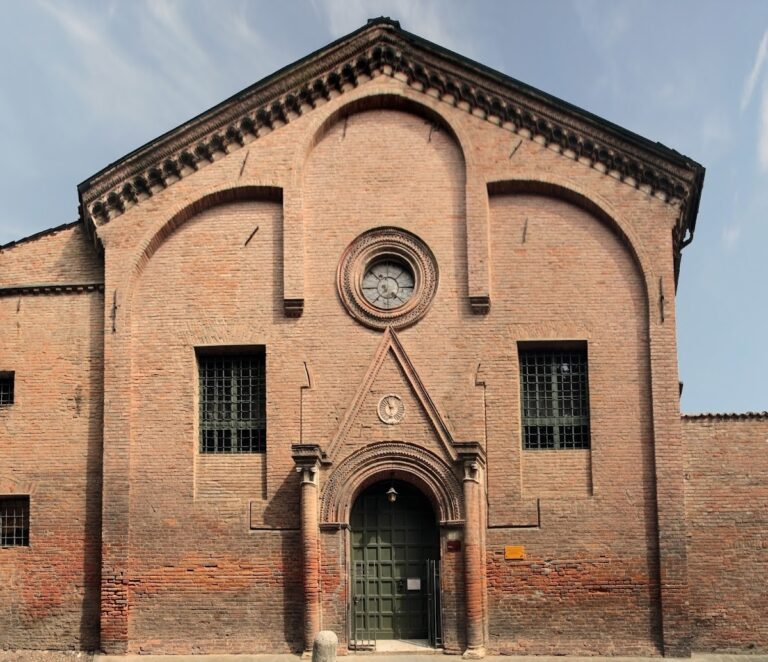
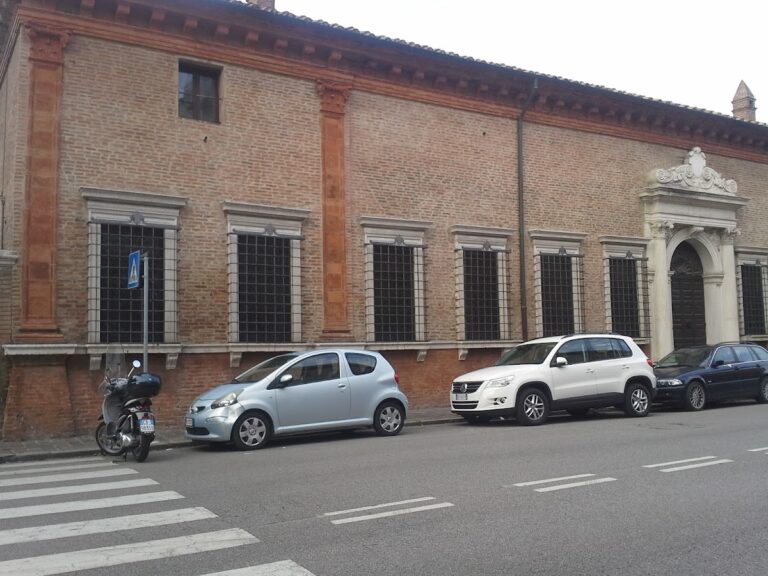
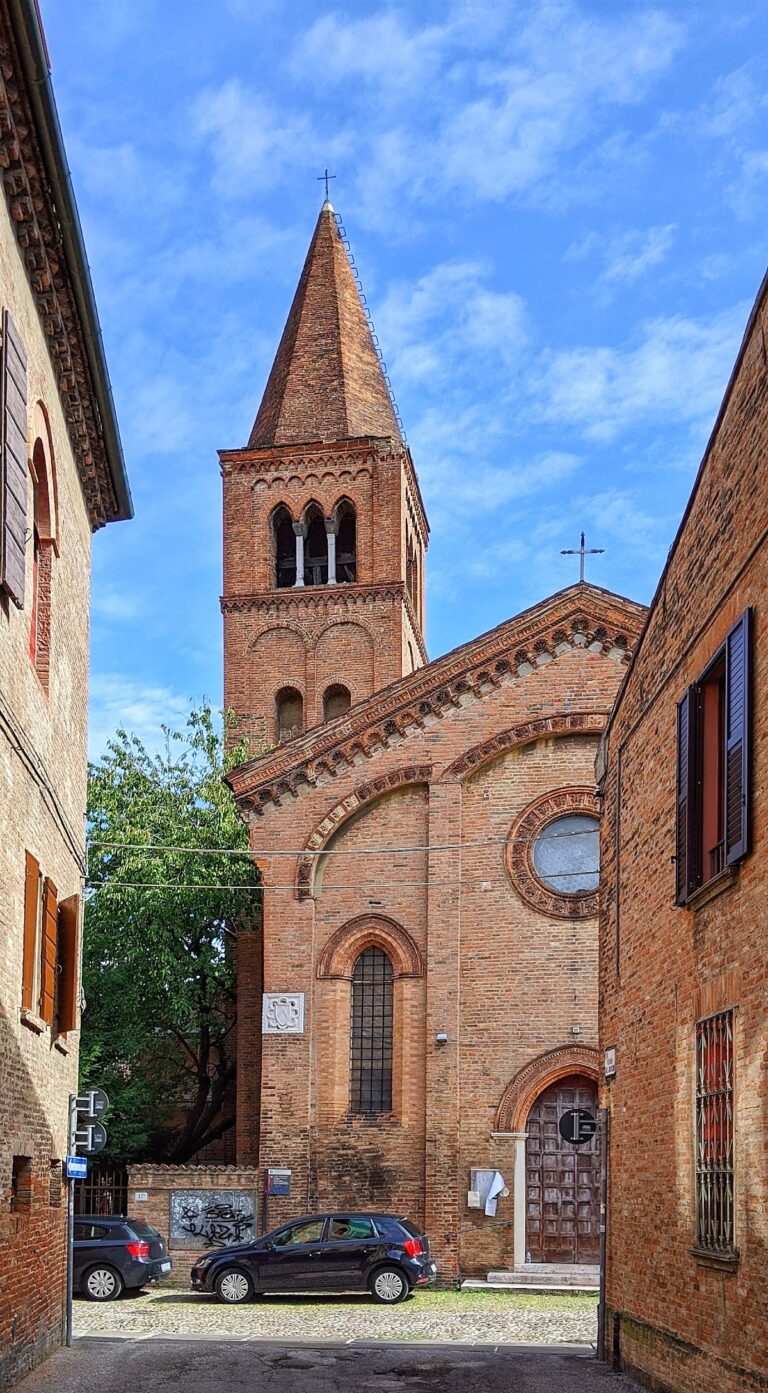
The basilica stands at the corner of Via Borgovado and Via Scandiana. Its west-facing principal façade is built in terracotta and has a marble portal attributed to Andrea Ferreri. A second entrance on the north façade along Via Scandiana has an architectural dignity described as nearly equal to that of the main façade.
Inside, the church has three naves, a transept, and an apse. The high altar contains an Annunciation altarpiece by Camillo Filippi, the father of Bastianino, dating no later than 1560. The left transept houses a monumental organ from the sixteenth century.
Painted Decoration
Carlo Bononi was the principal painter of the decoration on the ceilings of the central nave, transept, and choir. Giulio Cromer assisted him with the Presentation of Mary in the Temple. The presbytery contains large canvases by Domenico Mona, painted around 1580, showing the Nativity of the Virgin and the Nativity of Christ. The Marriage at Cana and the Marriage of the Virgin were begun in 1622 by Carlo Bononi with help from his workshop.
The basin of the apse contains Bononi’s Glory of the Holy Name, also called the Exaltation of the Name of God. Painted in oil on plaster between 1616 and 1621, it forms part of the church’s later decorative programme. Giuseppe Antonio Ghedini, assisted by Ferrarese painters specializing in quadratura, an illusionistic technique that creates architectural frameworks on flat surfaces, executed the transept frescoes. His large paintings The Sacrifice of Melchizedek and The Beggar Expelled from the Wedding Feast are in the Chapel of the Sacrament.
The church also contains nineteenth-century copies of works by Garofalo, Battista Dossi, Carpaccio, Panetti, Coltellini, and other artists. Their originals were transferred to the Pinacoteca of Ferrara, where they are preserved.
Eucharistic Miracle Sanctuary
The right transept contains the sanctuary associated with the Eucharistic miracle. Its elements include the small vault traditionally linked with the miraculous blood and an urn in which the blood is presumed to have become visible. The richly decorated chapel has a small staircase leading to the level of the traditionally associated bloodstains. On 26 March 1501, the vault was moved from its original wall and incorporated into the right transept, where the sanctuary was established.
Lapidarium
The Lapidarium occupies two chapels placed on either side of the miracle sanctuary. They display 529 small plaques commemorating the same number of Ferrara war dead. Additional plaques collectively record the names of those killed or missing in conflicts from the First War of Independence through the Second World War.