Santi Simone e Giuda: A Medieval and Baroque Church in Florence


Site at a Glance
- Rating
- 4.7
- Popularity
- Very Low
- Country
- Italy
- Primary era
- Early Modern
- External website
- Open
- Eras represented
- Medieval, Early Modern
- Civilizations
- Grand Duchy of Tuscany, Republic of Florence
- Site type
- Religious
- Remains
- Church
On this page11 sections
History
Santi Simone e Giuda is a historic church in Florence, Italy, begun around 1192 as a small oratory for monks associated with Badia Fiorentina. It stood outside the city walls beside the monks’ vineyard and was enlarged in 1209 before being completely rebuilt in 1243. The church combines its medieval foundation with a major seventeenth-century renovation in Renaissance and Baroque forms.
Medieval Foundation
The rebuilt church was consecrated in 1247 by Bishop Ardengo Trotti and became a parish church, serving a defined local Christian community. A foundation inscription on the building states that Abbot Bartholomew of the Florentine abbey of Santa Maria laid the first stone in 1243 on land described as his own. The wording presents him as the legitimate lord and true patron of the foundation.
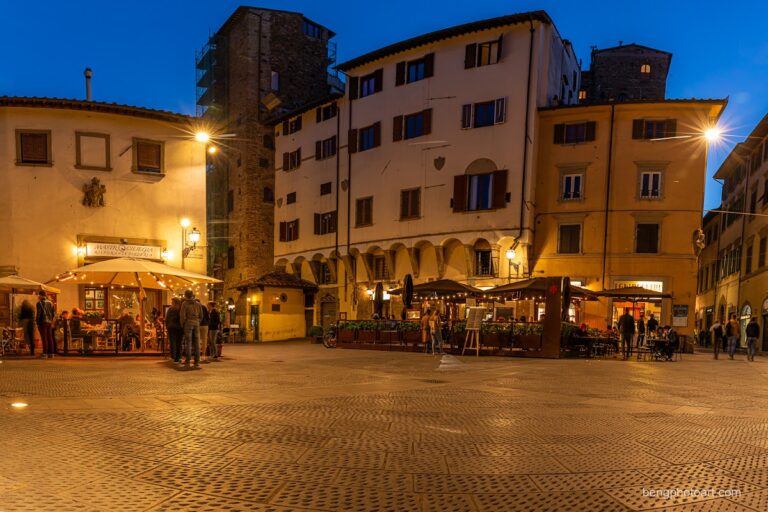
The church and the square before it also witnessed the political tensions of medieval Florence. In 1309, Cialdino degli Ughi, a White Guelph, was killed in the square by opponents associated with the Donati family and the Black Guelphs. The Guelphs were a major Florentine political faction, and the White and Black divisions represented rival groupings within it.
Burials and Seventeenth-Century Renewal
The church became a place of burial for notable figures. Raffaellino del Garbo, a painter and pupil of Filippo Lippi who died in 1524, was buried here in 1527. The poet and librettist Andrea Salvadori was also buried in the church.
An Arno flood in 1557 damaged the building and completely swept away its wooden ciborium, the structure that covered the main altar. Major renovation began in the first quarter of the seventeenth century after Archbishop Alessandro Marzi Medici elevated the church to a priory, a religious house governed by a prior, and appointed Giovanni Niccolai as its first prior in 1608. Niccolai came from a wealthy and cultivated Tuscan family, initiated the renovation, and remained prior until his death in 1642.
A new high altar had been installed by 1619. The choir and presbytery were then substantially renovated under the patronage of Bartolomeo Galilei, a Knight of Malta and relative of Galileo Galilei. Principal rebuilding and enlargement began in 1630 to designs by Gherardo Silvani, financed by Galilei’s nephew. This campaign gave the church much of its present character, including its richly decorated ceiling.
Religious and Civic Associations
The church is dedicated to the apostles Simon and Jude Thaddeus. It now belongs to the Ukrainian Greek Catholic Church, an Eastern Catholic church in communion with the pope that follows the Byzantine liturgical tradition, and it hosts the Divine Liturgy for Florence’s Ukrainian community.
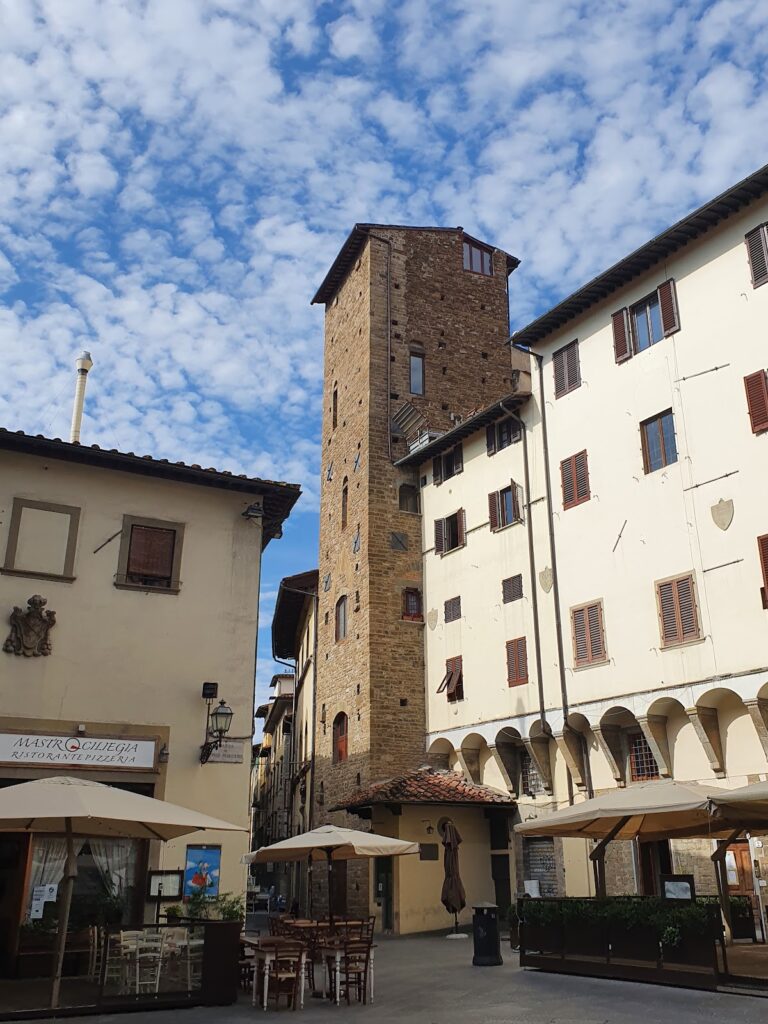
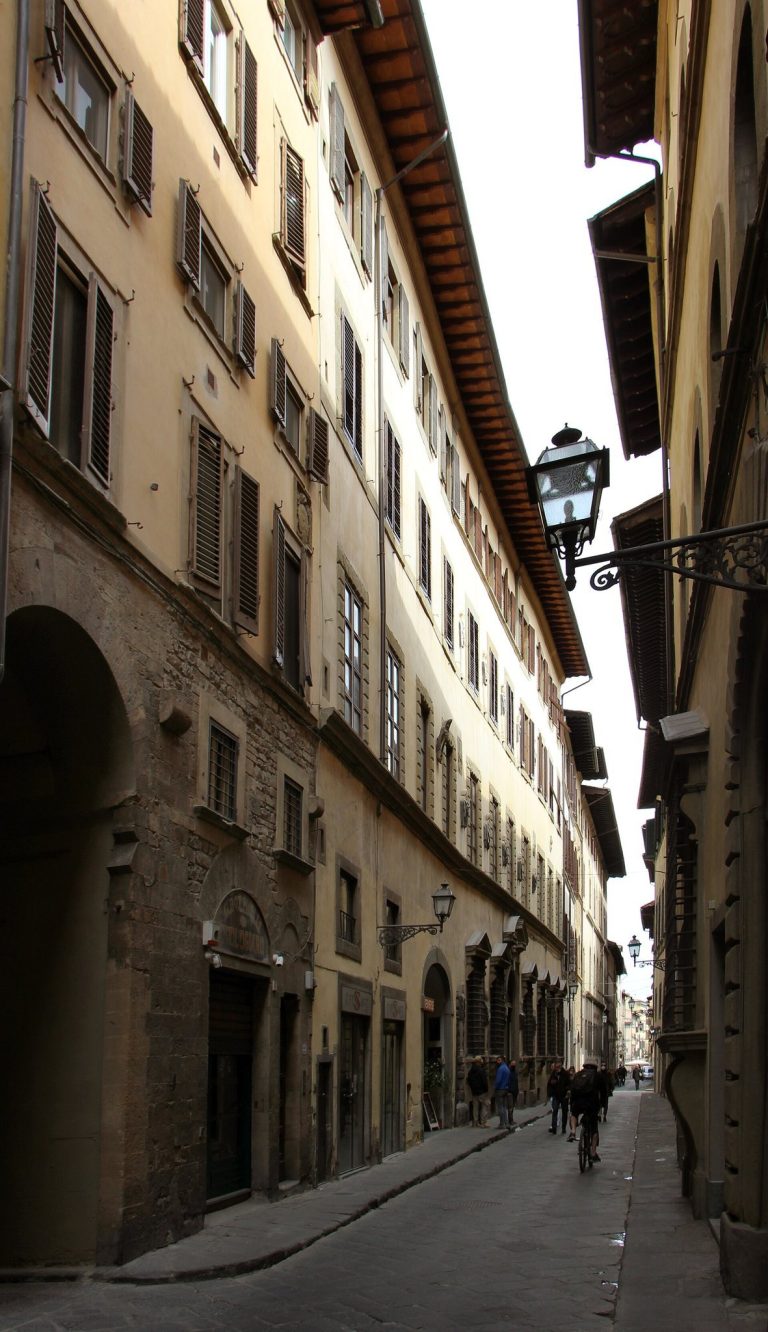
Santi Simone e Giuda faces Piazza San Simone, a space reached from Via dei Lavatoi, Via della Vigna Vecchia, and Via dell’Isola delle Stinche. Historically, the square held a food market for the feast of Saint Simon on 28 October, with wholesale chestnut trading and retail sales. A regular market in old furniture could also extend toward Piazza Santa Croce. Nearby buildings and features include a secondary entrance to the former Oratory of San Martino degli Osti, now a parish hall, Casa Ricasoli, Palazzo Lottini, Palazzo da Cintoia, and a side of the Teatro Verdi with the Fontana dell’Agnellino.
Giovanni Dupré is commemorated by a plaque on Palazzo Lottini, which records that he modeled his Dying Abel there.
Remains
The surviving church has a hall-like interior shaped by the medieval rebuilding of 1243 and Silvani’s extensive seventeenth-century work. Gray pietra serena, a sandstone widely used in Florentine architecture and sculpture, divides the interior and also appears in the entrance furnishings. The church’s present arrangement incorporates medieval remains, Renaissance and Baroque decoration, and features associated with its current Byzantine rite.
Facade and Medieval Features
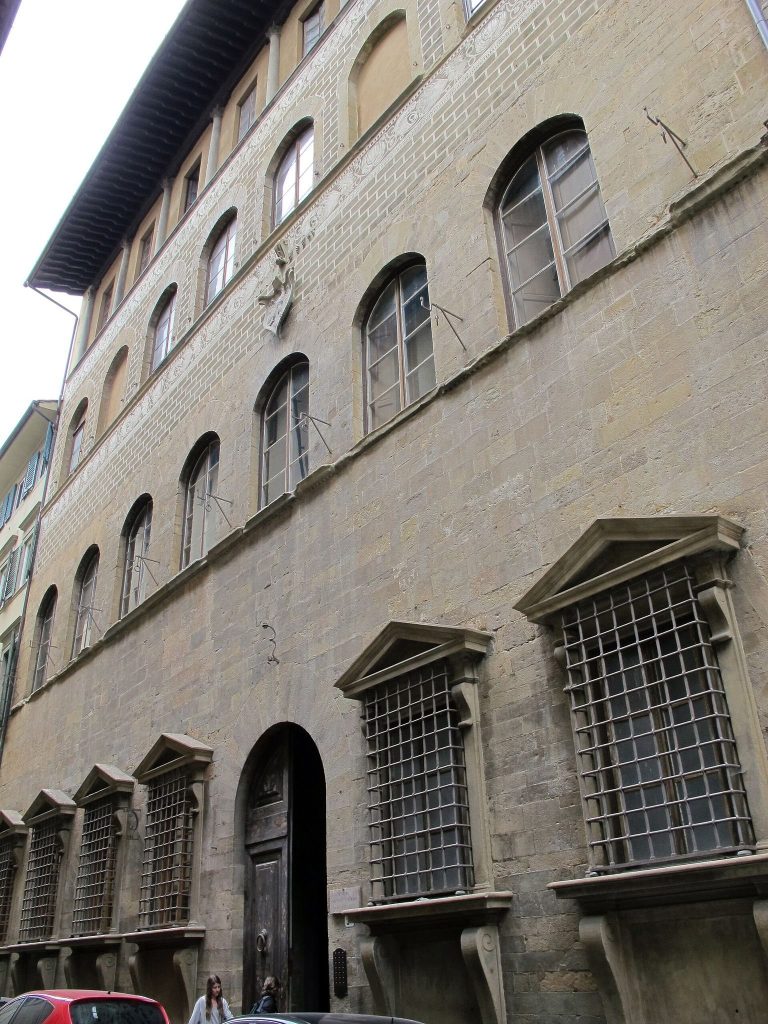
The facade portal is framed by two fluted columns of pietra serena supporting an arch with ornamental bas-reliefs attributed to Benedetto da Rovezzano or his circle. Its lunette contains Nicodemo Ferrucci’s Virgin between the Apostles Simon and Jude. On the left interior wall, a marble plaque preserves the foundation inscription in Lombard characters.
Two lateral niches, rediscovered after the 1966 flood, are the openings of medieval facade windows. Silvani blocked these windows during the seventeenth-century renovation, leaving their later-discovered openings as evidence of the earlier facade.
Interior Decoration
Ceiling and High Altar
The carved wooden ceiling is painted green and gold and dated 1670. It displays the cross of the Knights of Malta and the Galilei arms, a red ladder on a gold field. The emblems of the Galilei family and the Maltese order recur elsewhere in the church. The high altar, made of marble and semi-precious stones, was produced by Giovan Battista Cennini around 1630. An iconostasis, the screen separating the sanctuary from the nave in many Eastern Christian churches, reflects the traditions of the present Greek-Catholic liturgy.
Altarpieces and Paintings
The first altar on the right contains Saint Peter Enthroned by the Master of Saint Cecilia, the conventional name for an unidentified Florentine painter active around the late thirteenth and early fourteenth centuries. The painting is dated 1307 and originally came from San Pier Maggiore. Other side-altarpieces include Onorio Marinari’s Saint Jerome in the Grotto and Francesco Curradi’s Assumption of Mary, both associated with the fourth altar on the right.
Jacopo Vignali’s Christ Descending from the Cross Showing His Wounds to Saint Bernard is at the fifth altar on the right, while his Saint Francis in Ecstasy Supported by Angels is at the fifth altar on the left. Fabrizio Boschi’s Saints Charles Borromeo and Philip Neri Kneeling before the Crucifix is at the second altar on the left. Cecco Bravo’s Martyrdom of Saint Nicholas is no longer in its former position. Heritage authorities probably exchanged it for Francesco Granacci’s Martyrdom of the Ten Thousand Martyrs, now identified with the third altar on the right. Matteo Rosselli’s Rest during the Flight into Egypt was installed between the fifth and fourth altars on the left during the 2000s.
Frescoes and Presbytery Sculpture
Nicodemo Ferrucci painted the frescoes of the Martyrdom of Saint Simon and the Martyrdom of Saint Jude Thaddeus, as well as the prophets and putti on the altar arch. Giovanni Battista Naldini painted the Pietà on the counterfacade in 1566. The work is identified as a transferred fragment from the Ospedale degli Innocenti.
Two white-marble statues by Orazio Mochi, representing Saints Simon and Jude, stand on either side of the presbytery. Above the right side door, a polychrome pietra serena tabernacle by Andrea di Piero Ferrucci contains the Madonna and Child.
Former Entrances and Sacristy
Above the former side entrance from Via dei Lavatoi is a fourteenth-century bust of Saint Ursula, commissioned by Geri Risaliti. It is framed by a glazed polychrome terracotta aedicule with garlands and cherubs attributed to Andrea della Robbia and dated approximately 1470 to 1480.
The sacristy was formerly a chapel of the Tolosini family. It preserves a fragment of Niccolò Gerini’s fresco Birth of Saint Nicholas of Bari together with its detached sinopia, the preparatory underdrawing traditionally made on plaster before a fresco was painted.