Cividale del Friuli Cathedral: A Gothic and Renaissance Cathedral in Italy


Site at a Glance
- Rating
- 4.6
- Popularity
- Very Low
- Country
- Italy
- Primary era
- Early Modern
- External website
- Open
- Eras represented
- Medieval, Early Modern
- Civilizations
- Venetian
- Site type
- Religious
- Remains
- Cathedral
On this page11 sections
History
Cividale del Friuli Cathedral, also known as the Duomo or Santa Maria Assunta, is a Catholic cathedral in Cividale del Friuli, Italy. Dedicated to the Assumption of Mary, it developed from an eighth-century church built when Patriarch Callixtus transferred the episcopal seat of the Patriarchate of Aquileia from Grado to Cividale. The present building belongs to the Archdiocese of Udine and combines Gothic and Renaissance architecture.
The episcopal seat at Cividale
The earlier church served as the cathedral of the Patriarchate of Aquileia until the patriarchal seat was moved onward to Udine in the mid-thirteenth century. Although its cathedral function changed with that transfer, the title “Duomo” continued to be used for the later church. Cividale remained connected with the ecclesiastical district of Friuli Orientale, and the cathedral is now a parish church of the Archdiocese of Udine.
The former cathedral was severely damaged by an earthquake in 1348 and suffered further destruction in the earthquake of 8 August 1364. A new reconstruction began in the mid-fifteenth century under Bartolomeo delle Cisterne, in a Venetian or International Gothic style. His death in 1480 left the building unfinished.
From Gothic reconstruction to the present cathedral
On 29 January 1502, a pier in the right nave failed, bringing down much of the structure. The rebuilding was then entrusted to Pietro Lombardo, whose work created the mixed Gothic and Renaissance form of the present cathedral. Lombardo died in spring 1515, but construction continued until the building was completed and consecrated on 9 May 1529.
The campanile was added between the seventeenth and eighteenth centuries on the site of a small church dedicated to Saint Anthony. At the end of the eighteenth century, Giorgio Massari and Bernardino Maccaruzzi carried out an extensive restructuring of the interior. Pope Pius X raised the church to the rank of minor basilica in June 1909. A minor basilica is a church granted a special papal title recognizing its religious and historical importance. The building later required rehabilitation after the 1976 Friuli earthquake.
Religious traditions and associated collections
The cathedral remains affiliated with the Archdiocese of Udine and holds the title of minor basilica. Some liturgical services and hymns are conducted in Friulian as well as Italian. Each year on 6 January, the church celebrates the Mass of the Spadone, a distinctive ritual whose origins date to 1366.
Remains
Plan, structure, and principal furnishings
Layout and vaults
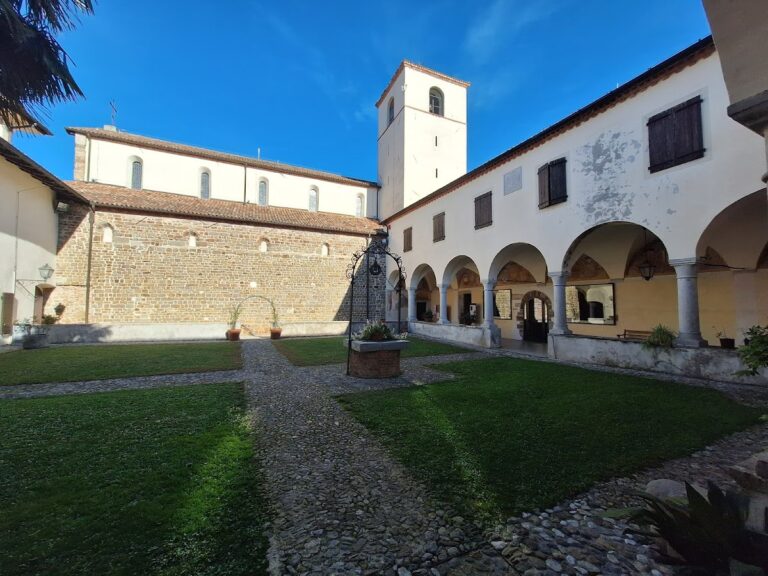
The cathedral is a three-nave hall church with a rectangular plan. Each nave ends in an apse, a rounded or polygonal termination of a church interior, while the choir apse projects beyond the eastern wall. The central nave is wider than the aisles and has a barrel vault. The two side aisles have cross vaults. A simple entrance front contains three openings, and the bell tower rises on the right side. The sacristy stands to the right of the choir.
Altars and paintings
The present main altar is a table altar without an altarpiece. It stands on an altar island in the nave immediately before the entrance to the choir. The medieval altarpiece of Patriarch Pilgrim II is now placed on it. This major work of Italian goldsmithing consists of 123 panels of gilded silver made in repoussé, a technique in which metal is shaped by hammering from the reverse. The central section shows the Madonna and Child between the archangels Michael and Gabriel. Two side compartments contain three superimposed bands with 25 saints, while 23 biblical figures and a full-length image of Patriarch Pilgrim II form the frame. Its style combines Byzantine formulas with softened Romanesque modeling, and its Latin inscription was made with individual letter punches.
The Altar of the Blessed Sacrament occupies the left apse or left choir area. Ercole and Orazio Liberale made it in 1580, and a figure of the risen Christ stands above the dome of its small architectural shrine. The right apse contains an altar dedicated to Saint Donatus. On the left wall, Pomponio Amalteo painted a large Annunciation in 1546.
Other artworks and liturgical furnishings
A life-sized Romanesque wooden crucifix from the thirteenth century hangs in the left nave. The church also contains a fifteenth-century Vesperbild, or Pieta, from the German school, and a Madonna enthroned with saints by Matteo Ponzone, dated 1617. Jacopo Palma the Younger painted both the Stoning of Saint Stephen and the Last Supper in 1606. The sacristy contains frescoes by Giuseppe Diziani and Giuseppe Mattioni, while Max Piccini created a terracotta Stations of the Cross in 1964.
A Baroque baptismal font made of black marble has a lid decorated with a small painted and polychrome carved figure of Saint John the Baptist. Above the doors, four tombstones commemorate episodes in the history of the Duomo and honor its benefactors.
Memorials in the cathedral
Above the main portal, on the interior wall of the facade, is an equestrian monument to Marcantonio di Manzano. The lacquered-wood sculpture was commissioned by the citizens of Cividale in 1621 and made by Girolamo Paleario. Marcantonio di Manzano was a Cividale condottiere, a professional military commander, who died during the 1617 siege of Gradisca, the event commemorated by the monument.
The funerary monument of Patriarch Nicolò Donato stands near an entrance at the beginning of the left nave. Giovanni Antonio di Bernardino da Carona began making it in 1515.
The adjoining Christian Museum
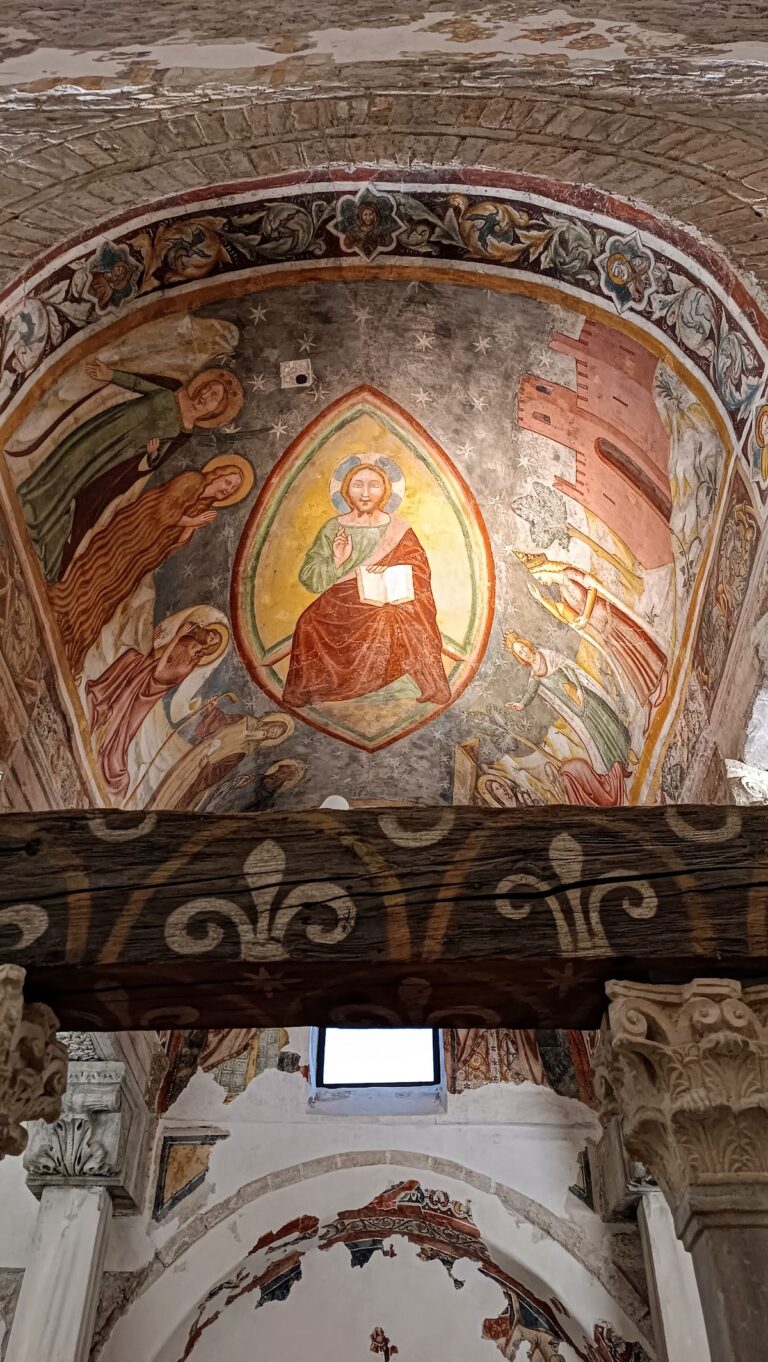
The cathedral is attached to the Christian Museum, which preserves material connected with the Lombard period and the history of the cathedral. Its associated features include a Lombard throne, the Callixtus baptismal font, the Altar of Duke Ratchis, frescoes, and sgraffito depictions of Lombard daily life. Sgraffito is a decorative technique in which surface layers are scratched or cut away to reveal contrasting layers beneath.