Church of the Annunciation: A Carmelite Church in Alcamo, Italy


Site at a Glance
- Rating
- 4.7
- Popularity
- Very Low
- Country
- Italy
- Primary era
- Medieval
- Eras represented
- Medieval, Early Modern
- Civilizations
- Crown of Aragon, Spanish
- Site type
- Religious
- Remains
- Church
On this page10 sections
History
The Church of the Annunciation, also known as the Church of Carmine, is a Catholic church in Alcamo, Italy, associated with the Carmelites. Its original construction probably took place between 1332 and 1379 during the Aragonese period, when Sicily was governed by the Crown of Aragon, although the historian Ignazio De Blasi proposed a much earlier foundation in 1032. The church became an important religious centre in the town, developing through repeated enlargements and alterations, especially during the sixteenth and seventeenth centuries.
Medieval origins and confraternities
A confraternity dedicated to Mary Most Holy Annunciation may have existed before 1380. A confraternity was a lay religious association formed around devotion, charitable activity, and support for a church and its rituals. This association is considered the oldest confraternity in Alcamo. During the sixteenth century, a Confraternity of Saint Blaise also existed in the church and may later have joined the Confraternity of the Annunciation.
The church was connected to an adjoining convent occupied by Carmelite friars, whose religious order combined communal life with preaching and pastoral work. The confraternity rebuilt the adjoining oratory in 1537. In 1752, it was elevated to the status of a company, a more formally recognized type of religious association in the terminology of the period.
Expansion and artistic development
The building acquired new chapels and furnishings as its religious communities and patrons developed the interior. Stefano Adragna commissioned the chapel that bears his name, whose marble elements were completed after 1517 following the dissolution of his partnership with Giuliano Mancino. During the second half of the sixteenth century, the chapel was decorated by Bartolomeo Berrettaro, whose work included a marble high relief of the Dormition of the Virgin carved in 1519.
The church’s principal altar received a white-marble group of The Annunciation in 1545. Antonino Gagini and Giacomo Gagini, members of a prominent Sicilian family of Renaissance sculptors and architectural decorators, represented the kneeling Virgin with the Archangel Gabriel and the Eternal Father above. The Virgin held a vase and lily, while seraphim appeared at the base of the composition.
Decline and later history
The abolition of religious orders in 1866 brought the expulsion of the Carmelites from the convent. The former convent was converted into barracks, while the church was abandoned. The friars tried to recover the building, but the proceedings continued for years. By the time the government agreed to return it, the roof had collapsed, and the church had become a ruin by the end of the nineteenth century.
In 1906, the marble Annunciation group was transferred to the Church of Saint Olivia. The Confraternity of Mary Most Holy Annunciation moved to the same church in 1950, regained the title of confraternity in 1954, and became extinct soon afterward. The surviving ruins and adjoining former convent remain in Piazza della Libertà. The former convent is occupied by the State Police, while the church is normally closed and is periodically used for cultural events such as exhibitions and concerts.
Remains
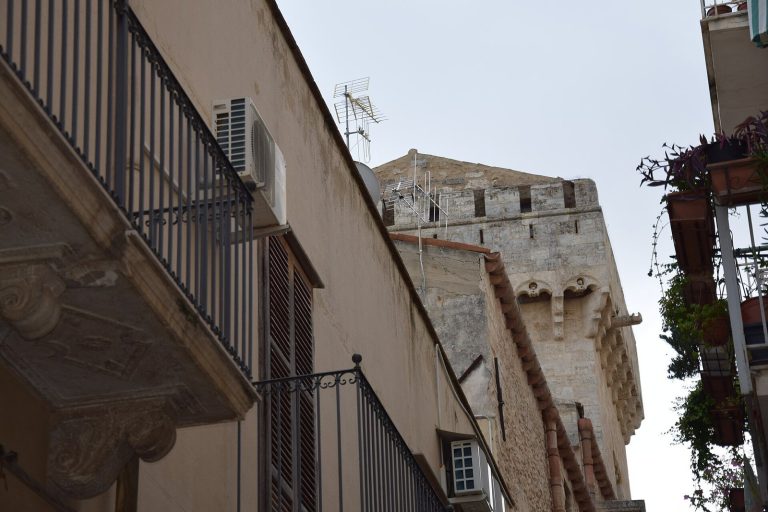
The surviving church had a trapezoidal plan with a central nave and two aisles divided by two rows of tuff columns. Each row carried five pointed arches in Gothic-Catalan forms, a medieval and early-modern tradition associated with Catalan architectural practice. The capitals were very low and individually decorated with floral and animal forms. One row of columns on the right-hand aisle survives from the original structure, together with several richly decorated chapels.
Church layout and surviving structure
Three apses formed the rear of the building, each covered by a pointed arch. Three further arches separated the naves from the presbytery, the part of the church reserved for the altar and clergy, which stood one step above the nave floor. Beneath it was a crypt used for public burial. Its entrance opened beside the raised step, and the chamber contained a fresco of the Holy Crucifix.
The original wooden saddleback roof, formed by two slopes meeting at a central ridge, has disappeared. At the entrance, a portal with two broad bands of carved Norman-style foliage was surmounted by a circular pierced window filled with openwork decoration. A square bell tower stood to the right of the portal. Built at the beginning of the fifteenth century, it was reached from inside the church and received a second elevation beginning in the sixteenth century.
A later music platform rested on an arch extending from the bell tower to a projecting chapel on the left side of the entrance. This addition cut through the portal decorations and the circular window, producing a portico-like structure in front of the church. Frescoes once decorated the walls and piers. Most were covered by whitewash, although images of a monk and a crucifix were found.
Chapels and sculptural remains
Adragna Chapel
The Adragna Chapel occupied part of the church’s decorated interior and was made during the second half of the sixteenth century. Its large marble arch had two pilasters, whose bases carried putti holding shields. Eight compartments contained high-relief figures of the four Evangelists, Matthew, Mark, Luke, and John, and four Fathers of the Church, influential early Christian theologians.
Berrettaro’s marble high relief of the Dormition of the Virgin, carved in 1519, is now kept in the Church of Saint Mary of the Rosary. One putto, the shield-bearer, and one Evangelist from the chapel are positioned on the counter-façade of the Church of Saint Olivia.
Chapel of Francesco Lombardo
The Chapel of Francesco Lombardo stood in the north-eastern part of the church. Its small apsidal basin was carved as a shell in a Baroque manner, and its entrance arch used rusticated voussoirs, wedge-shaped stones given a rough, blocklike treatment. Mariano Smeriglio made the entrance arch in 1602 and the frescoes that formerly covered the vault in 1606.
Transferred furnishings
A white alabaster holy-water stoup with bas-reliefs of the Announcing Angel and the Virgin is now in the Church of the Jesuit College. Its connection with the Church of the Annunciation is considered probable. The papier-mâché statue of the Madonna of Carmelo, once carried in procession by the Carmelite friars, is kept in the Church of Saints Paul and Bartholomew.
The church’s Eucharistic tabernacle, made by Luigi Di Battista, is now in the apse of the Church of Saint Olivia. It includes adoring angels and Carmelite saints, including Saint Albert degli Abati with a lily and book, and Blessed Luigi Rabata with a cross and book. Its predella, the lower section of an altarpiece or liturgical furnishing, depicts Christ the Redeemer of the World holding a globe topped by a cross and surrounded by the Apostles with the instruments of their martyrdom. Giovan Leonardo Bagolino gilded the tabernacle.