San Nicolò al Lido: A Historic Church and Monastery in Venice


Site at a Glance
- Rating
- 4.5
- Popularity
- Low
- Country
- Italy
- Primary era
- Early Modern
- Eras represented
- Medieval, Early Modern
- Civilizations
- Venetian
- Site type
- Religious
- Remains
- Monastery
On this page12 sections
History
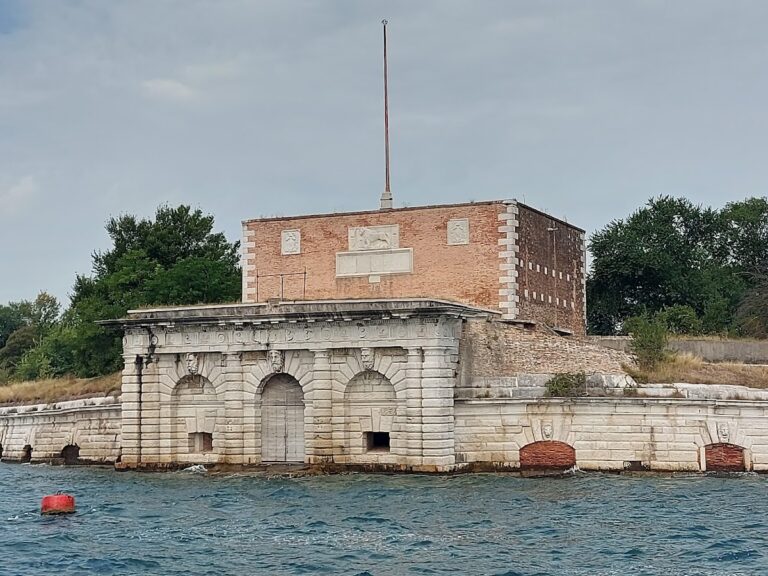
San Nicolò al Lido is a Roman Catholic church and monastery in Venice, Italy, founded in the early Middle Ages at a strategic point controlling the city’s main access to the sea. The present church is a Baroque building constructed between 1626 and 1629, while the complex continues to function as a parish church associated with the Franciscan order and the Patriarchate of Venice.
Early foundations and maritime power
Tradition gives different accounts of the complex’s foundation. One attributes it to the Zancaruol family, while another dates the foundation to 1044 or 1050 and credits Doge Domenico Contarini, the Patriarch of Grado Domenico Marango, and the Bishop of Olivolo Domenico Contarini. The first church was built between 1053 and 1064. Its position gave it a role in Venice’s maritime and political life from an early period.
Venetian expeditions against the Narentine pirates departed from the site in 996 and 998. On 9 May 1000, the fleet of Doge Pietro Orseolo II sailed from the Lido for the campaign that led to the submission of Dalmatia. That departure remains commemorated in the Marriage of the Sea, the ceremony in which Venice symbolically renews its relationship with the sea.
In 1071, while Saint Mark’s Basilica was being reconstructed, Doge Domenico Selvo was elected and crowned at San Nicolò. Domenico Contarini, one of the figures associated with the foundation traditions, was buried there in the same year. A major donation in 1072 enlarged the monastery’s possessions around Trieste, including the church of Sant’Apollinare, vineyards, olive groves, and other lands.
Monastic expansion and medieval diplomacy
The monastery’s authority expanded during the twelfth and early thirteenth centuries. In 1114, Bishop Bertoldo of Parenzo placed Sant’Anastasio and other churches in the Parenzo area under its control. In 1133, the Patriarch of Aquileia transferred the Abbey of San Pietro di Carso to the monastery, a foundation confirmed in 1205 by Wolfger of Aquileia.
Royal privileges reinforced the institution’s position. Conrad III granted protection and privileges in 1151, and Frederick II confirmed them in 1222. During the peace negotiations of 1177 between Pope Alexander III and Emperor Frederick I, Venetian chroniclers state that the pope was received at San Nicolò and escorted to Saint Mark’s Basilica. The emperor arrived there aboard six galleys on 23 July and was ceremonially escorted to Saint Mark’s the next day.
The site also remained connected with major military expeditions. Venetian forces taking part in the First Crusade departed from the port in 1099 under the leadership of the Bishop of Castello and Giovanni, son of Doge Vital I Michiel. Forces of the Fourth Crusade left from San Nicolò in 1202. Salinguerra II Torelli, a Ghibelline nobleman associated with support for imperial authority in medieval Italian politics, was buried at the church in 1245.
The Great Council ordered a substantial enlargement of the church in 1316. In 1451, Patriarch Lorenzo Giustiniani began a reform of the monastery, after which its abbots were elected every three years. In 1454, at the monks’ request and with the approval of Pope Nicholas V, the Benedictine congregation was united with the Congregation of Saint Justina of Padua. The Benedictines followed the Rule of Saint Benedict, a foundational code for Western Christian monastic life.
Rebuilding and changes in use
The monastery was reshaped as a Renaissance cloister in the sixteenth century, and the cloister was built in 1530. The Benedictine congregation was suppressed by the Republic of Venice in 1770, after which the monastery was secularized. Measures introduced under Napoleon from 1805 converted it into military barracks.
The present church was built on a different site from the original. Work began in 1626 and ended in 1629. On 11 May 1628, the relics were ceremonially transferred from the church to the monastery under Abbot Girolamo Spinelli, and they were moved into the new church in 1634.
After the suppression of the Benedictines, Franciscan monks reopened the monastery for educational purposes. The church reopened in the early twentieth century and was entrusted to the Franciscans in 1926. In 1938, the monastery passed to the Friars Minor of Saint Anthony, the principal male branch of the Franciscan order. The former monastery now also houses a scientific research centre and an exhibition space.
Saint Nicholas and the Marriage of the Sea
The present church was intended to receive the relics of Saint Nicholas of Myra, a fourth-century Christian bishop from Lycia whose cult made him a major patron of sailors and maritime communities. Tradition holds that Venetian crusaders obtained the relics in 1100, although Pope Urban II had already entombed them at Bari in 1089.
The authenticity and division of the relics became a long-running issue between Venice and Bari. The Venetian reliquary was opened in 1282 and closed again in 1287, with further examinations in 1399 and 1449. In 1449, the remains of three saints were again stored separately. Scientific examinations in Bari in 1953 and Venice in 1992 indicated that the relics divided between the two cities may come from the same person. Bari possesses the larger bone fragments, while Venice has smaller fragments said to have been left behind by Bari’s sailors. About 500 bone fragments are kept in the Venetian church.
San Nicolò remains the traditional destination of the doge during the Festa della Sensa, or Marriage of the Sea. In the ceremony, the doge cast a golden ring into the lagoon to renew Venice’s symbolic relationship with the sea. The tradition continues today, with the mayor taking the doge’s place.
Remains
The present church
Exterior and bell tower
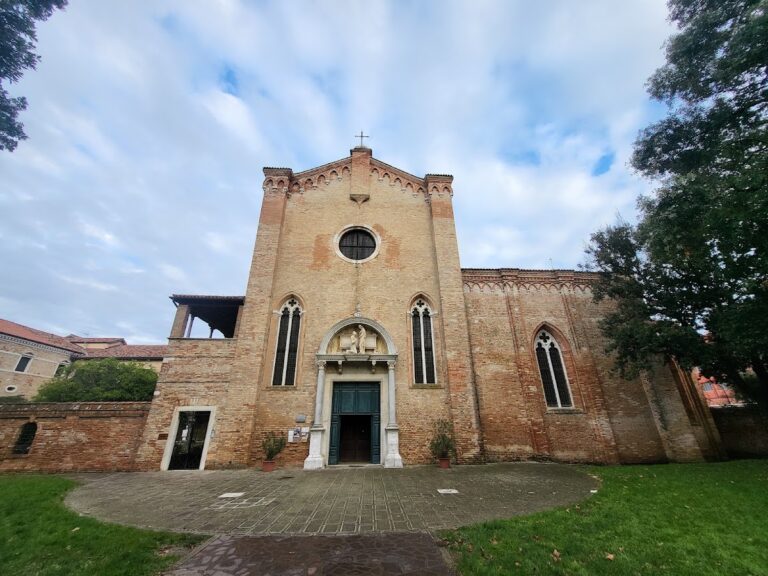
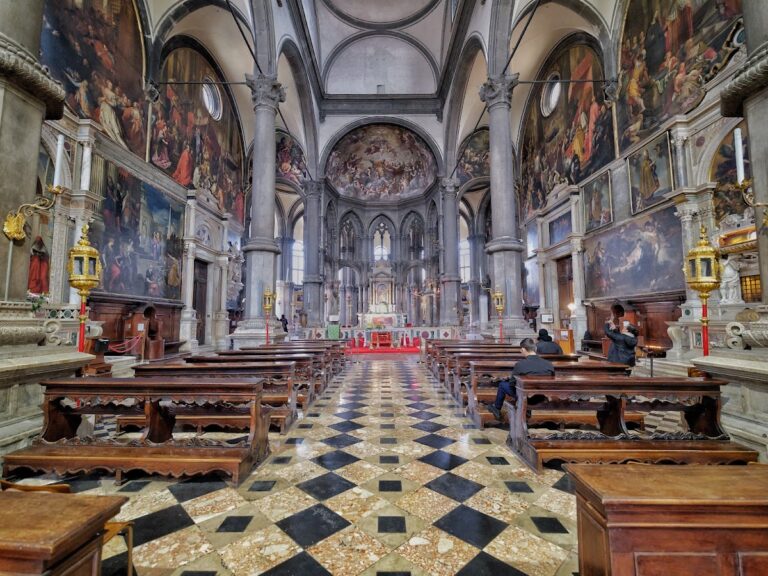
The complex occupies the northern part of Lido, with the church entrance facing west toward the city and the apse, the curved eastern end of the church, facing east. The present building is a single-nave brick church in Baroque form, with three chapels on each side. Its façade remains unplastered and unfinished, and a pediment surmounts it. Above the portal, a marble urn contains the remains of Doge Domenico Contarini.
The side walls are coated with opus signinum, a waterproof mortar made with lime and crushed ceramic material. Large semicircular-headed thermal windows pierce the walls, which are reinforced by buttresses. Near the entrance stands a wooden crucifix dating to about 1300.
The attached Baroque campanile, or bell tower, was built between 1626 and 1629 and rises approximately 38 metres. Its three bells, tuned in G major, date from the sixteenth century.
Interior, altar, and artworks
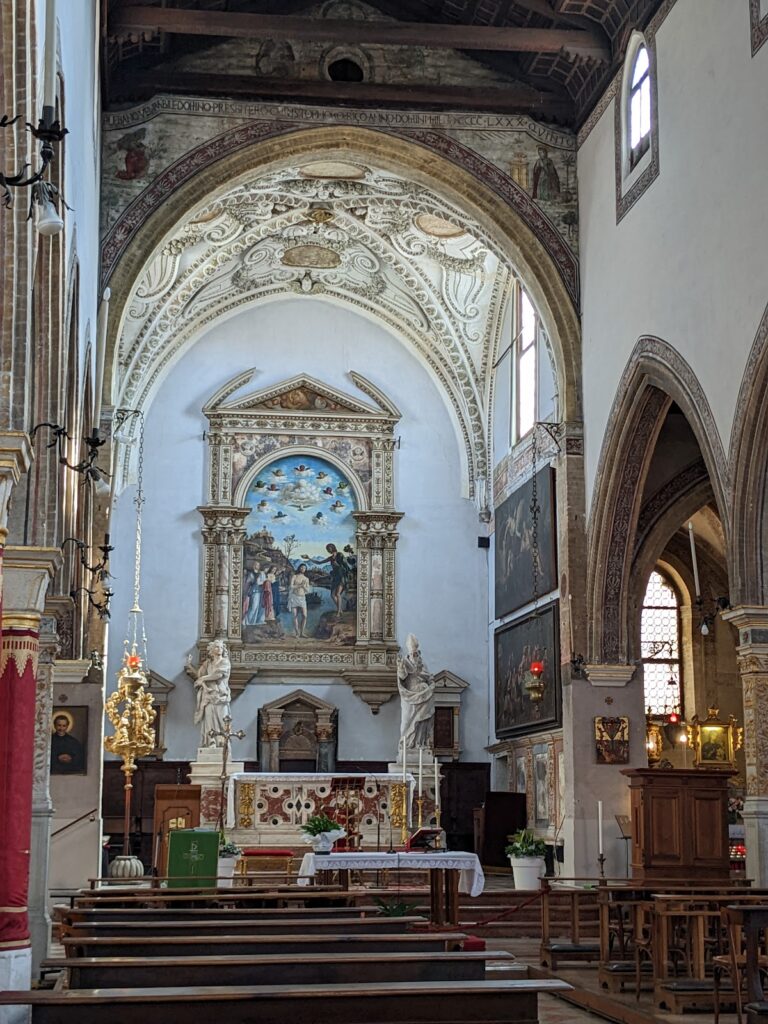
The interior has a vaulted nave and a Baroque high altar dated 1630. Polychromed marble details enrich the altar, whose sarcophagus, made by Cosimo Fanzago, contains the remains of Saints Nicholas and Theodore. The approximately 500 fragments attributed to Saint Nicholas are associated with the church’s principal cult and are kept beneath the altar.
Behind the altar is a wooden choir made in 1634 by Giovanni Carlo and Giovanni Cremasco. The choir includes 27 panels by Giovanni Cremasco depicting scenes from the life of Saint Nicholas. The church also contains frescoes by Girolamo Pellegrini and Pietro della Vecchia, a Madonna with Child by Palma il Vecchio, and a depiction of the young Saint John by Palma il Giovane.
The monastery and earlier basilica
Renaissance cloister and monastic buildings
The monastery is attached to the church and includes a large sixteenth-century cloister, a covered walkway surrounding an open courtyard. Its southeastern area contains an exhibition hall. The historic buildings, cloister, church interior, and Contarini tomb appear in works by Venetian painters including Francesco Guardi, Gabriele Bella, and Andrea Vicentino. Guardi’s views include the Bucintoro, the ceremonial state galley used in the Marriage of the Sea, and scenes of the ceremony at San Nicolò.
Remains of the original church
Parts of the original church survive within the monastery area, including sections of its southern aisle. The original apse contained an image of Christ accompanied by two angels, with inscriptions referring to the Bishop of Olivolo and Domenico Contarini. Archaeological investigations in the 1980s recovered fragments of the wall mosaics, probably made by Byzantine craftsmen. The small pieces forming the mosaics, known as tesserae, were separated and stored in two crates.
Corinthian capitals with palmette ornament, dating from approximately the eleventh century, were found around 1940 after being incorporated into the later building. Investigations during the 1950s and 1960s also uncovered and restored a floor mosaic from the original Romanesque basilica. Its decoration combines geometric and vegetal motifs, preserving material evidence of the earlier church within the later monastic complex.
Nearby sites