Rotunda of Saint Martin: A Romanesque Church in Prague


Site at a Glance
- Rating
- 4.7
- Popularity
- Low
- Country
- Czechia
- Primary era
- Medieval
- External website
- Open
- Eras represented
- Medieval, Early Modern, Modern
- Civilizations
- Duchy of Bohemia, Habsburg, Holy Roman Empire
- Site type
- Religious
- Remains
- Church
On this page12 sections
History
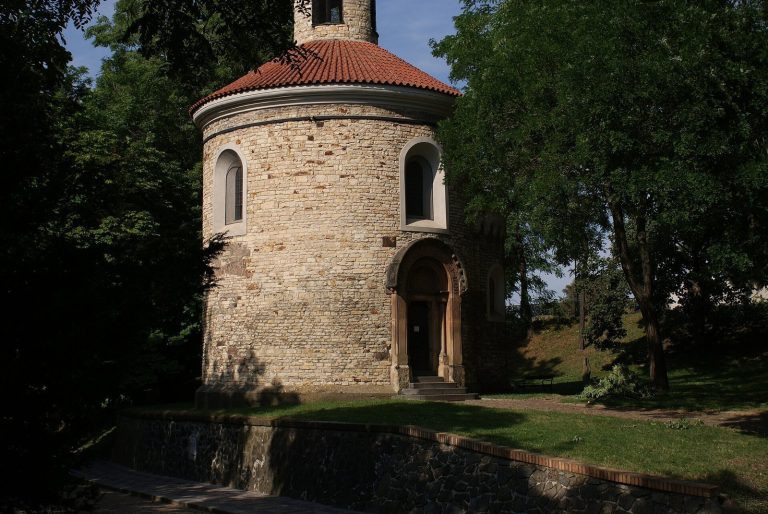
The Rotunda of Saint Martin is a late 11th-century Romanesque church in Prague, Czechia, probably built during the reign of Duke Vratislav II, who ruled Bohemia from 1061 to 1092. Its foundation is traditionally attributed to Martin, the contemporary dean of the Vyšehrad Chapter, a collegiate body of clergy responsible for an ecclesiastical foundation, although its exact date is uncertain. The rotunda probably served as the parish church of the settlement outside Vyšehrad’s main fortification.
Medieval Church and Hussite Conflict
The area around the church was used as a cemetery during the 12th and 13th centuries. Later archaeological finds indicate the burial function of the surrounding settlement. In 1420, during the Hussite assault on Vyšehrad, the rotunda escaped the destruction that affected most of the fortress’s religious buildings. Its decoration was severely damaged, however, and its custodians were expelled. The Hussites were a reforming Christian movement in Bohemia whose early 15th-century conflicts included attacks on religious institutions.
Military Use and Secular Functions
A fire damaged the building in 1528, after which it was rebuilt. During the Thirty Years’ War, a major European conflict of the 17th century, the rotunda was converted into a gunpowder magazine. Ferdinand III began constructing the Vyšehrad citadel in 1650, and the local population was expelled. The rotunda subsequently continued in use as storage space.
The chapel was restored in 1719, when its original Romanesque entrance was replaced by a Baroque portal. Further repairs followed. Prussian forces damaged the building in 1757, and Joseph II later deconsecrated it as an unnecessary chapel. It then served as a storehouse, workshop, and accommodation for poor people.
Protection and Restoration
Demolition was proposed in 1841 to create a road between Prague’s New Town and Pankrác. Count Karel Chotek was chiefly responsible for preventing the building’s destruction, although its entrance was partly altered so that it would not obstruct the road. The Vyšehrad Chapter acquired the rotunda in 1875 for 500 gulden.
With financial support from the Vyšehrad canon František Kočí, the building was restored to a Romanesque appearance in the later 19th century. The work is also dated to 1878 to 1880 and followed designs by the Czech architect and archaeologist Antonín Baum. The rotunda is now a Roman Catholic filial church, meaning a church subordinate to a parish church, within the Prague-Vyšehrad parish of the Prague Diocese. It is owned by the Vyšehrad Chapter and dedicated to Saint Martin of Tours, the 4th-century bishop and missionary associated with the legend of giving half his cloak to a beggar. The church forms part of Prague’s historic centre, which was included as a cultural World Heritage site in 1992.
Remains
The surviving building is a cylindrical Romanesque rotunda with a dome and a lantern, a small windowed structure crowning the dome. Its internal diameter is 6.5 metres, while the walls reach a thickness of 95 centimetres. It is built mainly from dressed marlstone blocks, with occasional sandstone blocks. The masonry was newly repointed during the 19th-century restoration.
Exterior Structure
Cylindrical Body and Apse
An apse projects 2.2 metres from the eastern side of the cylindrical body. Its semicircular vault is a conch, or semi-dome, and its exterior retains the original pilaster strips. The apse has two windows, while three further windows pierce the main cylindrical body. Their stained glass and stucco surrounds were restored in the 19th century.
Dome and Lantern
The lantern contains four windows. Its columns and impost blocks, which are projecting blocks supporting the arches, were renewed during the 19th-century restoration. The same work renewed the stained glass, stucco window surrounds, and stucco cornices. A new bell cast in Prague was installed in the lantern, and a gilded cross was placed above it.
South Portal
The present south entrance is a Neo-Romanesque portal made of Hořice sandstone. Its tympanum, the decorated field enclosed by the portal frame, carries motifs inspired by the Vyšehrad Codex, an illuminated medieval Gospel manuscript associated with Vyšehrad. The earlier western doorway became inaccessible because of the road and was replaced during the 19th-century restoration. Beside the window above the portal, an embedded cannonball commemorates the damage caused by the Prussian forces in 1757.
Interior and Decoration
Altar
The interior contains an altar mensa, the horizontal slab forming the top of an altar, and altar steps made of Slivenec marble. Jan Brejcha of Slivenec made the mensa, while the Neo-Romanesque altar is associated with the 19th-century restoration.
Presbytery Paintings
The presbytery, the area around the main altar reserved for the clergy, contains 19th-century paintings by Jan Heřman produced in collaboration with Josef Hellich. Their biblical scenes draw on the Vyšehrad Codex. František Sequens completed other decorative work and also painted the altarpiece. Above the altar, the apse wall bears an image of Saint Martin. The vault shows Christ blessing among angels, while the interior depiction of Christ is also associated with Antonín König and Jan Heřman.