Igreja Matriz da Calheta: Parish Church of the Holy Spirit in Madeira


Site at a Glance
- Rating
- 4.7
- Popularity
- Very Low
- Country
- Portugal
- Primary era
- Early Modern
- External website
- Open
- Eras represented
- Early Modern
- Civilizations
- Portuguese
- Site type
- Religious
- Remains
- Church
On this page15 sections
History
Igreja Matriz da Calheta, also known as Igreja Matriz do Espírito Santo, is a sixteenth-century parish church in Portugal, built in the Manueline and Mannerist traditions. Its history is closely connected with the early organization of Madeira’s parishes and with the wealth generated by sugar cultivation and processing in Calheta.
Foundation of the parish
The parish of Calheta was established around 1430, making it one of the earliest parishes founded on Madeira. Its first religious center was probably the Chapel of Nossa Senhora da Estrela at Lombo da Estrela. That chapel was commissioned by Diogo Cabral and his wife, Beatriz Gonçalves da Câmara, the daughter of João Gonçalves Zarco, a Portuguese navigator and early colonizer associated with Madeira’s settlement and the administration of the Funchal captaincy.
Diogo Cabral established a morgadio, a hereditary estate arrangement intended to preserve property within a family line, at the chapel and was buried there. The parish later moved to a new religious center in the village of Calheta, whose dedication became the Holy Spirit. At its creation, the parish was said to have had 1,931 inhabitants and was contemporary with the parishes of Nossa Senhora da Conceição de Baixo and São Sebastião in Funchal.
Construction and ecclesiastical organization
The precise construction date of the present church is unknown, but the building dates from the middle of the sixteenth century. A campaign of reconstruction and improvement took place in 1639, a date preserved on the pulpit. The curacy of Calheta, a subordinate parish ecclesiastical office or benefice, was established by royal decree on 27 August 1589, with an annual stipend of 20,000 reis.
Calheta’s growth was strongly tied to sugar production. The settlement’s prosperity enabled its churches to acquire religious paintings, sculpture, and liturgical objects. King Manuel I, who ruled Portugal from 1495 to 1521 during the expansion of Portugal’s overseas activities and Madeira’s sugar economy, recognized Calheta by elevating it to a town and, in 1502, to a municipality. He also presented the church with an ebony tabernacle decorated with silver and a Manueline processional cross.
Sugar wealth and religious life
During the seventeenth century, Calheta had a small customs office for collecting taxes on locally produced sugar. The quintador, an official responsible for administering sugar taxes, and the clerk of the fifths handled these duties. The wealth associated with this activity supported further purchases of valuable religious artworks.
The church is dedicated to the Holy Spirit, understood in Christianity as the third person of the Trinity. Its principal feast takes place on Pentecost Sunday, which commemorates the descent of the Holy Spirit upon the apostles. Other principal observances are the Feast of the Blessed Sacrament and the Feast of Nossa Senhora dos Bons Caminhos, held on the last Sunday of September.
Igreja Matriz da Calheta has been legally protected as a Property of Public Interest since 1977.
Remains
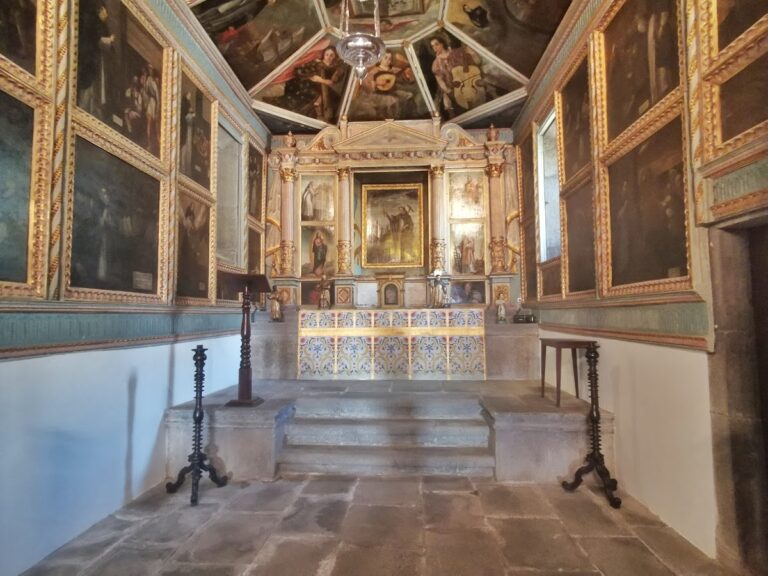
The surviving church combines Manueline characteristics, belonging to a Portuguese late Gothic style associated with elaborate architectural and naturalistic ornament, with the more complex forms of Mannerism. Its interior is richly decorated, and the ceiling follows a Moorish style comparable to that of Funchal Cathedral. The church’s furnishings and artworks preserve connections with royal patronage, Madeira’s sugar economy, and religious devotion from the sixteenth to the eighteenth centuries.
Royal and liturgical furnishings
Ebony tabernacle and silver objects
The ebony tabernacle presented by King Manuel I remains one of the church’s principal furnishings. Its decoration includes silver details. Other associated metalwork includes the poles of the canopy, lanterns, a holy-water vessel, candlesticks, silver lamps, and a salver dedicated to the Holy Spirit.
Manueline processional cross
A Manueline processional cross is among the church’s principal liturgical objects. Its style links the interior to the artistic culture associated with the reign of Manuel I and to the period when Calheta received royal recognition.
Paintings and sculpture
Chapel of the Blessed Sacrament
The Chapel of the Blessed Sacrament contains an oil painting of the Immaculate Conception. Tiles with a corncob pattern are also distributed across the floor of this chapel, connecting its devotional space with a distinctive decorative group found elsewhere in the church.
Flemish triptych panels
Two replicas of the side panels of a sixteenth-century Flemish triptych are installed in the chancel. The originals are preserved at the Museum of Sacred Art in Funchal. Painted in oil on cedar wood by Jan Provoost, a Flemish Renaissance painter active in the late fifteenth and early sixteenth centuries, the panels depict the Archangel Gabriel and the Virgin Mary, as well as Saint Francis and Saint Anthony.
Last Supper group
A full-length sculptural group representing the Last Supper dates from the late seventeenth century. It was restored after natural deterioration affected the work, preserving an important element of the church’s sculptural interior.
Tiles and chancel decoration
Pulpit tile group
Four tiles bearing a corncob pattern are set into the wall beneath the pulpit. Additional tiles from the same group are placed across the floor of the Chapel of the Blessed Sacrament.
Chancel tiles
Portuguese tiles from the late eighteenth century cover the side walls of the chancel. They form part of the church’s later decorative history alongside the older paintings, sculpture, furnishings, and Moorish-style ceiling.