Forte de Nossa Senhora do Amparo: A Coastal Defense Fort in Machico


Site at a Glance
- Rating
- 4.3
- Popularity
- Low
- Country
- Portugal
- Primary era
- Early Modern
- External website
- Open
- Eras represented
- Early Modern
- Civilizations
- Portuguese
- Site type
- Military
- Remains
- Fort
On this page7 sections
History
Forte de Nossa Senhora do Amparo, also called Forte de Santo Amaro, is an eighteenth-century fort in Machico, Portugal. Built in 1706, it defended the town and Machico Bay against pirates and privateers and formed part of a paired coastal defense system with Forte São João Baptista.
Early plans and construction
Plans for a fort at Machico were already recorded before the present structure was built. An earlier small fort, São Roque, had been constructed in 1595. The current fort was established in 1706 at the initiative of Governor Duarte Sodré Pereira. An inscription above the entrance commemorates him and gives the construction date. Captain Francisco Dias Franco became the fort’s first commander.
The fort’s construction was linked to Forte São João Baptista, built two years later. Together, the two works guarded Machico’s anchorage and settlement, strengthening defenses against attacks by pirates and privateers. A guardhouse once stood in front of the fort, but an 1817 inventory criticized its position within the cannon-fire zone. It was demolished in 1818.
Military action and changing use
On 22 August 1828, during the events preceding the Miguelist War, Miguelist forces supporting the absolutist King Michael I landed at Machico. The Miguelist War was the Portuguese civil war of 1828–1834 between supporters of Michael’s absolutist rule and advocates of constitutional government. Forte de Nossa Senhora do Amparo was the last local fortification to surrender.
The fort lost its military function in the following decades. The surrounding land was leased to a private individual in 1888, and in 1895 the fort passed to the Municipality of Machico for use as barracks for troops stationed in the town. After the 1910 Revolution, the royal coat of arms above the entrance arch was removed.
Heritage protection and later administration
In 1940, Forte de Nossa Senhora do Amparo was designated an Imóvel de Interesse Público, a protected property of public interest, and transferred to the Guarda Fiscal, the Portuguese state service responsible for customs control, tax matters, and preventing smuggling. In 1970, at the municipality’s request, cannons from the Quinta das Cruzes Museum in Funchal were transferred to the fort for display. Ownership passed to the Regional Government of Madeira in 1993, and the fort currently houses Machico’s tourist office.
Remains
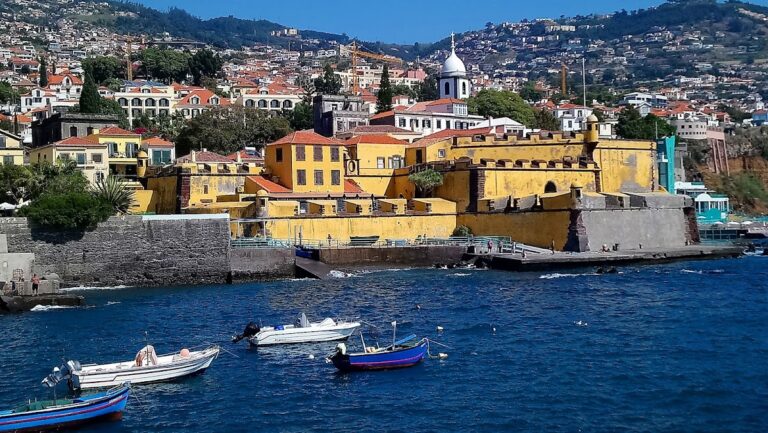
Forte de Nossa Senhora do Amparo stands a few metres from the beach of Machico Bay, directly in front of the town’s historic centre. Its triangular ground plan has the point directed toward the sea, while the entrance gate faces the town. The fort is described as a ruin, although its walls, entrance, battery, barracks, and displayed cannons remain identifiable parts of the site.
Walls and artillery battery
The exterior walls are plastered and painted yellow, rise approximately five metres, and are capped with crenellations, the regularly spaced raised sections along the top of a defensive wall. Behind them lies the battery, a fortified emplacement designed to hold and operate artillery pieces. This area contains the cannons transferred from the Quinta das Cruzes Museum.
Entrance and barracks
The entrance is formed by a round arch. Two relief stones above it carry a coat of arms and an inscription beneath the arms commemorating the fort’s construction. Two single-storey rectangular barrack buildings stand against the rear wall, one on each side of the entrance gate.
Nearby sites