Fortaleza de São Tiago: A Coastal Fort in Funchal, Portugal


Site at a Glance
- Rating
- 4.3
- Popularity
- Medium
- Country
- Portugal
- Primary era
- Early Modern
- External website
- Open
- Eras represented
- Early Modern, Modern
- Civilizations
- Portuguese
- Site type
- Military
- Remains
- Fort
On this page7 sections
History
Fortaleza de São Tiago is a historic Portuguese military fort in Funchal, Portugal, built in the seventeenth century to defend Madeira’s Atlantic coast. Construction began in 1614 under the master builder Jerónimo Jorge, and continued under his son after his death in 1617. The work was completed in 1637.
Seventeenth-Century Foundation
Commissioned by the Portuguese Crown, the fort protected Funchal and Madeira from pirate raids, corsairs, privateers, and attacks by other European powers. Its construction reflected the islands’ strategic position in the Atlantic during the seventeenth and eighteenth centuries. The fort stood in Funchal’s old town, Zona Velha, within the parish of Santa Maria Maior.
Eighteenth-Century Expansion
The fort was expanded and rebuilt in the eighteenth century under Governor José Correia de Sá. This phase was completed around 1767, a date preserved on a plaque attached to the gate. Further alterations took place in later centuries, including substantial nineteenth-century rebuilding associated with the construction of the island governor’s residence.
Military Use and Cultural Reuse
In 1803, Fortaleza de São Tiago provided refuge for people affected by a flood disaster. By 1921, it contained barracks for an artillery battery, and it continued to serve mainly military purposes until 1990. The barracks were repaired in 1974 and housed Funchal’s military police until July 1992, when the fort passed to the Regional Government of Madeira.
After the transfer, the fort became part of the protected historic urban area of Zona Velha do Funchal, recognized as a monument of regional architectural importance. Restoration then prepared it for cultural use. From 1992 until 2015, it housed the Madeira Museum of Contemporary Art, which later moved to Calheta, and the fort continued as a museum and cultural venue.
Remains
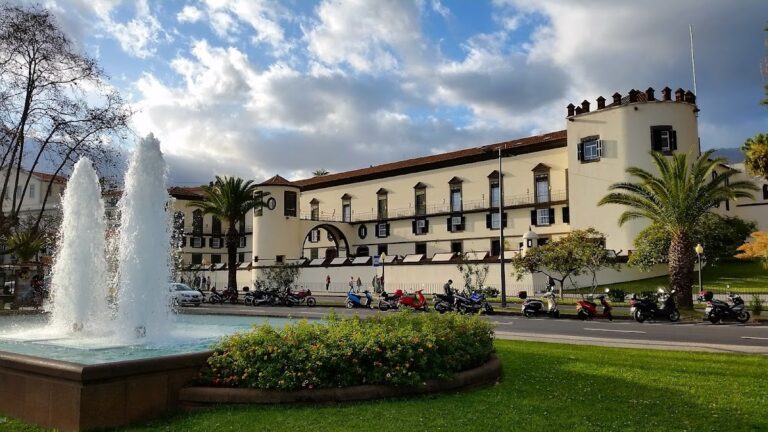
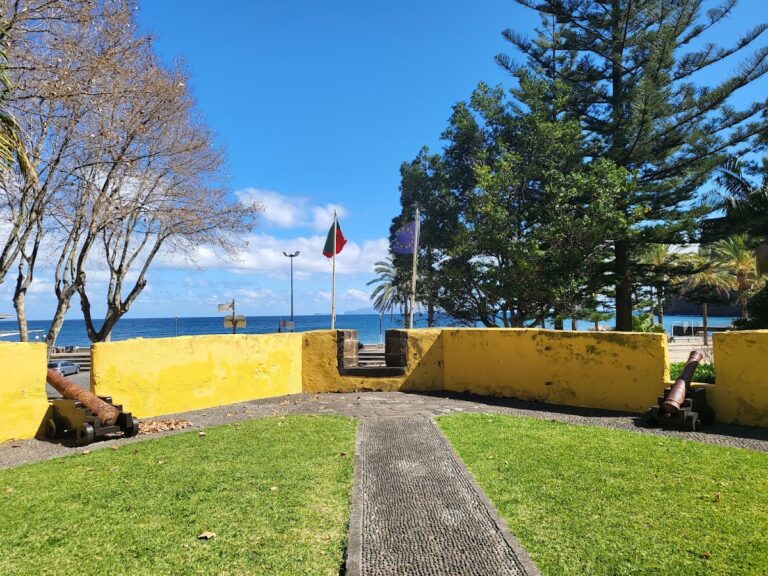
Fortaleza de São Tiago is a seventeenth-century coastal defense structure built of stone and brick. It stands directly beside the sea in a position overlooking the Atlantic, Funchal’s harbor, and the surrounding coastline. Its surviving form combines heavy defensive walls with bastions, raised ramparts, watchtowers, courtyards, battlements, and a small chapel.
Defensive Works
Thick stone walls, bastions, and ramparts formed the fort’s principal defensive system. A bastion, a projecting part of a fortification, allowed defenders to observe and fire along adjoining walls. The ramparts were raised defensive walls or embankments, while the battlements used notched parapets for protection. Together, these features were designed to withstand cannon fire and repel attacks from the sea.
Watchtowers and Interior Spaces
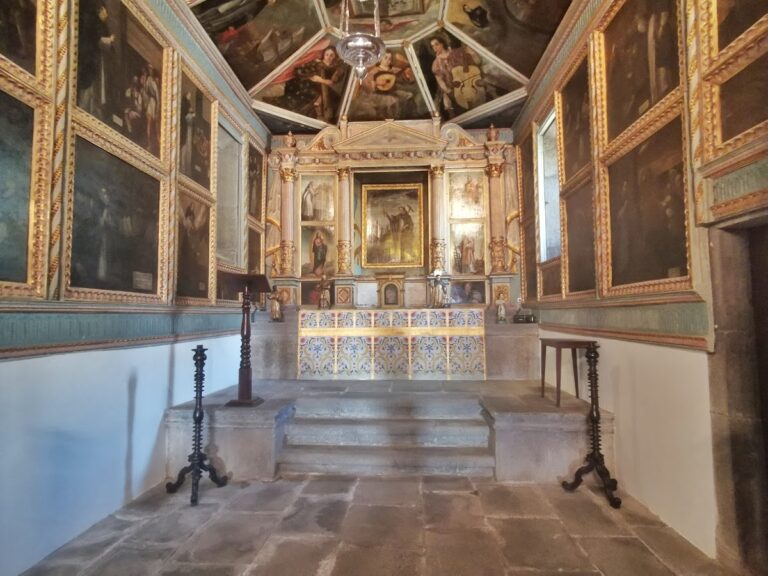
The watchtowers provided views across the harbor and coastline, helping the garrison detect approaching ships at an early stage. Inside the fort, courtyards organized the complex, while battlements reinforced its military character. A small chapel served the religious needs of the soldiers stationed there.
The walls are painted a prominent yellow, a color scheme introduced during twentieth-century restoration that contrasts with the surrounding buildings of Funchal’s historic district. The fort remains relatively well preserved, although its fabric reflects numerous alterations and restoration campaigns.
Nearby sites