Church of San Francesco in Cortona: A Franciscan Church and Its Artistic Heritage


Site at a Glance
- Rating
- 4.7
- Popularity
- Very Low
- Country
- Italy
- Primary era
- Medieval
- Eras represented
- Classical, Medieval, Early Modern
- Civilizations
- Roman
- Site type
- Religious
- Remains
- Church
On this page19 sections
History
The Church of San Francesco is a Roman Catholic church in Cortona, Italy, dedicated to Francis of Assisi and belonging to the Diocese of Arezzo-Cortona-Sansepolcro. Construction began around 1245 or 1246 on a large artificial terrace, probably of Roman origin, after the Municipality of Cortona donated the land to Friar Elia Coppi. The church was already in use by 1254, although its consecration took place only in 1374, as recorded by the inscription on the facade.
Foundation and Franciscan Custody
Friar Elia Coppi was probably also responsible for the church’s design. He belonged to the Franciscan movement founded by Francis of Assisi in the thirteenth century, and the church follows the characteristic plan of a Franciscan church. The building and its adjoining convent were entrusted to the Conventual Franciscan Friars, the branch of the order devoted to communal convent life and the pastoral care of churches and convents. They remain the custodians of the complex.
Elia Coppi also brought to Cortona a fragment of the True Cross. John III, emperor of the Empire of Nicaea, a Byzantine successor state centered in western Anatolia after the Fourth Crusade captured Constantinople, donated the fragment to him in 1244. It was intended for preservation in a reliquary, and it remains connected with the church’s devotional history.
Counter-Reformation Transformation
During the late sixteenth and early seventeenth centuries, the church was adapted to the requirements of the Counter-Reformation. This was the Catholic reform movement that followed the Protestant Reformation. The Council of Trent encouraged churches to present religious teaching more clearly through worship and decoration, while many interiors became more ordered and austere. At San Francesco, earlier frescoes were removed and new monumental altars replaced or supplemented earlier arrangements.
The altars became an important record of this transformation. Antonio Buoni established the fourth altar on the right in 1596 and dedicated it to Anthony of Padua. Its architectural design is attributed to Mariotto Radi’s workshop, while Cigoli, also known as Ludovico Cardi, painted Saint Anthony of Padua and the Miracle of the Mule in 1597. Onofrio Sernini Cucciatti founded the third right-hand altar in 1606 for the Virgin, Saint Christopher, and Saint Catherine. Andrea Commodi’s Immaculate Conception with Saint Christopher, Saint Louis the King, Saint Cecilia, and Saint Catherine was completed in 1609 and restored in 2020.
The first altar on the right was erected in 1609 for Francis and Bonaventure by Pietro Capulli, a Franciscan friar who had been regent of the College of Saint Bonaventure in Rome and a scholar of Franciscan writings. Its original altarpiece by Andrea Commodi was later replaced by Niccolò Monti’s Saint Francis before the Sultan, painted in 1842. The dedication described Francis as “father” and Bonaventure as “guide.”
Margherita Venuti commissioned another altar in 1625 in memory of her husband, Niccolò Baldelli. Its design was commissioned from Mariotto Radi, who had died in 1624 and probably supplied only the design. Francesco Rustici painted Madonna in Glory with the Child and Saints Francis, Margaret of Cortona, and Nicholas of Bari in the same year. Domenico Rotani, a standard-bearer in the Medici army and a servant of Ferdinand I and Christina of Lorraine, commissioned the second altar on the right in 1643. Filippo Berrettini designed it, and its altarpiece, Orazio Fidani’s Meeting of Saints Joachim and Anne at the Golden Gate, bears the date 1645.
Chapels, Relics, and Later Patronage
The chapel to the right of the main chapel contains the funerary monument of Ranieri Ubertini, the first bishop of the Diocese of Cortona, who died in 1348. Angelo and Francesco di Pietro made the monument in 1360. Annibale Laparelli erected the chapel’s altar in 1657, and Ciro Ferri painted its altarpiece, The Virgin in Glory with Saint Louis, Saint Ludovico, Saint Margaret of Cortona, and Blessed Guido of Cortona, in the same year. The painting was later moved to the left wall.
The chapel on the left of the main chapel received an altar between 1657 and 1659. Girolamo Mancini established it according to the wishes of Evangelista Ridolfini and dedicated it to Saint John. The attribution and date of its Saint John the Evangelist at Patmos remain disputed. After restoration in 1997, it was regarded possibly as a late-eighteenth- or early-nineteenth-century copy or derivation of a painting from the Cortonese tradition.
The high altar’s tabernacle was produced by Bernardino Radi after a competition held in 1629, although work continued until the late 1670s. The Baldacchini altar occupies the former location of the crucifix venerated by Margaret of Cortona, a thirteenth-century penitential religious figure associated with the city. That crucifix was transferred to her sanctuary in 1602. Margherita Baldacchini requested a replacement altar in her will, and her nieces Guglielma Laparelli and Sister Maria Caterina funded and commissioned it in 1679.
The altar opposite the Baldacchini altar was erected in 1606 by Colonna Alfieri in accordance with the wishes of her brother Ludovico Alfieri, a celebrated jurist and bishop of San Marco Argentano in Calabria who died in 1593. The Radi workshop made it as a renewal of the family altar. Antonio Alfieri later commissioned Pietro da Cortona’s Annunciation, painted in 1669.
The Zeffirini family renewed the second altar on the left in 1615, retaining its dedication to Saint Lucy and adding Saint Jerome as a family patron. The Tozzi family built the first altar on the left in 1671. The church also preserves a fragment of the True Cross in a tenth-century Byzantine reliquary of ivory and silver. The convent holds a habit associated with Francis of Assisi, an embroidered cushion donated by Giacoma de Settesoli on which the dying Francis rested his head, and a Gospel book. Luca Signorelli, the prominent Renaissance painter from Cortona, was buried in the crypt beneath the church, which is now unused.
Remains
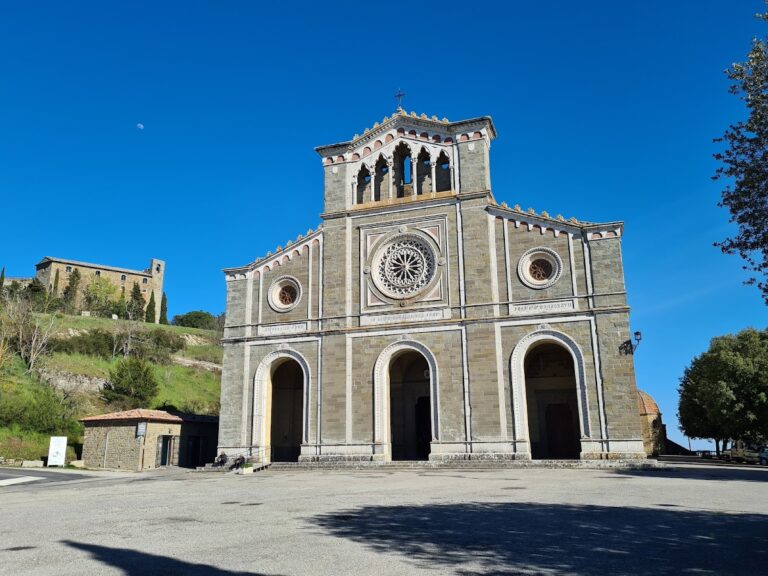
The church stands on a large artificial terrace probably of Roman origin and is reached by a long staircase. Its surviving fabric combines Gothic and Baroque elements. The building has a single nave covered by a timber truss roof and ends in three chapels with groin vaults, meaning vaults formed by the crossing of two barrel vaults. The central chapel rises higher than the two side chapels.
Facade, Apse, and Cloister
Facade and Gothic Openings
The facade retains a splayed pointed-arch portal with three small columns set in its recesses. Above it survives the springing, or starting point, of a large circular window. In the apse, the outlines of Gothic two-light windows remain visible, although the openings have been partly blocked with masonry.
Cloister Wing and Chapter House Doorway
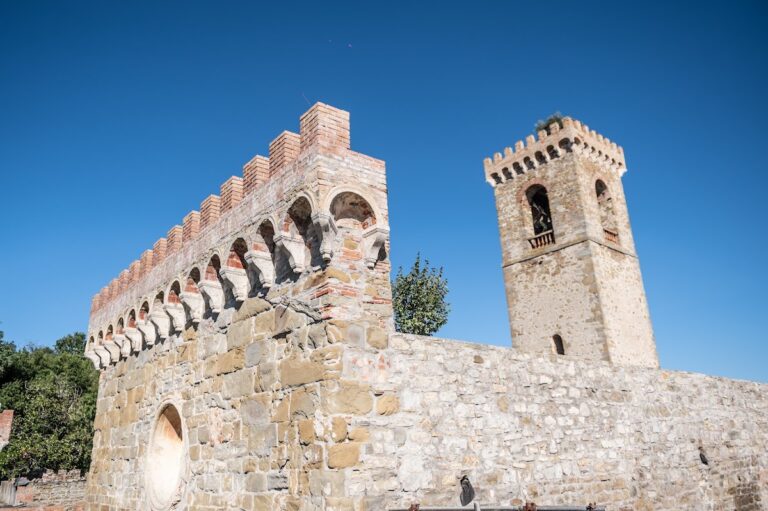
The visible eastern wing of the cloister on the left contains two former two-light windows that are now blocked. A pointed-arched doorway belongs to the Chapter House, preserving part of the relationship between the church and its adjoining convent.
Right-Hand Altars and Main Chapel
Radi Workshop Altars
The first right-hand altar displays the late Mannerist language of Mariotto Radi’s workshop. Its dedication presents Francis as “father” and Bonaventure as “guide.” The second altar, commissioned in 1643, carries Orazio Fidani’s 1645 depiction of the meeting of Joachim and Anne at the Golden Gate.
The third right-hand altar, attributable to the Radi workshop, is dedicated to the Virgin, Saint Christopher, and Saint Catherine. Andrea Commodi’s 1609 painting also includes Saint Louis the King and Saint Cecilia. Its naturalistic details include rocky ground and Saint Christopher’s large foot with dirty toenails. The fourth altar has an architectural design attributed to the same workshop. Cigoli’s 1597 painting of Saint Anthony of Padua and the miracle of the mule combines expressive emotion with naturalistic coloring influenced by Venetian and Correggesque models.
Venuti Altar
The altar commissioned by Margherita Venuti in 1625 repeats the composition of the first right-hand altar. Rustici’s painting, dated by an inscription, includes Margaret of Cortona, Nicholas of Bari, and Francis, reflecting the altar’s dedications and devotional associations.
Right Chapel and High Altar
The right chapel of the main chapel contains Ranieri Ubertini’s 1360 funerary monument by Angelo and Francesco di Pietro. Its 1657 altar has stylistic features associated with the Radi workshop, while Ferri’s altarpiece from the same year hangs on the left wall. In the presbytery, Bernardino Radi’s large, highly finished tabernacle dominates the high altar. Stairs behind it lead to the tenth-century Byzantine reliquary of the True Cross, made of ivory and silver and containing the cross fragment.
Left-Hand Altars and Devotional Works
Saint John Chapel
The left chapel of the main chapel contains the altar made between 1657 and 1659. The Saint John the Evangelist at Patmos has an uncertain attribution and chronology. It has been connected with a late-seventeenth-century Cortonese painter, with artists influenced by Filippo Berrettini, and with a later copy or derivation produced in the late eighteenth or early nineteenth century.
Baldacchini Altar
The Baldacchini altar contains a wooden crucifix probably made in the seventeenth century or shortly afterward. The figures of Margaret of Cortona and Joseph of Copertino were added in 1754 by the Cortonese woodcarver Francesco Fabbrucci. They are set within a curving frame decorated with scrolls and cherub heads.
Alfieri Altar
The altar opposite the Baldacchini altar is attributed to the Radi workshop and contains Pietro da Cortona’s Annunciation, painted in 1669. Its physical form belongs to the family altar renewed through Colonna Alfieri’s commission.
Zeffirini Altar
The Zeffirini altar is the most richly decorated altar front in the nave. Its ornament includes skulls, ribbons, cherub heads, and herms, or sculpted figures used as architectural supports. Above, a broken triangular pediment contains a small shrine with a curved pediment and a central painting.
At the center is a fourteenth-century fresco by Mino del Pellicciaio depicting the Coronation of the Virgin. Beneath it appears a female martyr, probably Lucy. The fresco remained visible before a separate altarpiece showing the Martyrdom of Saint Lucy was added in the eighteenth century. The latter work, once attributed to Giovanni Camillo Sagrestani, is now preferably attributed to Matteo Bonechi and dated 1730.
Tozzi Altar
The first altar on the left, built by the Tozzi family in 1671, contains Raffaello Vanni’s contemporary Adoration of the Shepherds.
Convent Relics and Crypt
The convent preserves the habit, embroidered cushion, and Gospel book associated with Francis of Assisi. The cushion, donated by Giacoma de Settesoli, is identified with the place where the dying saint rested his head. Beneath the church, the unused crypt contains the burial place of Luca Signorelli, linking the building’s surviving devotional spaces with the memory of one of Cortona’s major Renaissance painters.