Santa Maria del Monte Sanctuary: A Renaissance and Baroque Marian Church in Varese


Site at a Glance
- Rating
- 4.8
- Popularity
- Low
- Country
- Italy
- Primary era
- Early Modern
- External website
- Open
- Eras represented
- Classical, Medieval, Early Modern
- Civilizations
- Carolingian, Duchy of Milan, Holy Roman Empire, Roman, Spanish
- Site type
- Religious
- Remains
- Sanctuary
On this page16 sections
History
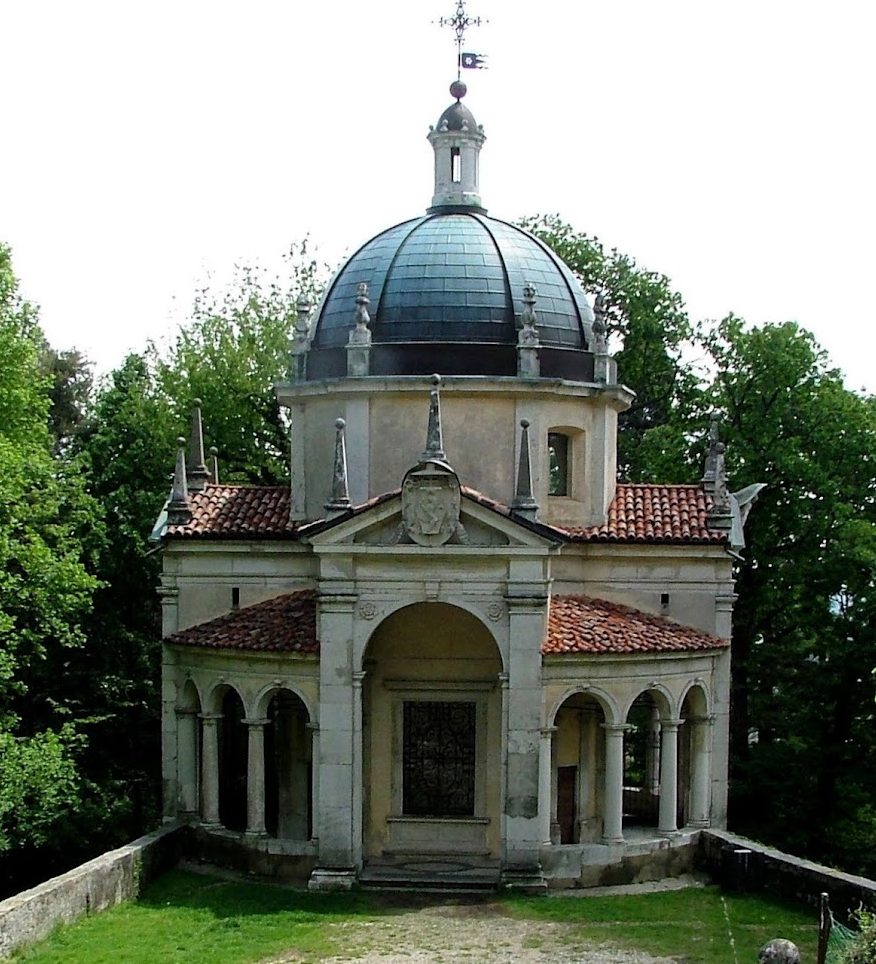
Santa Maria del Monte sanctuary is an ancient Marian sanctuary and parish church in Varese, Italy, rebuilt in Renaissance form in 1472 and later transformed in the Baroque period. It belongs to the Ambrosian Catholic rite and the Archdiocese of Milan. The church now forms the fifteenth chapel of the Sacro Monte of Varese, a devotional complex whose chapels, religious images, and pilgrimage route represent episodes from Christian sacred history.
Early churches and medieval development
Tradition, expressed in the sanctuary’s frescoes, attributes the construction of a modest fourth-century chapel to Saint Ambrose, the influential bishop of Milan. According to this tradition, Ambrose founded it as thanksgiving for victory over the Arians, Christians who rejected the later orthodox teaching that the Son was fully divine in the same sense as the Father. Excavations in 2013 revealed wall and pavement remains belonging to an earlier fifth-century church, providing physical evidence of an early Christian building at the site.
A church of the Carolingian-Ottonian period certainly stood here later. Its apsidal presbytery, the area around the main altar reserved for the clergy, survives as the present crypt beneath the sanctuary. During the Romanesque period, the church was enlarged westward and built above the earlier building, allowing the former presbytery to function as a crypt. The church is first mentioned in a document dated 8 June 922, preserved in the State Archive of Milan, under the name Santa Maria sopra Vellate.
A settlement gradually formed around the sanctuary. Houses accommodated priests and lay workers, while shelters served pilgrims. This growing religious community and pilgrimage function eventually contributed to the major rebuilding of the church in the fifteenth century.
Renaissance rebuilding and religious community
By the fifteenth century, the sanctuary had become too small for the pilgrims who came there. In 1472, Galeazzo Maria Sforza, Duke of Milan, initiated a rebuilding in Renaissance form, following a design by the architect Bartolomeo Gadio. The Sforzas were the ruling dynasty of the Duchy of Milan during the Renaissance. The new church had three naves and three apses arranged in a triconch plan, meaning that three rounded projections were organized around a central space. The central nave was later extended toward the entrance.
Religious life beside the sanctuary also changed during the second half of the fifteenth century. The blessed Caterina da Pallanza and Giuliana da Busto Arsizio withdrew to a nearby hermitage, a place for solitary or semi-solitary prayer. Their example attracted other young women. In 1474, Pope Sixtus IV authorized the community to establish a monastery, and on 10 August 1476 the women took the veil. They later became founders of the Order of the Ambrosian Romites, a Catholic female religious community associated with Milanese tradition and liturgy.
After the rebuilding, artists from the Milanese area were engaged to decorate the sanctuary and provide new liturgical furnishings. The Maestro di Trognano produced wooden panels for the high altar, while Andrea da Milano created the sculptural group of the Adoration of the Magi. Works and furnishings formerly associated with the sanctuary are also preserved in its museum, known as the Baroffio Museum.
Baroque transformation and Sacro Monte
The sanctuary acquired its present Baroque appearance during the seventeenth century. Between 1598 and 1600, the Varese architect Giuseppe Bernascone designed and built the exposed-stone and brick bell tower. Toward the end of the sixteenth century, the Ambrosian Romites also promoted several chapels dedicated to the Passion of Christ within the cloister precinct. Polychrome statues populated these chapels.
At the beginning of the seventeenth century, the wish to create an easier route from the Varese plain to the sanctuary led the Capuchin friar Giovanni Battista Aguggiari to seek the involvement of Milanese noble families and worshippers from surrounding communities. In 1604, the Fabbrica del Santissimo Rosario was established under Cardinal Federigo Borromeo and his delegate for the Sacro Monte, the archpriest Alessandro Mazenta. This administrative body supervised the construction and decoration of the chapels and sanctuary, and the works were completed in 1698.
The fifteenth-century reconstruction, its later Baroque transformation, and the associated Sacro Monte are included within the Sacri Monti of Piedmont and Lombardy, which were inscribed on the UNESCO World Heritage List in 2003.
Remains
Plan and earlier fabric
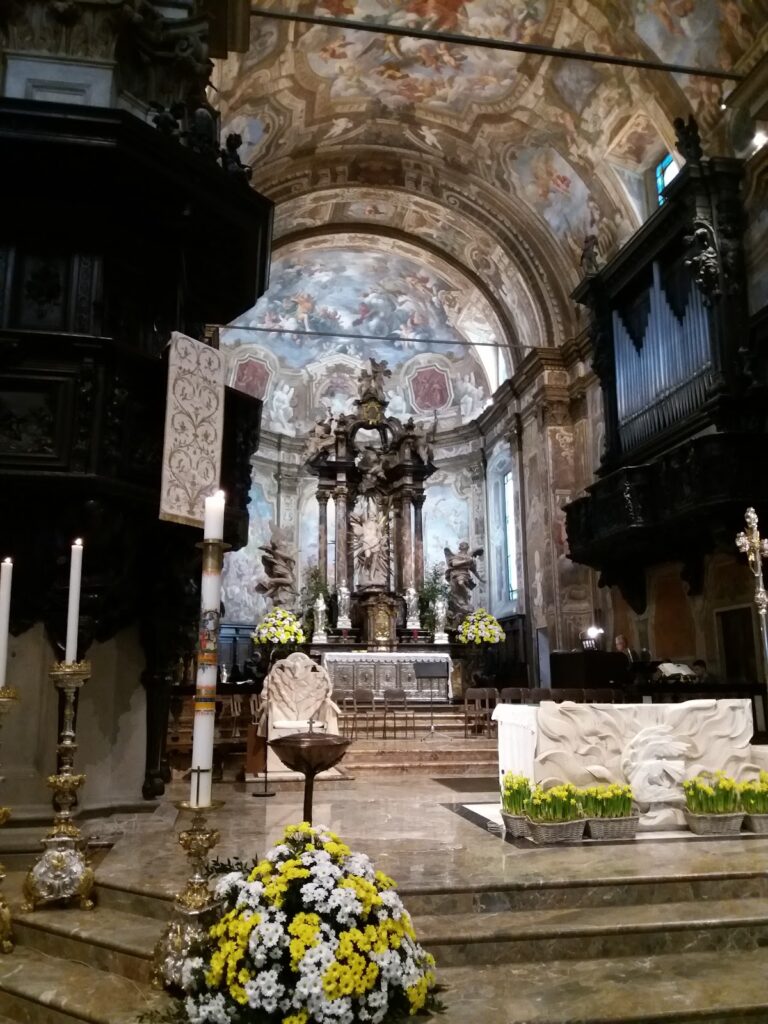
The sanctuary combines Romanesque, Renaissance, and Baroque elements. The Renaissance church has three naves and three apses in a triconch arrangement, with the central nave subsequently prolonged toward the entrance. The earlier apsidal presbytery lies below the church and forms the crypt. A stair descends to this lower level, where the Romanesque rebuilding incorporated the earlier church beneath it. Excavations carried out in 2013 exposed further wall and pavement remains in the crypt and in the passage below the altar.
Entrances, vaults, and painted decoration
Sforza Door
The Renaissance entrance portal is known as the Sforza Door and is reached from the apse side of the church. Its crowning tympanum bears the ducal emblem, a biscione quartered with an eagle, together with the abbreviated initials of Francesco II Sforza, Duke of Milan. The biscione is the serpent-like emblem traditionally linked with the Visconti and Sforza rulers of Milan.
Central nave
Halfway along the vault of the central nave, a late-fifteenth-century fresco by Vincenzo Civerchio of Crema depicts Christ Carrying the Cross among the Virgins. A grille allows the Ambrosian Romites to follow religious services. At the end of the seventeenth century, Salvatore Bianchi of Velate painted scenes from the life of Saint Ambrose on the nave walls. The vault contains medallions of Esther and Ahasuerus, Judith and Holofernes, and Jael and Sisera, accompanied by pairs of putti, decorative childlike figures often shown with wings.
Side naves and dome
The side naves contain frescoes by Giovanni Mauro della Rovere, known as Il Fiammenghino. They also house a wooden group representing the Presentation of Jesus at the Temple. The group is probably by the brothers Prestinari and is dated 1596 in the site inventory. The central dome is frescoed by Francesco Bianchi and Giuseppe Baroffio.
Altars and devotional images
High altar
The high altar represents the fifteenth mystery of the Rosary, the Coronation of the Virgin. Giuseppe Rusnati of Gallarate made its sculptures in 1662, with financing from Count Giacomo Simonetta. The decorated frontal panel of the altar, known as a paliotto, dates from 1894 and was made by Pogliaghi. The earlier high-altar furnishings included the wooden panels created by the Maestro di Trognano, while Andrea da Milano’s Adoration of the Magi remains in the sanctuary.
Madonna del Monte
The fourteenth-century statue of the Madonna del Monte is attributed to the Campionese school, a medieval sculptural tradition associated with artists from Campione and the wider Alpine-Lombard region. It shows Mary enthroned with the Child Jesus. Since at least the seventeenth century, the statue has customarily been covered by a valuable robe.
Chapel of Our Lady of Sorrows
The Baroque Chapel of Our Lady of Sorrows opens from the left nave. The Abbot Martignoni commissioned it in 1681. Its altarpiece, painted by Il Legnanino, depicts Christ blessed by the Virgin before Calvary.
Associated spaces
An oratory beside the sanctuary contains the remains of the blessed Giuliana and Caterina and is decorated with an extensive fresco cycle by Antonio Busca. A chapel dedicated to the two women is also associated with the sanctuary. The cloister precinct contains the chapels promoted by the Ambrosian Romites and populated with polychrome statues representing the Passion of Christ.
Bell tower and organ
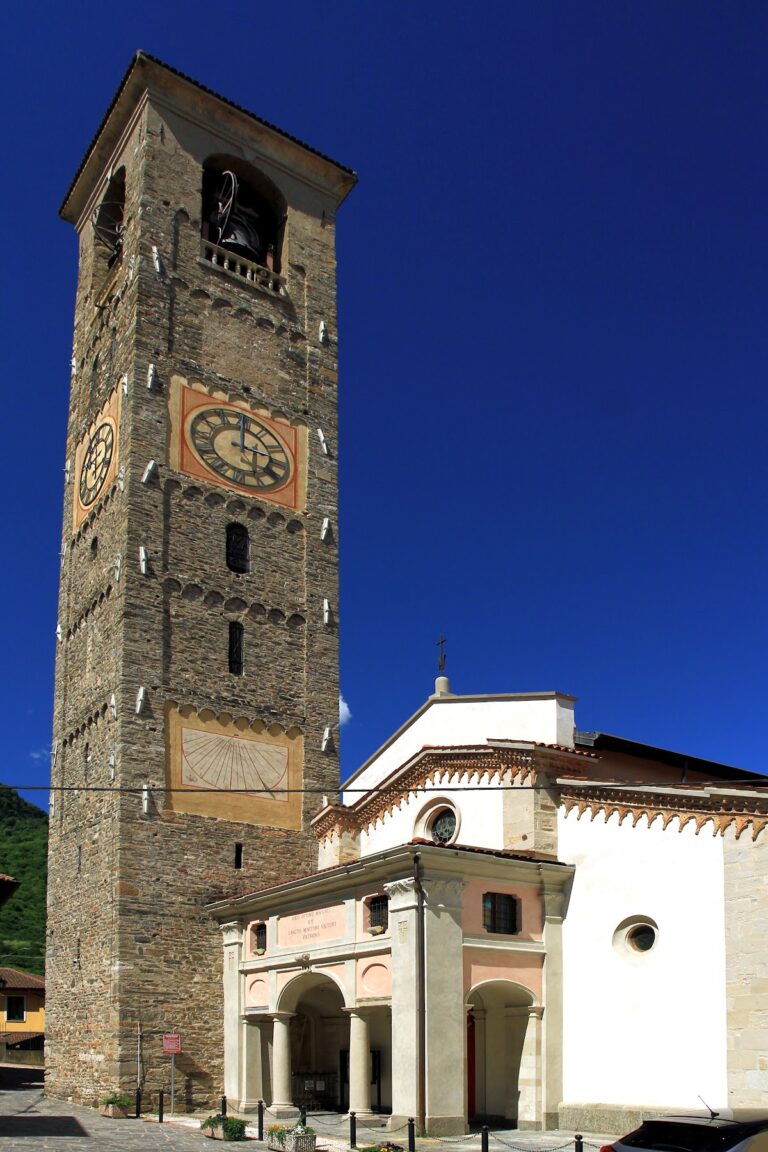
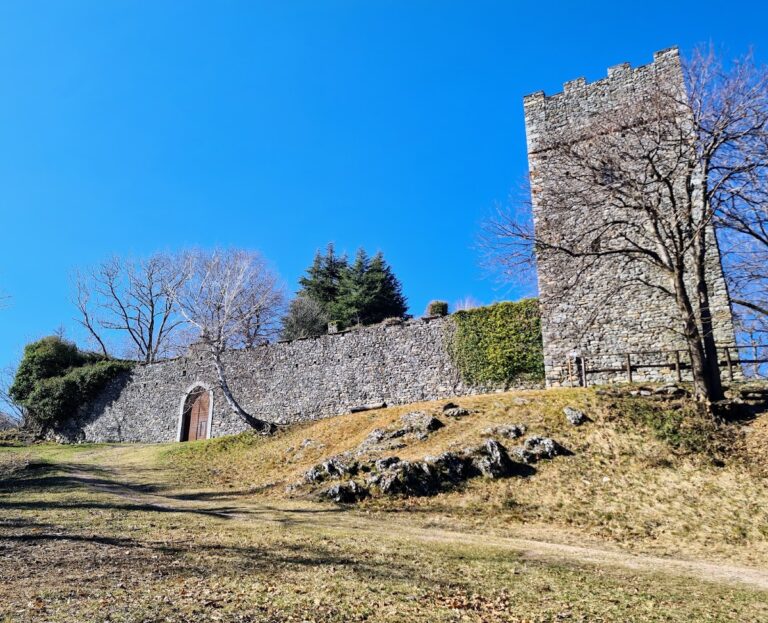
The bell tower, constructed between 1598 and 1600, is built of exposed stone and brick. Inside the sanctuary, a Neoclassical organ made by Luigi Maroni Biroldi dates from 1831. Pietro Talamona restored it in 1871, and Vincenzo Mascioni carried out a further restoration in 1989.