St.-Urban-Kirche: A Late Gothic Evangelical Lutheran Church in Ilsede


Site at a Glance
- Rating
- 4.7
- Popularity
- Very Low
- Country
- Germany
- Primary era
- Medieval
- External website
- Open
- Eras represented
- Medieval, Early Modern, Modern
- Civilizations
- Holy Roman Empire
- Site type
- Religious
- Remains
- Church
On this page16 sections
History
St.-Urban-Kirche is an Evangelical Lutheran church in Klein Ilsede, Germany, probably built in the fourteenth century in the late Gothic tradition. It is regarded as one of the oldest churches in the Peine church district and belongs to the Evangelical Lutheran State Church of Hanover. Before the Reformation, it served as a chapel for the Schwicheldt estate, whose lords held the church’s patronage rights, the historic rights to support the church and influence the appointment of clergy, by 1463.
Medieval Chapel and Schwicheldt Patronage
The church’s early history was closely connected with the Lords of Schwicheldt. Their patronage shaped the institution’s relationship with the estate and was later commemorated through furnishings, memorials, and the family burial place beneath the chancel extension. The medieval building formed the starting point for later alterations that changed both its appearance and internal arrangement.
Sixteenth-Century Extension
At the end of the sixteenth century, the church was enlarged with a polygonal half-timbered choir. This type of choir has several angled outer sides and a visible timber frame filled between the wooden members. The weather vane carries the Schwicheldt coat of arms and the date 1580, while a ceiling beam bears the date 1600, linking the extension and its associated work with the family’s continuing presence.
The extension also became the location of the hereditary burial crypt of the von Schwicheldt family. The crypt and the family’s memorial furnishings preserved the connection between the church, the estate, and successive generations of its patrons.
Nineteenth-Century Reordering
The church was renovated and partly renewed several times in later centuries. Galleries were added along the west and north sides in 1840. In 1877, the original Baroque pulpit altar was removed. Its pulpit basket was placed on the south side, and a new organ by Philipp Furtwängler & Sons was installed on the east wall.
The church’s medieval three-part winged altarpiece, a central panel with hinged side wings, had previously hung on the north wall of the choir as an epitaph, a commemorative monument for deceased people, within the patronal pew. After restoration in 1961, it was moved to its present position. Its central Crucifixion scene was recreated in 1839 by the Hanoverian painter Adolf Nieß from the original model, while the paintings on the wings retained their original condition and are attributed to the Flemish artist Marten de Vos, who lived from 1532 to 1603.
Restoration and Continuing Use
The altarpiece was restored again in 2005, and the interior underwent a complete renovation in 2009. In 2011, the straight gray concrete path around the church was replaced with a red-and-black paved baptism path. Its gently undulating course represents a river and lake before the church entrance and recalls baptism for those approaching the building.
The Schwicheldt hereditary burial crypt was severely damaged by vandalism in 1986, including damage to parts of its coffins. Archaeologists and anthropologists restored the crypt in 2015, reconstructed the damaged coffins, and identified the human remains. It was rededicated on 11 September 2016 during Open Monument Day. The church is listed in the Lower Saxony Monument Atlas.
Remains
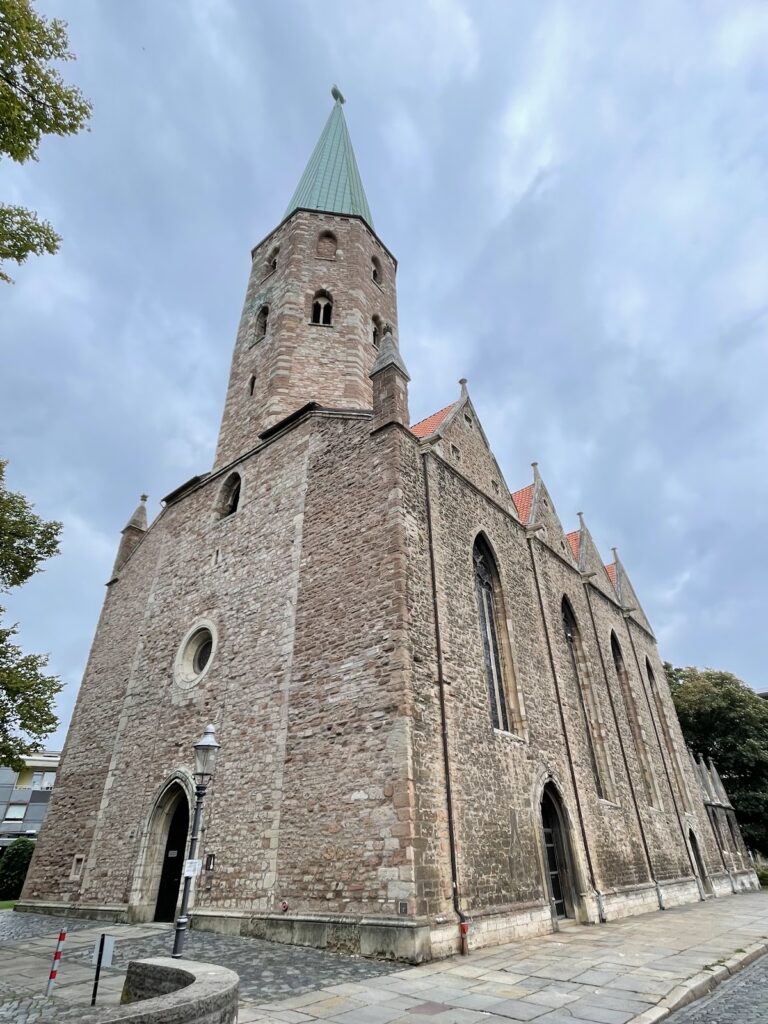
St.-Urban-Kirche survives as a late Gothic rubble-stone building with a polygonal half-timbered choir added at the end of the sixteenth century. The family crypt lies beneath this extension and reaches northward from it. Inside, the church preserves a group of historic furnishings that reflect its medieval foundation, its connection with the Schwicheldt family, and its Lutheran use in later centuries.
Choir and Burial Crypt
Half-Timbered Choir
The polygonal choir forms the later eastern extension of the rubble-stone church. Its timber frame and infill distinguish it from the medieval masonry and give the building a visible record of its sixteenth-century enlargement. The choir contains the chancel, the area around the main altar traditionally reserved for clergy, and stands above the Schwicheldt family crypt.
Schwicheldt Crypt
The crypt dates from 1600 and contains the coffins of members of the von Schwicheldt family. Older coffins were removed around 1760 when space became limited and were buried between the church and Im Schlage road. The oldest coffin now in the chamber belongs to Baron August Wilhelm von Schwicheldt, who lived from 1708 to 1766. The most recent burial is that of Imperial Count Curdt von Schwicheldt, who lived from 1839 to 1898. Following the 2015 restoration and the reconstruction of damaged coffins, the burial chamber was rededicated in 2016.
Altarpiece and Baptismal Furnishings
Winged Altarpiece
The wooden winged altarpiece began as an oak epitaph for two nobles of the Schwicheldt estate. Its central panel presents the Crucifixion, with Mary and John beneath the cross. The wings show the brothers Johann and Otto von Schwicheldt kneeling in full armor before Christ. Their helmets, gloves, and war hammers lie in front of them, while John the Baptist and Peter stand beside the brothers. John the Baptist was the New Testament preacher who baptized Jesus, and Peter was one of Jesus’s apostles and a central figure in early Christianity.
Johann and Otto both died at the age of 23, Johann in 1577 and Otto in 1578. The outer sides of the wings carry biblical quotations in three-dimensional painted letters, colored yellow against a blue ground. The left wing combines John the Baptist’s statement that Christ is the Lamb of God who bears the world’s sin with Johann’s memorial inscription from 1577. The central panel quotes 1 Peter 2:24, concerning Christ bearing human sins and healing through his wounds. The right wing carries Peter’s statement from Acts 10:43 about forgiveness through Christ together with Otto’s memorial inscription from 1578.
Additional painted texts refer to Job 19:25–27 and the living Redeemer, Psalm 68:21 and deliverance from death, 1 Corinthians 15:21–22 and resurrection through Christ, and John 6:40 and eternal life and resurrection on the last day. The Crucifixion panel made by Adolf Nieß in 1839 follows the original design, while the wing paintings attributed to Marten de Vos preserve their earlier appearance.
Baptismal Angel and Basin
A Baroque wooden baptismal angel stands in the chancel. Made in 1726, it is 1.00 metre high and 0.42 metre in diameter. The figure supports a wooden bowl on its head, with a metal baptismal basin fitted into it. G. Plünnecke and his wife donated the basin in 1869. Its outer rim carries the words from Mark 10:14, “Let the little children come to me, and do not hinder them.”
Organ and Bells
Furtwängler Organ
Philipp Furtwängler & Sons built the organ in 1877 in the Romantic style. Its original arrangement had six stops, controls for sets of organ pipes, on the manual keyboard and two on the pedal keyboard. The manual contained Bordun 16′, Principal 8′, Salicional 8′, Lieblich Gedackt 8′, Octave 4′, and Octave 2′. The pedal contained Subbass 16′ and Principal 8′, with the pedal stops transmitted from the manual.
In 1962, Hans Joachim Düngel extensively altered the organ to suit contemporary taste and expanded it to nine voices, reusing much of the older pipework. The revised manual included Gedackt 8′, Principal 4′, Flute 4′, Nasat 2 2/3′ in the treble, Octave 2′, and a newly made two- to three-rank Scharff. The pedal contained Subbass 16′, Octave 8′, and Pommer 4′. The Nasat and the pedal Octave and Pommer used older pipes supplemented in 1962, while the Scharff was newly made. After an intermediate restoration toward its earlier form, the organ again follows the 1877 specification, with a Mixtur stop added to the manual. Its keys and stops operate mechanically, and a pedal coupler allows the foot keyboard to operate selected manual stops.
Tower Bells
Two bells hang in the tower. The older is a 600-kilogram bell in the note G, cast in 1724 by Christian Ludewig Meyer of Braunschweig. It was recast from a predecessor made in 1580 after that bell cracked during the funeral ringing for Anna Jürges, née Hoyer, in 1722. The second bell weighs 350 kilograms, sounds in B, and was cast in 1972 by the Rincker brothers of Sinn in the Dillkreis.
A smaller bell is mounted outside the tower and strikes the clock. It measures 36 centimetres in diameter. Although it has no casting date, its decoration consists of two cord bands near the crown, a form no longer used from the fifteenth century onward, indicating a fourteenth-century origin. It originally hung in a roof turret or separate bell support.
Sacred Vessels and Crosses
The church retains a 1637 chalice and paten bearing the coats of arms of Caspar Jost von Schwicheldt and Margareta von Falckenbergk, as well as a chalice from 1700 and an eighteenth-century silver communion spoon. A chalice from about 1980, a tin ewer from 1701 donated by the miller Hinrich Müller, and a cast-iron altar crucifix with wooden cross and base made by C. Metzing in 1868 are also preserved. The sacristy contains a cast-iron standing crucifix dating from about 1840.