St. Margarethen (Tinz): A Medieval Evangelical Lutheran Church in Gera


Site at a Glance
- Rating
- 4.8
- Popularity
- Very Low
- Country
- Germany
- Primary era
- Medieval
- External website
- Open
- Eras represented
- Medieval
- Civilizations
- Holy Roman Empire
- Site type
- Religious
- Remains
- Church
On this page11 sections
History
St. Margarethen (Tinz) is an Evangelical Lutheran church in Gera, Germany, built around 1200 under the authority of the abbess of the Quedlinburg collegiate foundation. It is regarded as one of the oldest churches in the Gera area and preserves a medieval history shaped by pilgrimage, rebuilding, changing religious practice, and long-term restoration.
Medieval origins
The earliest surviving part of the church is the lower storey of its tower, a late-Romanesque structure dating from the thirteenth century. The church was associated with Saint Margaret, and until 1540 it possessed an indulgence connected with Saint Margaret’s Day on 13 July. An annual pilgrimage and market took place at Tinz, drawing people on foot from distant places who sought blessing and the intercession of Saint Margaret.
Tinz’s growing importance as a pilgrimage destination led to a major rebuilding around 1472. The original apse was replaced by an eastern Gothic choir containing several altars, and a nave was added west of the tower. Before the Reformation, the sixteenth-century religious transformation that reshaped western Christianity, the pastor of Tinz also served as castle chaplain at nearby Osterstein Castle.
Reformation and later alterations
The pre-Reformation church contained at least three altars, including the main altar and an altar dedicated to Saint Valentine of Terni, a Christian bishop and martyr. The Saint Valentine altar was dated 1513. The pilgrimage tradition and the multiple-altar arrangement belonged to the period before the Reformation.
During the seventeenth century, the tower received its octagonal bell-shaped dome and spire. The nave was demolished in 1838, after which the church’s ground plan remained unchanged. Only a small number of surviving views show the former nave west of the tower.
Closure and restoration
After the church closed in 1973, congregational life moved to an assembly room built in 1952 on the walled cemetery grounds opposite the west portal. The church interior was used for storage until the end of the 1980s.
Extensive repairs began in 1990 and halted the building’s further deterioration. Masonry was dried and drainage systems renewed in 1990, while the windows were restored and a new electrical system installed in 1995. Interior plaster and flooring were renewed in 1999, the slate roof and tower sheet-metal work were repaired that year, and the interior was repainted in 2000. Church benches were installed in 2002.
The church returned to religious use around the turn of the millennium, with its first service after more than 25 years held on 1 December 1999. A winged altar formerly associated with the church was returned from St. Nicholas Church in Roschütz in 2002. The Eifert organ was repaired, restored, and returned in 2005. Pew heating was installed progressively from 2008, the tower clock was repaired and modernized in 2009, and the tower received slate reroofing and facade restoration in 2017 and 2018. St. Margarethen belongs to the Gera-Langenberg parish office within the Gera church district of the Evangelical Church in Central Germany.
Remains
St. Margarethen stands at the southern edge of Tinz’s historic village center. Its surviving medieval layout combines the late-Romanesque lower storey of the tower with the eastern late-Gothic choir and the site of the former nave west of the tower. The choir, tower, bells, clock, altar, organ, and associated parish house preserve different phases of the church’s construction and use.
The choir and its windows
The present choir has a ground plan formed by five irregular wall sides, interpreted as a reference to the five wounds of Jesus. Five small, high-set windows are arranged in relation to the former sacristy entrance on the south side and the sacrament niche in the north-eastern wall. Their stained glass dates from the 1950s. From north to south, the windows depict the Last Supper, Baptism, Margaret of Antioch as the church’s patron saint, Saint George killing the dragon, and Saint Martin dividing his cloak.
The late-Gothic winged altar
The late-Gothic winged altar was made in 1497 by Matthias Plauener of Zeitz. It has two movable wings and two fixed wings. On its festive side, the central figure is the Virgin Mary as the Crescent Madonna with the Christ Child. Mary Magdalene, holding a container of ointment, and Anna Selbdritt, showing Saint Anne with Mary and the Christ Child, appear on the right. Saint Margaret with the dragon and Saint Barbara appear on the left. The right movable wing shows Bishops Wolfgang and Valentine of Terni, while the left movable wing shows Saints Andrew and Sebastian.
When the altar is closed, its painted scenes include Ottilia of Hohenburg and Saint Lucy of Syracuse on the reverse of the right wing. Saint Lucy is shown with a sword through her neck. The corresponding saint image on the reverse of the left wing has been lost. The fixed wings show Saint Lawrence on the right and John the Baptist on the left.
The carved crucifix
A carved crucifix dated 1505 is mounted five metres above the northern choir wall. It shows the crucified Jesus with overlapping legs pierced by three nails, a late-Gothic convention known as the three-nail type. The diagonally raised arms and the pain-marked face reinforce the image’s character as a carved work from around 1500.
The tower, bells, and clock
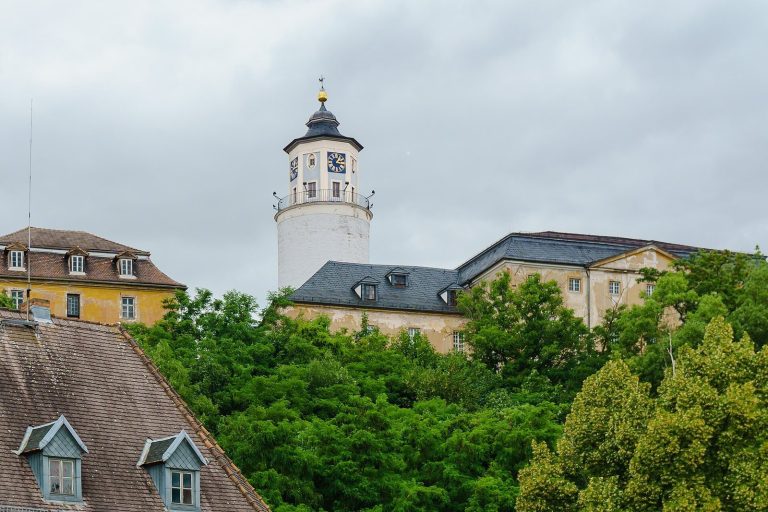
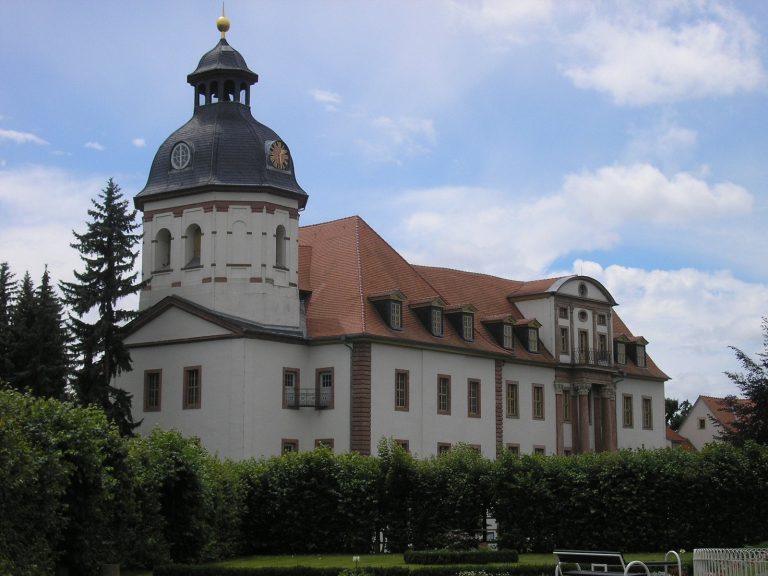
The 36-metre-high tower retains its late-Romanesque lower storey and its later octagonal dome and spire. Three steel bells were installed in 1963 after the bronze bells had been melted down for wartime purposes in 1941. Their inscriptions read “Persevere in prayer” on the large bell, “Patient in tribulation” on the middle bell, and “Rejoice in hope” on the small bell.
The bell-rope floor contains a clockwork mechanism with two striking trains. Princess Luise Christiane of Reuss-Gera originally donated the mechanism, which was repaired in 1930. Following the installation of electric weight drives and restoration of the wheel and hand mechanisms, a radio-controlled pendulum system has operated the three clock faces on the north, west, and south sides of the tower since 2009.
The Eifert organ
The mechanical organ was built in 1895 by Adolf Eifert of Stadtilm for the church at Schmirchau. When expanding uranium-ore mining around Ronneburg led to the demolition of the Schmirchau church, the organ was removed and transferred to Tinz in 1954.
In 1955, the Schmeißer organ-building firm of Rochlitz renewed the case, electrified the bellows, and tonally altered five stops. Moisture, woodworm damage, and the church’s limited use later led to its removal to St. John’s Church in Gera in 1978. Damage to its windchests made it unplayable there from 1984 until it was dismantled in 2005. After its return to the repaired church and comprehensive restoration, the organ was dedicated during a service on 28 August 2005.
The assembly and parish house
The assembly or parish house built in 1952 stands on the cemetery grounds opposite the church’s west portal. Its ceiling area contains 18 Christian symbols designed and executed by the Gera artist and restorer Kurt Thümmler. The window wall has stained glass depicting the four Evangelists, Matthew with a human figure, Luke with a bull, Mark with a lion, and John with an eagle. Beginning at the altar, the sequence relates these symbols to the Incarnation, Christ’s sacrificial death, the Resurrection, and the Ascension.