Church of Saints Peter and Paul in Byšičky: A Roman Catholic Filial Church


Site at a Glance
- Rating
- 4.7
- Popularity
- Low
- Country
- Czechia
- Primary era
- Medieval
- Eras represented
- Medieval, Early Modern, Modern
- Civilizations
- Habsburg, Holy Roman Empire, Kingdom of Bohemia
- Site type
- Religious
- Remains
- Church
On this page11 sections
History
The Church of Saints Peter and Paul in Byšičky, Czechia, is a Roman Catholic filial church belonging to the parish of Lázně Bělohrad. Its origins lie in a Romanesque chapel on the hill, first mentioned in writing in 1267, while the present building incorporates later Gothic, Baroque, and Classicist elements.
Medieval origins
Byšičky was first recorded as a settlement in 1318. During the Thirty Years’ War, the major European conflict fought from 1618 to 1648, the settlement disappeared, while the church survived as its only remaining part. The oldest portion of the building is the Romanesque apse, dating from the beginning of the thirteenth century. The nave and presbytery belong to the beginning of the following century.
Baroque and nineteenth-century changes
A major repair in 1718 altered the southern and western portals and windows in the Baroque style. A rectangular, two-storey tower was added to the western façade in 1850. From 1851 to 1880, Augustýn Hoření, described as the last of the Czech hermits, lived beside the church.
Conservation and continuing associations
A comprehensive reconstruction took place at the end of the twentieth century, along with repairs to the Stations of the Cross leading to the church. In 1988, sheet metal replaced the earlier slate roofing. Repairs in 2010 and 2011 installed drainage, sealed cracks inside and outside the building, and structurally secured the northern buttress. The church is protected as a cultural monument of the Czech Republic.
A cemetery lies beside the church and includes the graves of the composer Karel Moor, the writer Leontina Mašínová, and the actor Jiří Letenský. Byšičky are traditionally associated with Karel Jaromír Erben, a nineteenth-century Czech poet, folklorist, and collector of traditional ballads, and are said to have inspired his ballad The Wedding Shirts. Another hypothesis places the inspiration at the cemetery of the Church of Saint Mary Magdalene in Velhartice, in the Klatovy region. Popular pilgrimages take place at Byšičky each June.
Remains
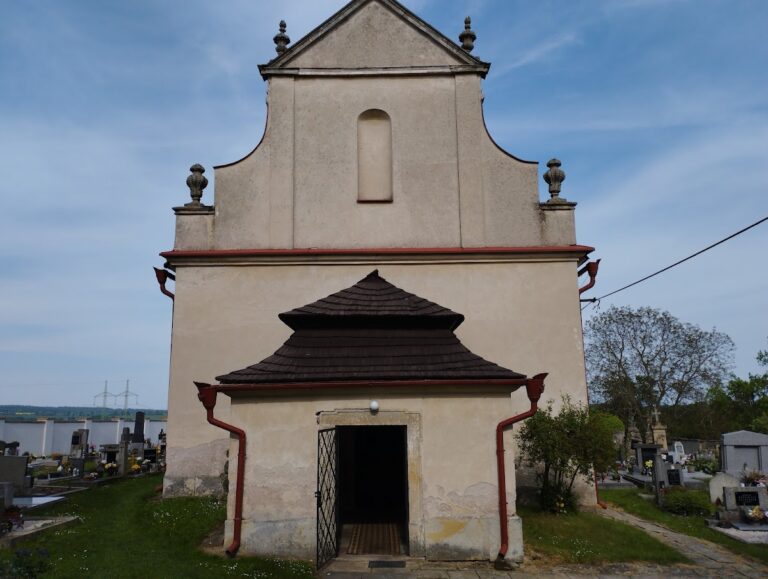
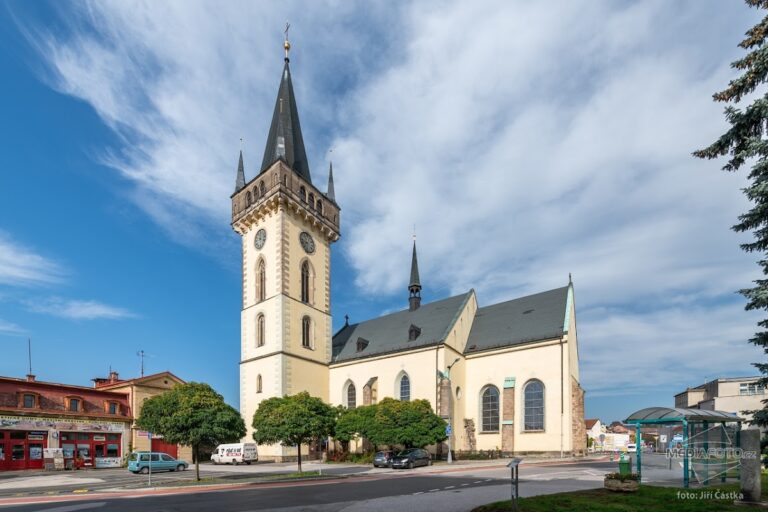
The church is an oriented, single-nave rough-stone building standing on a hill within the cemetery. Its main body has a gabled roof with a hipped section, while the western tower carries an eight-sided pyramidal roof covered with galvanized sheet metal. The exterior façades are smooth, with a socle and a crowning cornice providing their principal articulation.
Western tower and exterior
Tower
The two-storey tower adjoins the western end of the nave. Its Baroque treatment is expressed through cornices and pilaster-like frames containing recessed panels. Taller semicircular-headed and semicircular windows light the tower, and its roof rises in an eight-sided pyramid.
Nave and eastern end
The south wall contains five round-arched windows with wide surrounds. Beyond the nearly square nave, the narrower Gothic presbytery has a five-sided plan and two corner buttresses. A separately projecting, five-sided apse adjoins it on the east and has a rectangular window.
Interior spaces
Gothic nave
The Gothic nave measures 7.8 by 7.55 metres internally and is 5.15 metres high. Its ceiling is flat, and a pointed triumphal arch separates it from the presbytery. A choir loft occupies the western part of the nave and rests on two rectangular pillars.
Presbytery and Romanesque apse
The Gothic presbytery has a flat ceiling and measures 6.9 metres in width and 4.9 metres in depth. At its eastern end, an arch opens into the oldest part of the church, the Romanesque apse. This polygonal termination is covered by a semidome and completes the eastward orientation of the building.