Church of the Assumption of the Virgin Mary: A Baroque Church in Chotěborky, Czechia
Site at a Glance
- Rating
- 4.8
- Popularity
- Very Low
- Country
- Czechia
- Primary era
- Early Modern
- Eras represented
- Medieval, Early Modern
- Civilizations
- Holy Roman Empire, Kingdom of Bohemia
- Site type
- Religious
- Remains
- Church
On this page12 sections
History
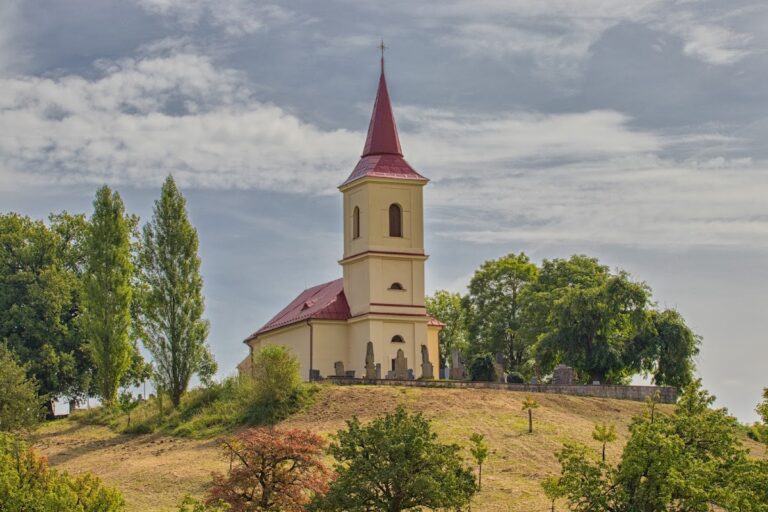
The Church of the Assumption of the Virgin Mary is a Roman Catholic filial church in Chotěborky, Czechia. Its present appearance derives mainly from an extensive Baroque rebuilding during the first half of the eighteenth century, while parts of the building preserve a Gothic church first recorded in 1348. The church was formerly the parish church of Chotěborky and now belongs to the parish of Dvůr Králové nad Labem in the Hradec Králové Diocese.
Medieval foundation
A wooden church once stood within a hillfort enclosure on the site before fire destroyed it. A Gothic replacement followed, and in 1348 Aleš of Rýzmburk and Vojek of Vřešťov founded a new altar and chaplaincy there. Their connection with the church is also preserved by the Rýzmburk coat of arms above the southern portal. The Rýzmburk and Vřešťov names belonged to medieval noble lineages associated with the church’s foundation.
Conflict and Baroque rebuilding
The church was looted during the Hussite Wars, fifteenth-century religious and political conflicts in Bohemia that brought attacks on many Catholic churches and religious institutions. It was repaired afterward. During the first half of the eighteenth century, a major reconstruction in the Baroque style gave the building its overall form, with more elaborate architectural treatment and a richly furnished interior.
Parish history and protection
Chotěborky later ceased to be an independent parish, and from mid-2006 the church became part of the parish of Dvůr Králové nad Labem, within the Trutnov Vicariate and the Czech ecclesiastical province. The church is protected as a cultural monument of the Czech Republic. Its history also includes the loss of bells from the adjoining tower during requisitions in both World Wars.
Remains
Main church
Exterior and medieval fabric
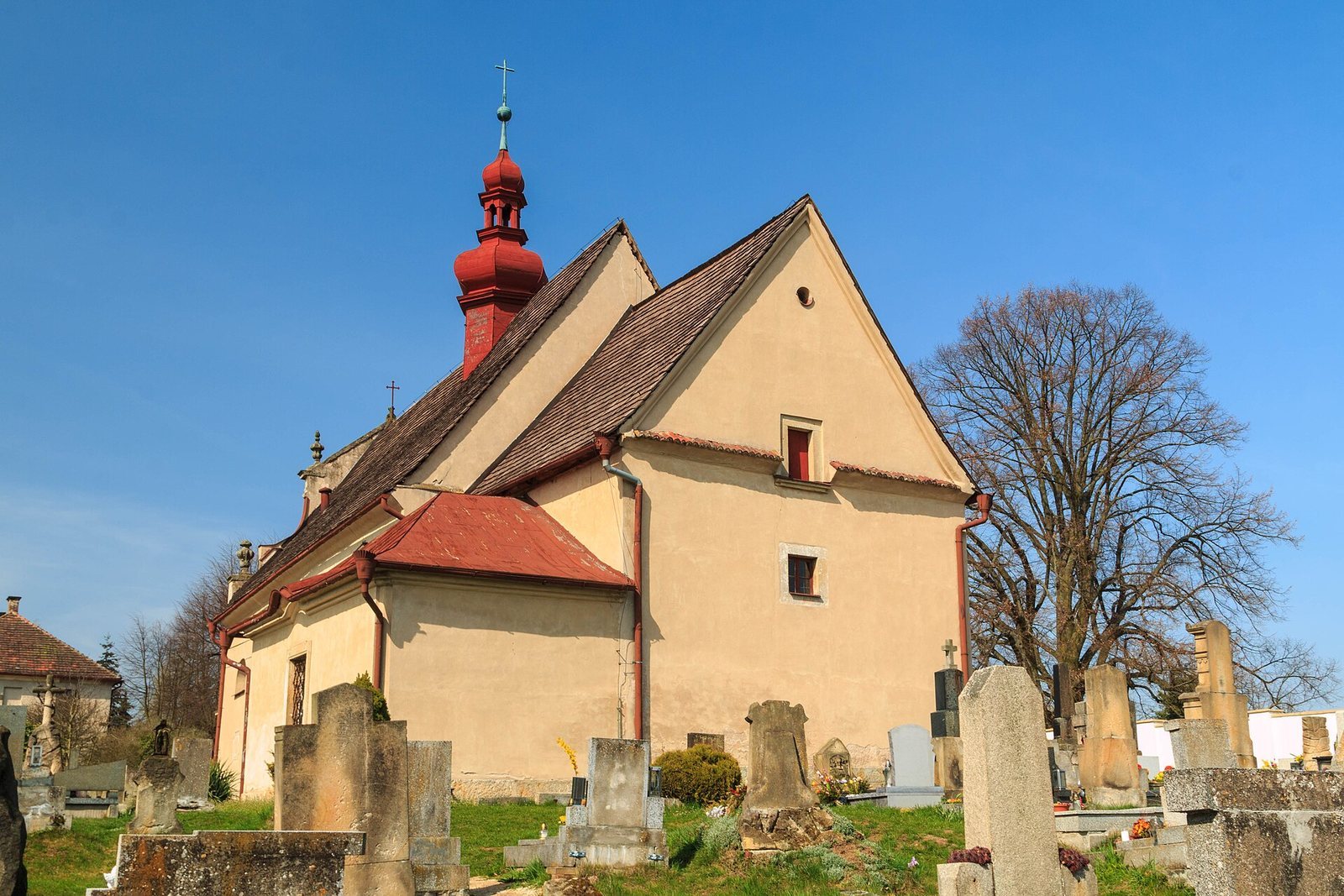
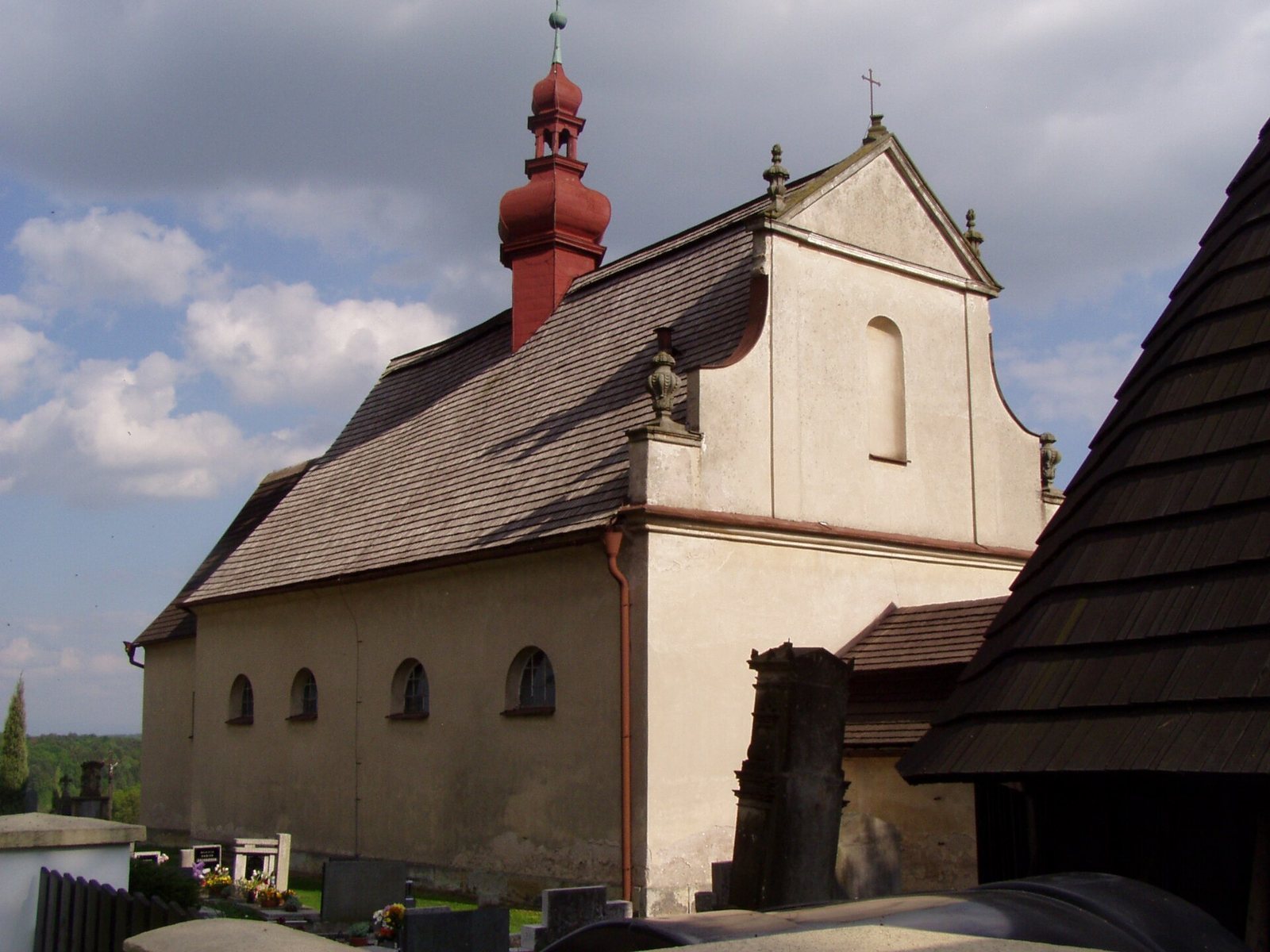
The church is an oriented single-nave building with a chancel set slightly south of the nave axis, a sacristy on the south side, and a vestibule before the western facade. A stone plinth supports walls pierced by lunette windows with flat surrounds. The building is covered by a slate hipped roof, above which rises a central sanctus turret with an onion-shaped roof, lantern, and cupola. Its shingle covering was renewed in 2000.
A pointed stone Gothic portal opens on the south side of the nave. Its jambs retain three rounded mouldings from the first half of the fourteenth century, preserving part of the church’s original medieval architecture. Above the portal is the coat of arms of Aleš of Rýzmburk and the Rýzmburk lineage, showing a gold stirrup on a blue shield, blue-and-gold mantling, and a peacock-feather crest with another gold stirrup.
Interior furnishings
The choir loft rests on two Tuscan columns, one of which is anchored on the 1559 tombstone of Václav Kordule and his three wives. The pulpit dates from 1880 and carries an image of Saint John the Baptist, the biblical preacher who baptized Jesus. The main altar has its present columned, three-winged form from 1876, while its painting of the Assumption of the Virgin Mary dates from around 1700 and was repaired in 1876.
Polychromed wooden statues of Saint Roch and Saint John the Baptist, both from the mid-eighteenth century, stand on the chancel walls. Saint Roch is traditionally associated with protection against plague. The stone baptismal font has a wooden cover bearing a sculptural group of the Baptism of Christ dated 1700. A side altar dedicated to Saint Joseph was installed in 1876, and the furnishings also include paintings of Saint Joseph and Saint Anne, a series of the Stations of the Cross, and a statue of Our Lady of Lourdes donated by Antonín Prokeš in 1900.
Baroque pews from the first half of the eighteenth century remain in the church. The building also owns a painting of Saint John of Nepomuk by Petr Brandl, a prominent Bohemian Baroque painter. Saint John of Nepomuk was a Bohemian martyr and became one of the most prominent saints of the Czech lands.
Timber bell tower
A separate late-Gothic timber bell tower stands beside the church. Dating from the end of the sixteenth century, it has an octagonal lower section, a tall pyramidal roof covered with shingles, and opening shutters over the belfry windows. Its frame uses four corner load-bearing posts that converge upward, a construction described as unique among Bohemian bell towers and as one of the most valuable examples in Bohemia. Bells dated 1548, 1555, and 1618 were removed during wartime requisitions. The tower now contains a larger bell from 1576 and a death knell from 1928.
Cemetery and village green
Cemetery portal and memorials
A Baroque stone portal from around 1740 is set into the cemetery wall. Made in the workshop of the Pacák brothers, Baroque sculptors whose workshop produced works for the Špork family, it carries a relief of the Assumption of the Virgin Mary. Eleven tombstones are embedded in the same wall, most displaying the coats of arms of the former owners of Vřešťov Castle and the Kordules of Sloupno. The oldest dates from 1546. These memorials were moved from the church interior during later building alterations; members of the Kordule family were buried at the site.
Column of Saint John of Nepomuk
On the village green in front of the church stands a Baroque stone column of Saint John of Nepomuk from around 1730. It is attributed either to Matthias Bernard Braun, a leading sculptor of the Bohemian Baroque, or to the Pacák brothers’ workshop, which worked for the Špork noble family. The column has been protected as an immovable cultural monument since 1958.