Saint Francis of Assisi Church in Jutrzyna: Parish Church and Diocesan Sanctuary


Site at a Glance
- Rating
- 4.9
- Popularity
- Very Low
- Country
- Poland
- Primary era
- Medieval
- External website
- Open
- Eras represented
- Medieval, Early Modern, Modern
- Civilizations
- Habsburg, Holy Roman Empire
- Site type
- Religious
- Remains
- Church
On this page12 sections
History
Saint Francis of Assisi Church in Jutrzyna, Poland, is a Roman Catholic parish church established, built, and dedicated during the last quarter of the thirteenth century, probably around 1273. Its original early Gothic form belongs to the medieval architecture of Silesia, while its later interior reflects the Baroque style. The earliest documents concerning the church date from 1335.
Templar and Hospitaller ownership
The church and the village initially belonged to the Knights Templar, a medieval military-religious order. After the suppression of the Templars, the property passed to the Knights Hospitaller, another military order that inherited former Templar possessions. This ownership continued until the secularization of religious orders.
Eighteenth-century enlargement
The church was extensively enlarged in the eighteenth century. Its original eastern presbytery, the part of a church surrounding the main altar, was demolished and replaced by the present main nave. The building was restored around 1800, and its later appearance brought together the surviving early Gothic structure and elaborate Baroque furnishings.
War damage and later development
In 1945, during the Second World War, Soviet artillery fire seriously damaged the Gothic tower and its clock. Soviet soldiers who were killed during the attack were buried in front of the main gate. Their remains were later exhumed and transferred to the Soviet Army Soldiers’ Cemetery in Wiązów.
A bell tower was erected within the church precinct in 1958. Three bells, named Maria, Stanisław, and Franciszek, were installed in it. Since 2 October 2016, following a decree issued by Wrocław Metropolitan Józef Kupny on 10 June of that year, the church has also served as the Diocesan Sanctuary of Saint Francis of Assisi. Its liturgical feast is celebrated on 4 October.
The sanctuary contains first-class relics, meaning bodily parts, of Saint Francis of Assisi and Saint Hedwig of Silesia. It also preserves a second-class relic of Saint Maximilian Maria Kolbe, a beard hair, together with first-class relics of the Polish Franciscan martyrs Blessed Michał Tomaszek and Blessed Zbigniew Strzałkowski. Since 2008, the church has appeared in guidebooks that include the works of Felix Anton Scheffler, an eighteenth-century painter associated with the Silesian Baroque. Its architecture and artistic furnishings make it an important element of the region’s cultural landscape.
Remains
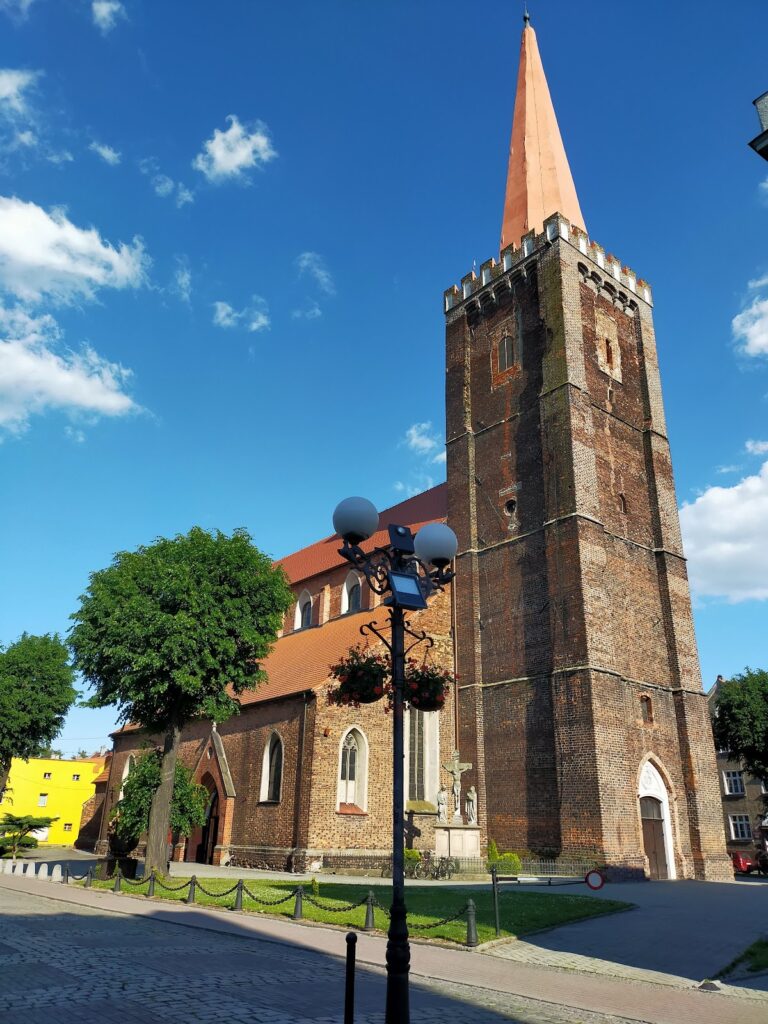
The present church is a single-nave brick and rubble-stone building that combines an early Gothic architectural form with Baroque furnishings. It is approximately 32 metres high and includes one 32-metre tower and one dome. The building is designed for 646 worshippers. Inside, the nave is covered by a barrel vault with lunettes, curved spaces formed where a vault intersects an opening or another vault. The two-bay presbytery has a cross-ribbed vault supported by intersecting masonry ribs. The church belongs to the group of single-nave early Gothic buildings in Silesia.
Main altar
The main altar is a one-storey, three-axis architectural retable, the sculptural and architectural structure behind an altar, set on a high plinth broken twice in profile. Arched gates occupy its sides and are surmounted by figures of saints. The central section contains a marbled rectangular mensa, or altar table, whose front panel, called an antependium, is decorated with gilded dry-acanthus foliage and a round plaque bearing the Christian monogram “IHS”.
The altar has strongly stylized turquoise-green marbling with gold veining. Its column and pilaster shafts use more naturalistic light-pink marbling with brown elements. The figures are uniformly gilded, apart from the silver attribute held by Saint Hedwig. Above the side gates stand Saint Joseph with the Christ Child and Saint John of Nepomuk. Saint Peter and Saint Paul occupy the central section, while naked putti sit along the crowning cornice. Saint Elizabeth of Thuringia and Saint Hedwig, holding a model of a church, stand beside the inner volutes. The crowning includes a half-length Saint Aloysius Gonzaga holding a crucifix, with a skull beside him as one of his attributes.
Felix Anton Scheffler painted the principal altar picture. It represents the Assumption and Coronation of the Virgin Mary by the Holy Trinity. Mary rises on a cloud in a wide white dress, a red long-sleeved undergarment, and a long blue mantle. A luminous halo is held before her chest, and her right foot rests on a crescent moon.
Christ sits to Mary’s right, displaying the spear wound in his chest and the stigmata on his hands as he places a starry crown on her head. To her left, God the Father appears as an aged man seated on a terrestrial globe and grasping a ray from the Holy Spirit, shown as a dove. Saint Francis occupies the lower right of the composition, looking upward with raised hands. He wears a brown hooded habit and cord with a rosary, while the stigmata mark his hands and a wound is visible through an opening in his right chest. A skull lies at his feet. Eight putti participate in the scene, including one holding a breviary with red pages and a crucifix. A large column on a high plinth behind Saint Francis suggests that the scene takes place on church steps.
Side altars
Right side altar
The right side altar stands in the northern part of the nave and probably dates from the end of the seventeenth century. An inscription on its rear boards records its erection on 21 April 1696 and shows that it was originally dedicated to the Holy Family. Its niche now contains an 1829 Pietà, a representation of the Virgin Mary mourning over the dead Christ.
An oil painting of the Crucified Savior hangs above the altar. Its background contains a cityscape with features characteristic of Silesia. A figure of the Savior holding an attribute in his right hand stands at the top of the altar.
Left side altar
The left side altar is formed from separately defined, flat scrolls of small clouds. Its central field is vertically rectangular with a rounded top and contains a full-length sculpture of the Immaculate Virgin standing on a terrestrial globe. A crown within a foliate frame surmounts the field. Small winged putti and heads surround it, while two upper angels hold Mary’s attributes, a scepter and a wand. The crowning contains a glory of long rays.
Pulpit and devotional furnishings
Pulpit
The pulpit forms a unified ensemble with the rest of the interior. Its construction, colors, and ornament place it within the Late Baroque. Dry acanthus ornament and a lambrequin, a hanging valance-like motif, decorate the structure. Its imagery refers to the Evangelists, includes a dove in a radiant glory symbolizing the grace of the Holy Spirit, and features the Tablets of the Ten Commandments. Numerous elements are gilded or silvered.
Stations of the Cross
The Stations of the Cross were produced by local workshops in the Classicist style at the end of the eighteenth century. They form part of the church’s later devotional furnishings. Prewar photographs show that the church once contained four altars.