Heiligengeistkirche in Kiel: Franciscan Monastery Church and University Church


Site at a Glance
- Rating
- 4.4
- Popularity
- Very Low
- Country
- Germany
- Primary era
- Medieval
- External website
- Open
- Eras represented
- Medieval, Modern
- Civilizations
- German, Holy Roman Empire
- Site type
- Religious
- Remains
- Church
On this page13 sections
History
Heiligengeistkirche, also called Heiliggeistkirche and Klosterkirche, was a Franciscan monastery church in Kiel, Germany, built in 1246. It stood between Falckstraße and Klosterkirchhof at the Alter Markt and, alongside St. Nikolai, was one of the two churches in the medieval city. The Franciscans were a mendicant religious order founded by Francis of Assisi, whose communities depended on shared religious life and voluntary support rather than extensive landed wealth.
Foundation and Franciscan beginnings
Count Adolf IV of Schauenburg founded Kiel in 1227 and established a Franciscan monastery there. After taking part in the foundation, he entered the monastery as a monk and remained there until his death in 1261. His tombstone, carrying a Gothic inscription, survives in the monastery cloister.
The church served the Franciscan community and the medieval town for centuries. Its small size reflected its origins as the church of a mendicant order. Burial chapels were added outside the church from the sixteenth century, and local residents continued to use them and the church as a burial place until the eighteenth century.
Reformation and hospital use
The monastery was dissolved on 13 October 1530 during the Reformation, the sixteenth-century movement that challenged established Western Christianity and led to the closure of monasteries in many regions. The former monastery buildings first housed a Latin school. In 1546, the Heiligengeist Hospital, an institution for poor and sick people, moved into the abandoned monastery.
From 1562 the church was known by the names Heiligengeistkirche and Heiliggeistkirche. It became a place of worship for the hospital’s residents, while the church and its burial chapels retained their role as a place of burial for people from Kiel.
University and preaching
After the Christian-Albrechts University of Kiel was founded in 1665, the former monastery church became the university church. A university church supported academic worship and preaching, including the practical training of theology students. The city council retained exclusive authority to appoint the church’s preachers, although theology professors regularly preached there.
The Pietist Paul Sperling and Joachim Justus Breithaupt held homiletic exercises in the church. Pietism was a Protestant reform movement that stressed personal devotion, practical Christianity, and spiritually focused preaching. From 1775, theology students attending the homiletic seminar of the Enlightenment professor Johann Andreas Cramer preached there. Homiletics, the study and practice of preaching, trained students in composing and delivering sermons. Karl Peter Matthias Lüdemann, who held the post until 1868, was the last university preacher.
The church received its own pastor in 1632. Its preachers were appointed by the city council and often also worked as deacons or adjuncts at St. Nikolai, or as garrison preachers for the dukes of Holstein-Gottorf. The recorded sequence included Janus, also Johannes, Vicostadius of Wernigerode from 1632 to 1651; Bartholdus Brammer from 1652 to 1655; Henricus Störning from 1655 to 1669; Troels Arnkiel from 1670 to 1672; Martinus Bützer from 1674; Matthias Bützer from 1724 to 1749; Marcus Hinrich Becker from 1750 to 1782; Peter Christian Weller around 1790 to around 1797; Johannes Köster from 1797 to 1809; Carl Blech from 1809 to 1826; Jürgen Bookmeyer from 1827 to 1834; Karl Peter Matthias Lüdemann from 1834 to 1868; and Heinrich Mau from 1908 to 1916.
Decline, rebuilding, and military connections
The university left the long-neglected monastery buildings in 1766. Parts had already been quarried for a new university building, and the remaining structures then decayed. In 1881, the ruins were demolished apart from the cloister wing. The resulting gap toward the Kleiner Kiel was named Falckstraße after Niels Nikolaus Falck.
Kiel’s transformation into a naval centre changed the church’s responsibilities. After Holstein was conquered in the German-Danish War, the Prussian king designated Kiel as a naval city on 24 March 1865. Kiel became a port of the North German Confederation in 1867 and an imperial naval war port in 1871. The Heiligengeistkirche then served naval personnel in the city. The garrison grew from about 500 naval personnel and marines to approximately 2,800 naval and 750 army soldiers within a few years.
Because the church was too small for naval services, worship was held in the drill shed of the Feldstraße barracks. Naval pastor Büttner pressed for a new church, and the Pauluskirche on Niemannsweg was built between 1878 and 1882. Meanwhile, the Heiligengeistkirche was restored and remodelled in the neo-Gothic style between 1881 and 1891. Neo-Gothic architecture revived medieval Gothic forms. The attached burial chapels were demolished, and the church became the parish church for Kiel’s northern districts.
A further rebuilding in 1903 and 1904 gave the church its first tower. The independent Heiligengeist parish expanded northward into Düsternbrook. After the First World War, the reduction of the naval forces made the Petruskirche in Kiel-Wik sufficient as the Protestant garrison church.
Separation, wartime destruction, and survival
On 29 November 1925, the Heiligengeist parish formally took possession of the Pauluskirche in a festive service. Parish services and other church events subsequently took place there, while the Heiligengeistkirche was reserved for university services. A new bell was installed in 1928.
Ernst Barlach’s bronze figure Geistkämpfer was placed in front of the church on 29 November 1928. Barlach was a German sculptor, printmaker, and writer whose work was persecuted by the National Socialist regime as “degenerate art.” National Socialist circles criticized the figure from the beginning. It was removed on 20 April 1937 and taken to a museum. Although it was intended for melting down in 1939, Barlach’s friends saved it. Since 1954, the sculpture has stood in front of St. Nikolai.
On 13 December 1943, high-explosive bombs largely destroyed the church during the Second World War. The remaining ruins were removed in 1947, apart from the tower. Archaeological excavations in 1984 revealed numerous medieval crypts within the former church foundations, some with painted decoration. During the restoration of the garden in 2001, the church’s altar slab was found. The foundations were made visible again, preserving the archaeological outline of the former church and its relationship to the surviving cloister.
Remains
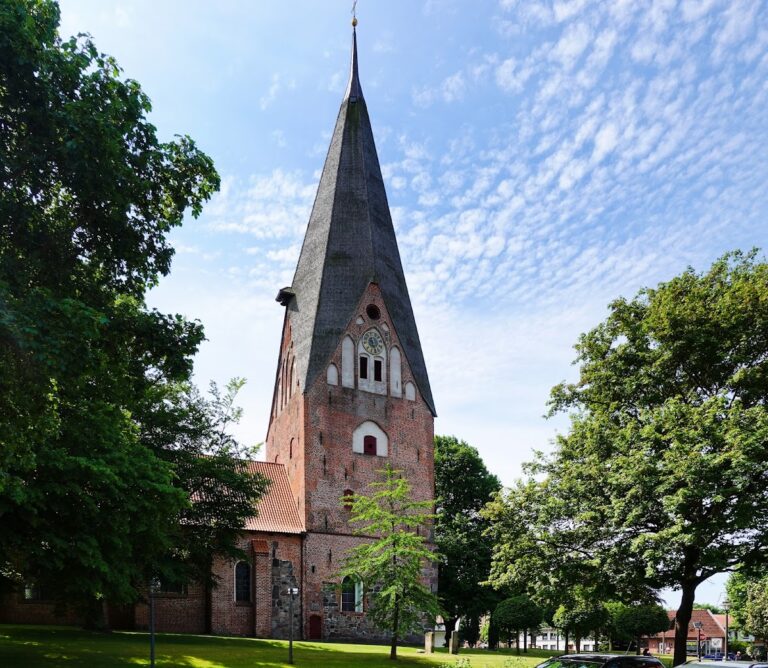
The surviving site combines the former church foundations with part of the monastery cloister and a simplified reconstruction of the tower. The church itself was a small, nearly square building about 30 metres long, with three aisles and a small polygonal choir, meaning an altar-end formed by several angled sides. As a mendicant church, it had a roof turret, a small tower-like structure rising from the roof to hold a bell, before the full tower was added in 1903 and 1904.
Church foundations and burial remains
Former church foundations
The foundations of the church remain archaeologically visible. They preserve the plan of the three-aisled building and its polygonal choir, while the recovered altar slab is secured beneath a crucifix in the cloister. The foundations also contain numerous medieval crypts, chambers used for burials beneath or within a church. Some of these crypts retain painted decoration, providing physical evidence of the church’s medieval burial history.
Cemetery grave slabs
Fragments of grave slabs from the church cemetery are mounted on an exterior wall. Together with the crypts and the altar slab, they connect the visible remains with the church’s long use as a place of worship and burial.
Monastery cloister and tower
Surviving cloister
The surviving cloister wing preserves the tombstone of Adolf IV of Schauenburg. Its Gothic inscription identifies the founder of Kiel and the monk who lived in the monastery until his death in 1261. The cloister also holds the recovered altar slab beneath a crucifix, bringing together material remains from the former church and the monastery.
Klosterturm
The remaining tower was retained after the church ruins were removed in 1947. It now forms part of a simplified, reconstructed structure known as the Kiel Monastery’s Klosterturm. The church’s bell from 1928 hangs in its carillon, a musical instrument consisting of tuned bells played from a keyboard. The tower and bell preserve a physical link with the church’s final pre-war period.
Nearby sites