Saint Lawrence Church in Lohja: A Medieval Gothic Parish Church in Finland


Site at a Glance
- Rating
- 4.6
- Popularity
- Low
- Country
- Finland
- Primary era
- Medieval
- External website
- Open
- Eras represented
- Medieval, Early Modern, Modern
- Civilizations
- Swedish
- Site type
- Religious
- Remains
- Church
On this page10 sections
History
Medieval origins
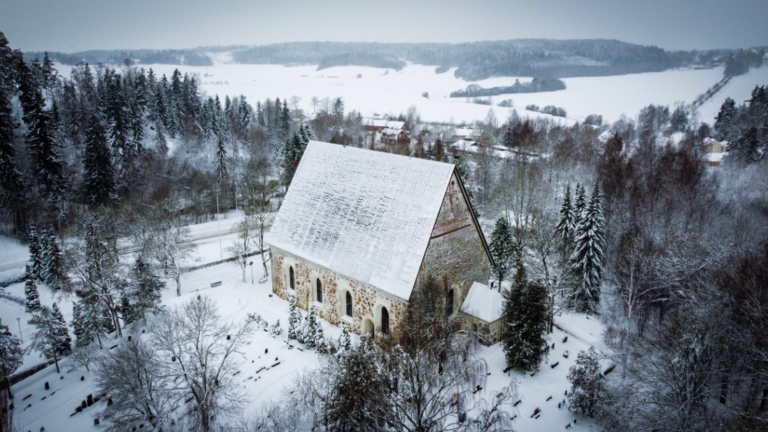
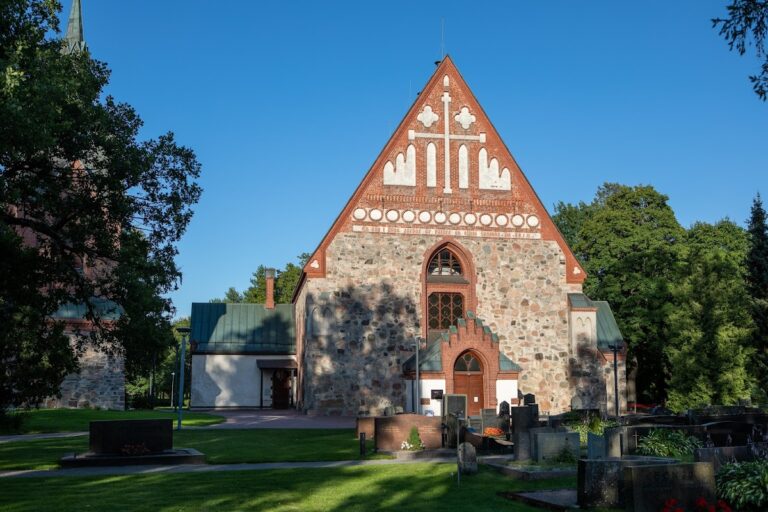
Saint Lawrence Church in Lohja, Finland, is a late-medieval Gothic stone church built around 1470–1490. Dendrochronological research carried out in 2003 supports this dating. The earliest written reference to a church in Lohja dates to 1382, while the present building developed in stages. The sacristy may have been the earliest stone part, originally attached to a wooden church before the three-aisled stone hall was constructed later in the fifteenth century.
Before the Protestant Reformation and the introduction of Lutheran worship in Finland, the church belonged to the Roman Catholic Church. It is dedicated to Saint Lawrence of Rome, a third-century Christian deacon traditionally associated with martyrdom under the Roman Empire. The church is now Evangelical Lutheran and belongs to Lohja parish in the Diocese of Espoo.
Reformation and later changes
The church’s extensive medieval murals make it one of Finland’s principal “picture-book” churches, alongside the Church of the Holy Cross in Hattula. Their images presented human figures and biblical events in a direct, rustic style intended to communicate Christian stories to people who could not read. The church is also described as Finland’s third-largest surviving medieval parish church.
During the early nineteenth century, the windows were enlarged and the interior paintings were covered with whitewash. The coating was removed and the murals repaired in the 1880s. Work directed by Emil Nervander strengthened the old paintings with bright colors, while Oskari Niemi restored their original colors in the 1950s. Many religious objects were probably lost during the early nineteenth-century cleaning campaigns.
Parish complex and furnishings
Since 2009, the church and its surrounding buildings have formed part of Finland’s inventory of nationally significant built cultural environments. The associated complex includes a parish house from the 1950s and a rectory whose main building dates from the late eighteenth century. The rectory now houses the Lohja Museum.
The medieval altar was replaced in 1662. A retable painted by Margareta Capsia was donated by Gregorius Arctopolitanus in 1738, and the present altar was designed by Pirkko Stenros in 1987. Jean Wik designed the pulpit in 1845. The organ was built by Veikko Virtanen in 1985–1986, with its architectural design and organ gallery created by Ola Laiho.
Remains
Church layout and construction
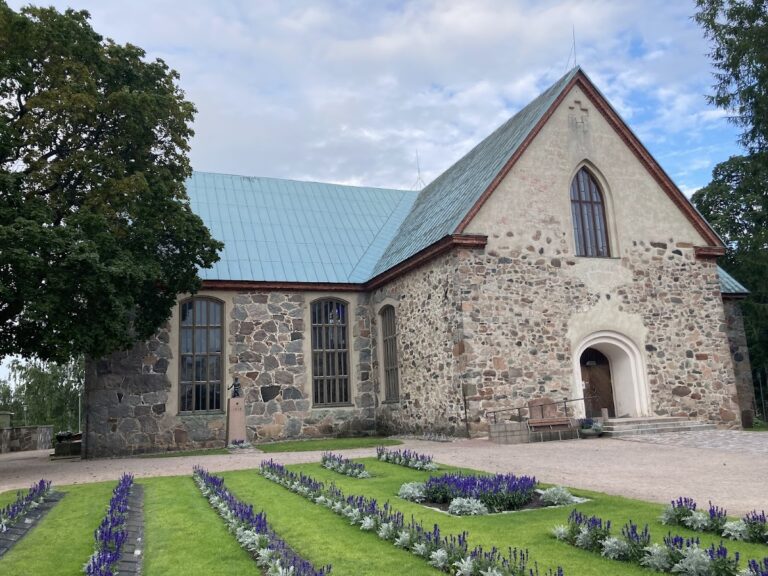
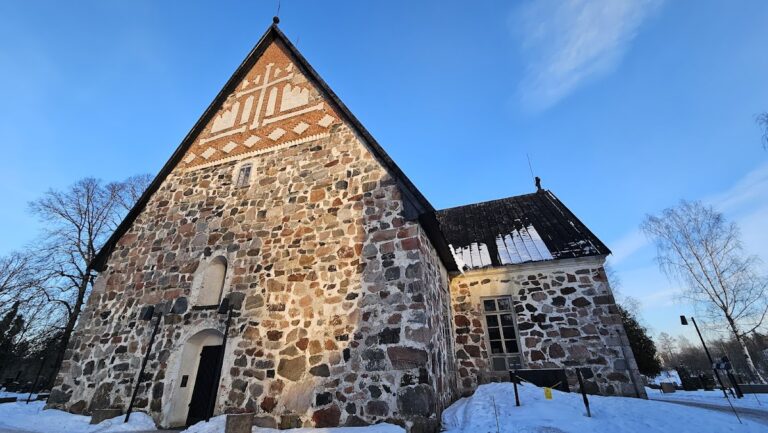
The surviving church is a late-medieval Gothic stone building with much of its original character intact. It measures approximately 40.3 by 22.3 meters externally, and the nave covers about 670 square meters. The walls rise 11–12.5 meters, while the vault reaches approximately 34 meters. The plan has three aisles and is oriented eastward. The choir occupies the easternmost part of the nave rather than forming a separate architectural section.
A sacristy, a room for storing liturgical objects and preparing clergy for worship, extends along the north wall. A small southern vestibule, known as the arms room, adjoins the church. It could provide additional protection at the entrance during wartime, although the interpretation that it served for removing weapons before entering the church has been questioned by recent research. Nineteenth-century repairs sought to restore the building’s earlier appearance.
Interior decoration and objects
Medieval murals
Murals cover the walls of the church, sacristy, and arms room. They date mainly from the early sixteenth century, during the period of Arvid Kurki, the medieval bishop of Turku. The paintings show human figures and biblical events in a simple style. The painters may have been pupils of the Swedish artist Albertus Pictor. Some of the saints are depicted with blond hair. Twelve consecration crosses also survive, marking places associated with the formal medieval consecration of the church.
Historic furnishings
The church contains a fifteenth-century cross and a fifteenth-century statue of Saint Lawrence. Its present altar dates from 1987, while the retable painted by Margareta Capsia belongs to the eighteenth-century furnishings. The pulpit, organ, and organ gallery represent later additions to the interior.
Bell tower
A bell tower stands at the church’s southeast corner on a gray-stone base probably dating from the Middle Ages. Its wooden upper structure acquired its present form during major repairs after the Great Northern War, the northern European conflict fought from 1700 to 1721. The upper section was constructed around 1740 under the supervision of the German master builder Johann Friedrich Schultz. Three bells hang in the tower: the oldest was cast in Tallinn in 1594, the largest in Lohja in 1624, and the smallest in Stockholm in 1740. The tower also contains three donated crowns, two given by the owners of Laakspohja Manor and one by Claes Tott.