Siuntio Church: A Medieval Gothic Stone Church in Finland


Site at a Glance
- Rating
- 4.4
- Popularity
- Low
- Country
- Finland
- Primary era
- Medieval
- External website
- Open
- Eras represented
- Medieval, Early Modern, Modern
- Civilizations
- Russian, Swedish
- Site type
- Religious
- Remains
- Church
On this page15 sections
History
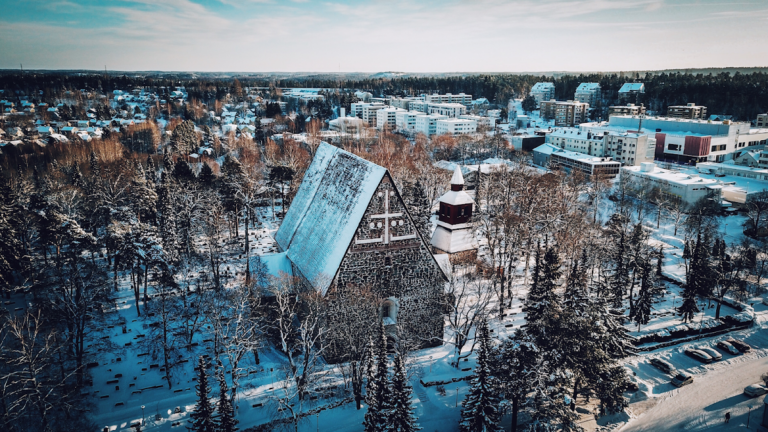
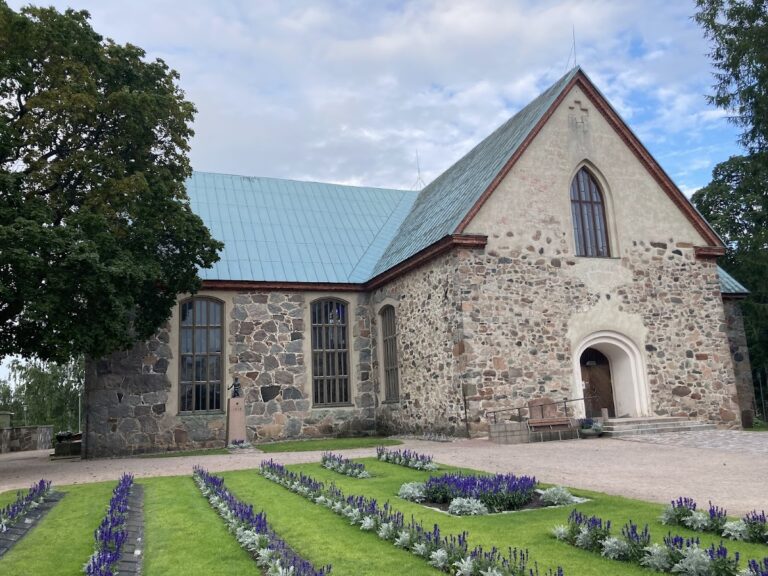
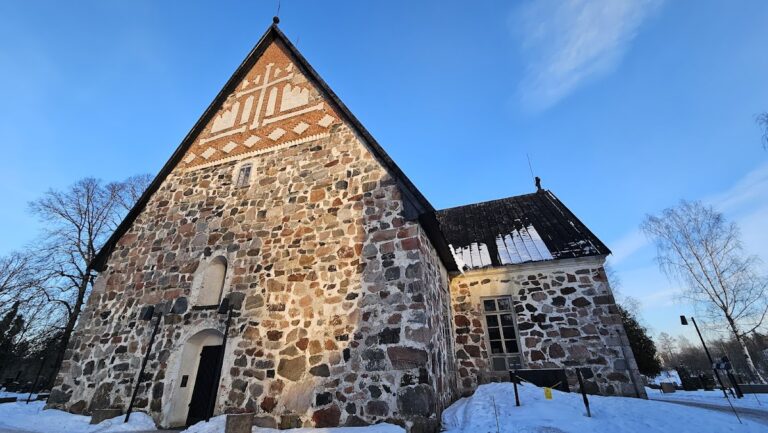
Siuntio Church is a medieval Gothic stone church in Finland, built of grey stone between 1460 and 1480 and dedicated to Saint Peter. It was originally Roman Catholic and is now used by Siuntio’s Finnish-speaking and Swedish-speaking Evangelical Lutheran parishes. Its history includes medieval religious use, Reformation-era change, wartime damage, repeated fires, and substantial restoration.
Medieval foundations and Catholic use
The church was built beside an earlier chapel connected with Suitia Manor, a noble estate whose owners supported furnishings and structures associated with the church. The predecessor is described as a fourteenth-century chapel, although an early fifteenth-century wooden church has also been considered possible. Once the stone church was complete, the earlier chapel was converted into a sacristy, a room for storing liturgical objects and preparing for worship.
During the Catholic period, biblical scenes and saints were painted across the walls and vaults. The paintings communicated biblical narratives to people who could not read and conveyed teachings that were delivered in Latin. Archaeological investigations have identified traces of a medieval main altar and two side altars, indicating the arrangement of worship within the medieval church.
Reformation, fire, and wartime destruction
The Reformation, the sixteenth-century religious movement that transformed much of northern Europe from Roman Catholic to Protestant Christianity, changed the church’s religious setting. Its paintings and most of its furnishings survived without being covered or confiscated, and wooden sculptures of saints were not destroyed. In the early sixteenth century, the original wooden ceiling was replaced by brick vaults.
A fire damaged the church in 1617. It was later heavily damaged and looted during the Great Northern War, the early-eighteenth-century conflict in which Sweden lost much of its position as a major Baltic power. The bell tower was destroyed and its bells were taken. The vicar and chaplain fled to Sweden, leaving only the chaplain’s assistant in Siuntio. Repairs did not begin until the 1730s.
The church burned again in 1823. The subsequent rebuilding followed contemporary architectural ideals in the Grand Duchy of Finland, the autonomous Finnish territory ruled by the Russian Empire from 1809 to 1917. The windows were enlarged, the medieval supporting pillars were rounded, and the former Suitia Manor chapel and church porch were demolished. The medieval paintings were covered with white oil paint. In total, the church has been ravaged by fire four times.
Restoration and continuing use
In 1938, the parish decided to uncover and restore the medieval paintings. By then, the paintings, especially those on the walls, had suffered serious damage. The church is owned by the Parish Union of Siuntio and belongs institutionally to both the Diocese of Espoo and the Diocese of Borgå, because its Finnish-speaking parish belongs to Espoo and its Swedish-speaking parish to Borgå. It is protected under Finland’s Church Act.
Siuntio Church received its first organ in 1786, becoming the first rural church in Finland to have its own organ. An oil-fired heating system was replaced by a climate-friendly system in December 2023, and the roof was renovated in 2024, with the work completed in December.
Remains
Church structure and medieval paintings
Siuntio Church is a three-nave stone building. Three pairs of pillars divide the interior and support the vaults. The central nave has star vaults, while the side aisles have transverse vaults. The building accommodates approximately 350 people. The surviving wall and vault paintings were made in two phases from the end of the fifteenth century to the beginning of the sixteenth century.
The earliest surviving paintings are six consecration crosses from the late fifteenth century. A consecration cross marks a place associated with the ceremonial consecration of a church. Later paintings show biblical legends and saints, including the Coronation of the Virgin Mary. One unusual scene depicts a dead man with the seven deadly sins emerging from his mouth as snakes. The paintings were uncovered and restored after the parish decision of 1938, although the wall paintings had already sustained serious damage.
Pulpits and baptismal font
The Pulpit of Tott
The church has two seventeenth-century pulpits. The older, known as the Pulpit of Tott, dates from 1625 and survives in parts displayed in the church. Åke Tott, lord of Sjundby Manor, and Queen Consort Catherine of Sweden donated it. Its surviving parts bear the coats of arms of Catherine, the House of Tott, and the House of Vasa.
The later pulpit
The second pulpit was donated in 1683 by Baron Ernst Johan Creutz, president of the Royal Court in Turku. It copies a pulpit formerly located in Turku Cathedral until a seventeenth-century fire there. Henrik Mattsson Leino and Matts Reiman are associated with its construction, although their authorship is uncertain. The pulpit is regarded as Reiman’s greatest.
The medieval baptismal font
A medieval limestone baptismal font was donated in 1550 by Hebbla Siggesdotter Sparre in memory of her husband, State Councillor Erik Fleming, lord of Suitia Manor. It is described as the latest surviving object in Finland linked to the medieval baptismal tradition.
Burial chapel and memorial objects
Burial chapel
A granite burial chapel was built against the east side of the church in 1774 after Maria Gyllenstierna af Lundholm received permission for its construction. After Finland came under Russian rule, the Reuterholm family emptied the chapel and moved to Sweden. Following the fire of 1823, the sacristy was transferred into the formerly empty chapel.
Altar painting
The altar painting shows Jesus in Gethsemane. An unknown artist painted it in Stockholm, and Baroness Gyllenstierna af Lundholm donated it in 1773 in connection with the burial chapel. The painting bears the coats of arms of the Reuterholm and Gyllenstierna families. An inscription states that the former altarpiece was preserved and transferred to Siuntio’s Finnish-speaking church.
Funeral coats of arms
Thirty-four funeral coats of arms were formerly kept in the church for noble people buried beneath its floor in family graves. Three survive: one belonging to the Creutz family, one to Otto Mauritz Krebs, and one to his grandmother Margareta Anrep af Soor.
Organ and textiles
The present organ is the church’s third. The Paul Ott organ factory in Göttingen, Germany, made it in 1971. The newest church textiles were made in 2009 by textile artist Helena Vaari.