Church of Vytautas the Great, Kaunas: A Lithuanian Brick Gothic Church


Site at a Glance
- Rating
- 4.8
- Popularity
- Medium
- Country
- Lithuania
- Primary era
- Medieval
- External website
- Open
- Eras represented
- Medieval, Early Modern
- Civilizations
- Grand Duchy of Lithuania
- Site type
- Religious
- Remains
- Church
On this page7 sections
History
The Church of Vytautas the Great, also known as the Church of the Assumption of the Blessed Virgin Mary, is a Roman Catholic church in Kaunas, Lithuania. Traditionally associated with Grand Duke Vytautas the Great, the medieval ruler whose reign extended Lithuania’s political influence in Eastern Europe, it was founded around 1400 and is regarded as the oldest church and oldest Gothic building in the city.
Foundation and Franciscan administration
The church’s foundation documents have not survived. Tradition connects its establishment with Vytautas around 1400, perhaps as a thanksgiving offering to the Virgin Mary after he survived the Lithuanian defeat at the Battle of the Vorskla River. The earliest surviving documentary reference dates from 1439. A wooden or stone building may have stood on the site before the present brick church succeeded it.
Franciscan friars brought from Vilnius were caring for the church by 1439. The Franciscans, a Catholic religious order based on the teachings of Saint Francis of Assisi, administered the church during its early history. The building was also associated with foreign merchants. Its tower was added at the end of the fifteenth or the beginning of the sixteenth century.
War, fire, and rebuilding
The church survived the major Kaunas fires of 1603, 1624, and 1668 with comparatively little damage. Russian forces almost destroyed or heavily devastated it in 1655 during the war between the Tsardom of Russia and the Polish-Lithuanian Commonwealth. A brick Franciscan monastery was built nearby in 1669, with three two-storey blocks.
The church suffered severe damage again during the Great Northern War. In 1812, during the French invasion of Russia, the occupying French army converted it into an armoury or military warehouse. A fire during the French retreat destroyed the interior and caused extensive damage to the building.
Franciscan guardian Grigalius Golickis began reconstruction in 1819. The work included new vaults and a brick floor. After Russian authorities abolished the Franciscan monastery, the church was closed in 1845 and remained unused for about five years. Between 1850 and 1853 it became an Orthodox winter church under the name Saint Nicholas Church.
Flooding and twentieth-century restoration
The church’s position beside the Nemunas, Lithuania’s principal river and a historic waterway, exposed it to repeated spring floods. In 1829, water inside the building rose above 70 centimetres. A plaque on the north wall of the tower records a level of 2.90 metres reached on 24 March 1946.
German forces captured Kaunas in 1915 during the First World War, removed the roof, and used the church as a warehouse. After their retreat, only blackened and cracked walls remained. The building returned to the Catholic Church on 18 April 1919. From 1920, Rector and Canon Juozas Tumas-Vaižgantas, a Lithuanian Catholic priest, writer, and national activist, directed its renovation. Prelate Aleksandras Jakštas-Dambrauskas consecrated the restored church on 15 August 1920, returning it to liturgical use.
Tumas-Vaižgantas continued the restoration until his death in 1933 and was buried in a crypt in the churchyard. Later rectors carried on the work. Major renovation campaigns took place from 1931 to 1938 and from 1978 to 1982, with restoration continuing through 1990. The church remains an active Roman Catholic institution under the Metropolitan Archdiocese of Kaunas. It was entered in Lithuania’s state Register of Cultural Values and protected as a national cultural monument in 2002 under reference number 825.
Remains
Building and setting
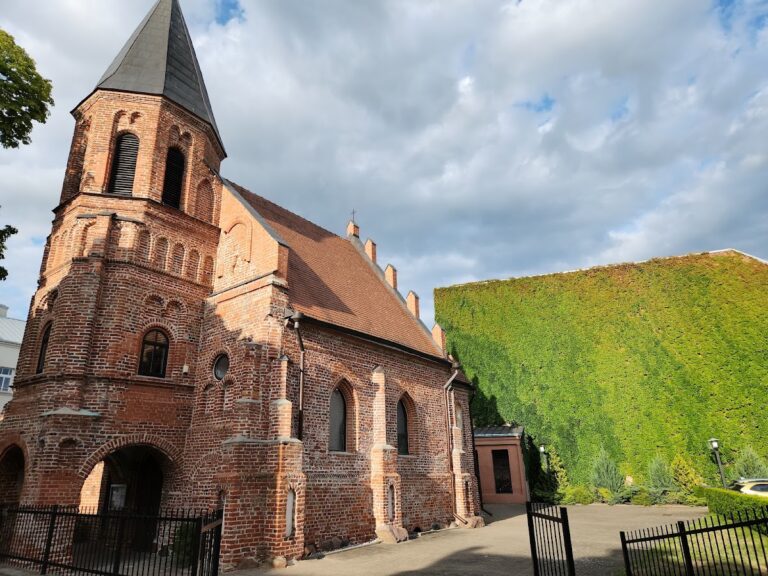
The church stands close to the north bank of the Nemunas and is built in the Lithuanian Brick Gothic tradition, a form of Gothic architecture using brick instead of dressed stone as its principal material. Its Latin-cross plan, incorporating side chapels, is unique in Lithuanian Gothic architecture. The later bell tower probably helped guide ships navigating the river.
The surrounding ground level has risen substantially over time, making the façades appear lower than they originally did. The windows were shortened to accommodate the changed level, and the side portals were removed. The tower, added around the transition from the fifteenth to the sixteenth century, received a reconstructed spire in 1982. The restoration, directed by architect Stefanija Čerškutė, used the church’s image in a seventeenth-century engraving by Tomasz Makowski as its basis.
Interior and commemorative features
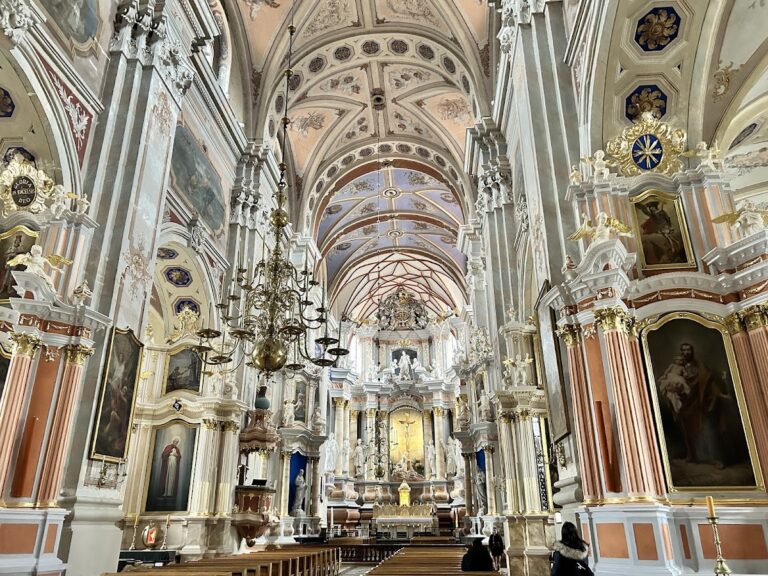
The 1819 rebuilding introduced new vaults and a brick-paved floor. Earlier Gothic, Renaissance, and Baroque interiors did not survive, and the present decoration and furnishings date mainly from the 1920s. Later work installed a new organ and added a vestibule to the sacristy. In 1990, the chancel received a polished stone floor and a new altar table.
Juozas Tumas-Vaižgantas is buried in a crypt in the churchyard. A bronze sculpture of him by Gediminas Piekuras was unveiled and consecrated there on 20 September 2019. A marble plate dedicated to the Lithuanian Siberian Battalion was installed in 1920 but has since been lost.