Kaunas Cathedral Basilica: Lithuania’s Archcathedral Basilica


Site at a Glance
- Rating
- 4.8
- Popularity
- Medium
- Country
- Lithuania
- Primary era
- Medieval
- External website
- Open
- Eras represented
- Medieval, Early Modern, Modern
- Civilizations
- Grand Duchy of Lithuania, Polish–Lithuanian Commonwealth, Russian
- Site type
- Religious
- Remains
- Cathedral
On this page9 sections
History
Kaunas Cathedral Basilica is a Roman Catholic church in Kaunas, Lithuania, dedicated to the Apostles Saint Peter and Saint Paul. Established by Grand Duke Vytautas the Great, whose rule helped consolidate the medieval Lithuanian state, it began as a Gothic church around 1410 and later became the principal church of the Metropolitan Archdiocese of Kaunas.
Foundation and medieval development
The exact date of the first construction is unknown, but the church was standing by 22 April 1413, when the Bishop of Vilnius held an indulgence feast there. Vytautas endowed the church around 1430. A parochial school attached to it was mentioned in 1473, while building work continued until 1624. This long period of construction shaped the medieval church that later phases would repeatedly alter.
War, fire, and reconstruction
The church suffered severe damage during the war with Russia in 1655 and was rebuilt in 1671 with Renaissance features. It was damaged again in 1707, when the Swedish army captured Kaunas. A major fire in 1732 destroyed the interior, furnishings, and finishes and caused both towers to collapse. The rebuilding that followed remodelled the interior in the Rococo style.
Renovations funded by Stanisław August Poniatowski, the last king of the Polish–Lithuanian Commonwealth, rebuilt one tower in 1771. In 1775, Tomasz Podhajski installed the main altar, lectern, and choir. A renovation completed in 1800 established the building’s present overall form.
Ecclesiastical changes under Russian rule
From 1808 to 1864, the Augustinians administered the church under orders from the Russian authorities. The Augustinians were members of religious orders following the rule and spiritual tradition associated with Saint Augustine of Hippo. These arrangements belonged to the period after the 1795 partitions of the Polish–Lithuanian Commonwealth, when Lithuania was governed by the Russian Empire.
After the failed Uprising of 1863, the Tsarist government transferred the seat of the Diocese of Samogitia from Varniai to Kaunas. The measure was intended to restrict the pro-Lithuanian activities of Bishop Motiejus Valančius, a Catholic bishop, historian, and Lithuanian writer. The church consequently became the cathedral of the diocese. Pope Leo XIII formally elevated it to cathedral status in 1895, and in 1921 it received the title of Minor Basilica, an honorary status granted to certain churches by the pope.
The archcathedral and modern heritage
Following the 1926 Concordat between Lithuania and the Vatican, Lithuania’s ecclesiastical province was established. Pope Pius XI reorganized the Diocese of Samogitia as the Metropolitan Archdiocese of Kaunas, and the church became its archcathedral, the principal cathedral of an archdiocese. It was the principal church of Lithuania until 1939.
The building was entered on the Registry of Immovable Cultural Heritage Sites of the Republic of Lithuania in 1996 and designated a national cultural monument in 2002. It remains an active Roman Catholic archcathedral basilica under the Roman Catholic Archdiocese of Kaunas.
Remains
Plan and exterior
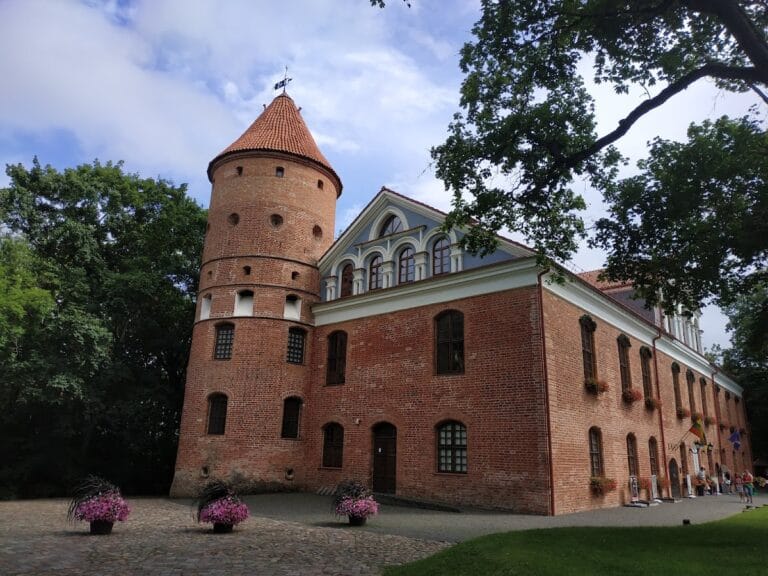
Built of red brick, the basilica measures 84 metres in length, 34 metres in width, and 28 metres in height. It is a three-aisled church without a transept, with a five-bay nave, a four-bay choir, and a three-sixth apse, meaning a polygonal apse formed from three sides of a six-sided figure. A simple square bell tower, 41 metres high, stands against the southern side of the west facade. Gothic forms are especially well preserved in the choir and apse, while the nave reflects remodelling during the Renaissance and Early Baroque periods.
White-plastered details set against the red brick include the triangular gable, the reveals around windows and doors, and the architraves, which are horizontal framing members above openings or supports. The Chapel of the Blessed Sacrament, added in 1895, is an independent Neo-Gothic extension on the church’s south side. Its carved wooden furnishings support a decorative program centred on Saint John the Baptist, the Christian prophet associated with the baptism of Jesus.
Interior decoration and altars
The interior combines Early and High Baroque features. Columns, walls, and vaults are partly painted to imitate pastel-coloured marble and partly covered with ornaments and pictorial medallions. This Neo-Baroque painting dates from the end of the nineteenth century and forms part of the interior’s later decorative appearance.
The High Altar, consecrated in 1775, carries sculptures of the crucified Jesus and the grieving Mary Magdalene, a prominent follower of Jesus in the New Testament. Above them is a figure of the risen Christ, flanked by kneeling figures of the Apostles Peter and Paul and surrounded by the symbols of the Evangelists, the four traditionally recognized authors or associated figures of the canonical Gospels. The altar forms the centre of a Baroque arrangement of columns with eight additional expressive statues of saints.
Four side altars stand along each side of the nave. The altar dedicated to the Assumption of Mary is regarded as the most artistically significant and has retained its seventeenth-century form. The latest altar is dedicated to Pope John Paul II and contains a blood relic associated with him.
Choir, memorials, and organ
The choir is covered by a Late Gothic net vault, a vault whose ribs form a net-like pattern. The cathedral organ was built in 1882 by the Lithuanian organ builder Juozapas Radavičius and follows the model of Late Romantic French organs.
Motiejus Valančius is buried in a crypt beneath the church. The tomb of Cardinal Vincentas Sladkevičius is located in the Chapel of the Blessed Sacrament. On the exterior wall of the southern side aisle, near the chapel, stands a Neo-Gothic mausoleum or tomb monument commemorating Maironis, the Lithuanian Catholic priest and major Romantic poet.
Nearby sites