Former Augustinian Monastery in Żagań: A Medieval Collegiate Monastery


Site at a Glance
- Rating
- 4.8
- Popularity
- Low
- Country
- Poland
- Primary era
- Early Modern
- External website
- Open
- Eras represented
- Medieval, Early Modern
- Civilizations
- Holy Roman Empire
- Site type
- Religious
- Remains
- Monastery
On this page11 sections
History
The Former Augustinian Monastery in Żagań, Poland, was founded in 1217 as a collegiate monastery of Augustinian Canons Regular, clerics who lived communally under the rule of Saint Augustine while carrying out pastoral and religious duties. Henry I, Duke of Silesia from the Silesian Piast dynasty, established it at Naumburg am Bober at the request of his wife, Hedwig of Andechs, who was later canonized. The monastery belonged to the Duchy of Glogau, was subordinate to the Sand Abbey in Breslau, and followed the Congregation of Arrouaise, a medieval federation of Augustinian Canons Regular houses. Both its original foundation and its later establishment in Żagań were dedicated to the Virgin Mary.
Transfer to Żagań and institutional development
Naumburg offered poor conditions for the monastery’s growth, so Duke Primko transferred the canons to Żagań in 1284 with the consent of his brothers Konrad and Henry. The parish church of Żagań, first mentioned in 1272, then became the collegiate church. In 1299, Duke Konrad III gave the monastery a house near the Marian Church that his brother Primko had built. This house became the conventual building. Four years later, Konrad transferred to the monastery the Holy Spirit Hospital founded by Primko, a donation confirmed by Heinrich von Würben, Bishop of Breslau.
Under Abbot Trudwin, who led the monastery from 1325 to 1347, the community carried out its first reform after 1339. The reform responded to Pope Benedict XII’s constitution Ad decorem ecclesiae, which sought to renew the discipline of the Augustinian Canons Regular. Trudwin also strengthened education and scholarship. He sent the later abbot Hermann to study law at the University of Bologna, where Hermann encountered humanist ideas and attended lectures by the jurist Johannes Andreae. Abbot Nikolaus I Weintrud, who governed from 1365 to 1376, later sent three canons to study at Erfurt and Prague, acquired property for the monastery, and promoted its written and liturgical resources.
Scholarship and the Hussite Wars
After its arrival in Żagań, the monastery developed into a cultural and scholarly center. Several canons studied in Prague before working at Żagań, which came to be regarded as an outpost of the scholarship associated with the University of Prague. Later abbots enlarged the library, and by the beginning of the sixteenth century the library and scriptorium, the workshop where manuscripts were copied and sometimes decorated, had attained European importance.
Abbot Ludolf governed from 1394 to 1422 and became the monastery’s most prominent abbot. He had studied at Charles University, the historic university in Prague founded in the fourteenth century, and maintained lifelong connections with Bohemian Augustinian monasteries linked to their mother house at Roudnice. At the beginning of, and during, the Hussite Wars, fifteenth-century religious and political conflicts centered in Bohemia and associated with the reform movement inspired by Jan Hus, Ludolf offered asylum at Żagań to canons who had fled from Bohemian Augustinian houses.
In his final years, Ludolf wrote the monastery chronicle Catalogus abbatum Saganensium, or Catalogue of the Abbots of Sagan. After his death, Prior Peter Weynknecht continued the chronicle until 1507. The monastery’s intellectual activity also included manuscript production. In 1422, Martin, a canon from Roudnice who had fled the Hussites, began copying and illuminating the missal identified as I F 349. He completed the work two years later.
Reformation, Prussian rule, and secularization
During the rule of Abbot Paul II of Lemberg from 1522 to 1525, Martin Luther’s teachings reached the city. Some canons converted to Protestantism while continuing to observe the order’s rule. Under the Wettins, the German ruling dynasty that introduced the Reformation into the Principality of Sagan during the second half of the sixteenth century, the monastery suffered severe losses and its institutional connection with Silesia weakened.
A city fire damaged the monastery buildings in 1730, after which they were remodeled in the Baroque style, the ornate architectural and artistic style associated with much of seventeenth- and eighteenth-century Europe. Following the First Silesian War, in 1742, the monastery and the Principality of Sagan passed to Prussia.
Johann Ignaz von Felbiger, one of the best-known abbots of Żagań, governed from 1758 to 1778. The monastery was secularized in 1810, meaning that the religious institution and its property were transferred out of ecclesiastical control. The church became the town’s parish church again. The monastic buildings were used as a Catholic parish house and a district court, while most of the valuable monastic library was transferred to the University Library in Breslau.
After the Second World War, in 1945, Sagan, as Żagań was then renamed, passed to Poland together with most of Silesia. The entire former canons’ monastery complex has been protected as a monument since 1953.
Remains
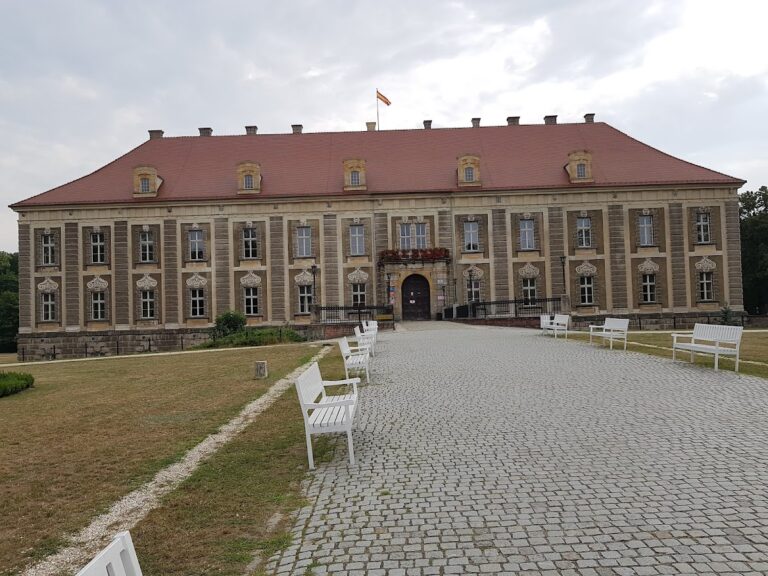
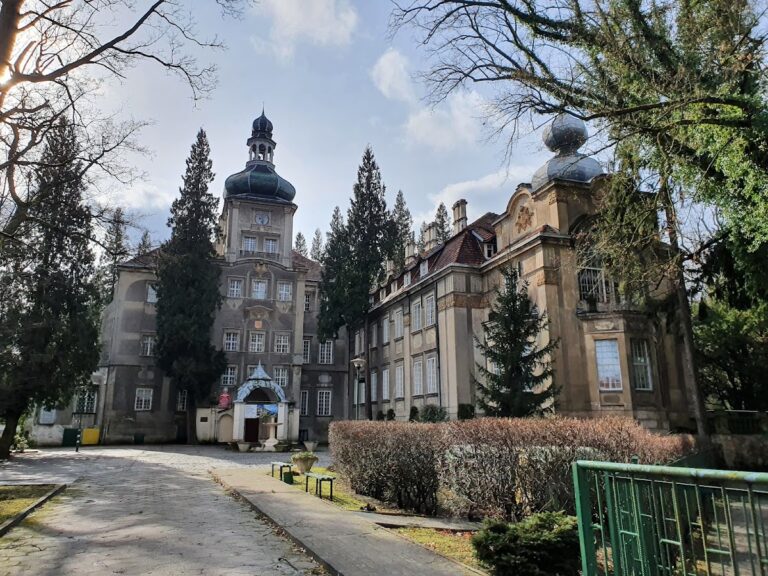
The surviving establishment is organized around the collegiate church and the conventual buildings, which formed its principal components. The complex also incorporated the Holy Spirit Hospital after its transfer to the monastery in 1303. Its present architectural character reflects the later rebuilding of the church and the Baroque remodeling of the monastery buildings after the 1730 city fire.
Church and conventual buildings
Collegiate church
The collegiate church was newly built during the Baroque period according to a design by the architect Martin Frantz. Its furnishings were produced with the participation of numerous artists, including Johann Georg Urbansky. The church later returned to use as Żagań’s parish church after the monastery was secularized in 1810.
Conventual buildings and hospital
The conventual building originated as the house near the Marian Church that Duke Konrad III donated in 1299. It became the residential and institutional building of the community. The Holy Spirit Hospital, founded by Duke Primko and transferred to the monastery in 1303, formed another component of the establishment. After secularization, the monastic buildings served as a Catholic parish house and a district court.
Library, chapter house, and manuscript work
Library and chapter house
The library retains paintings by Georg Wilhelm Neunhertz. The chapter house contains a series of 52 abbot portraits accompanied by historical scenes. Abbot Simon Th. Rihl commissioned this series, which preserves a visual record of the monastery’s leadership.
Scriptorium and missal
The monastery’s manuscript workshop began copying and illuminating the missal I F 349 in 1422. Martin, a canon from Roudnice, carried out the work after fleeing the Hussites, and completed the manuscript in 1424. The missal belongs to the written and liturgical heritage associated with Żagań’s scholarly community.