Kornmarktkirche: Former Franciscan Monastery Church in Mühlhausen, Germany

Site at a Glance
- Rating
- 4.5
- Popularity
- Low
- Country
- Germany
- Primary era
- Medieval
- External website
- Open
- Eras represented
- Medieval, Early Modern
- Civilizations
- Holy Roman Empire
- Site type
- Religious
- Remains
- Church
On this page9 sections
History
Franciscan Settlement
Kornmarktkirche is a medieval former Franciscan monastery church in Mühlhausen, Germany. Originally dedicated as the Church of the Holy Cross, it belongs to the group of twelve medieval churches in the town and developed as a thirteenth-century mendicant-order church. The Franciscans were a religious order founded in the early thirteenth century whose communities emphasized preaching, pastoral work, and material simplicity.
The first Franciscans are said to have reached Mühlhausen around 1225. Their settlement initially met opposition from the local clergy and the Teutonic Order, a medieval religious-military institution that exercised ecclesiastical and political authority in parts of central Europe. An agreement eventually allowed the Franciscans to work in the town, although their activities were restricted. In 1231, Franciscans from the Saxon Province settled permanently after receiving land for a monastery. A chapel already stood on the site and first served as their oratory.
Medieval Construction
Construction of the church in its present extent began in the mid-thirteenth century, incorporating parts of the earlier building. The monastery sometimes housed more than 150 brothers and became one of the largest Franciscan communities in the Saxon Province. Work progressed from the choir toward the west. The choir was raised in 1307, while the eastern window bays on the south side were rebuilt in altered form in 1348 after an earthquake.
A square chapel was added at the southwest corner of the choir in 1392. A tower with an octagonal upper section was built above it after 1400, and its slate-covered cap was added in 1568. In 1521, after the division of the Saxon Province, the Mühlhausen community became part of the Thuringian Franciscan Province.
Reformation and Secular Use
The Reformation, the sixteenth-century movement that challenged established Western Christian institutions and practices, brought the monastery’s religious life to an end. The monastery was dissolved in 1542. Its buildings were demolished in 1568, and a new street was laid across the former complex. Parts of the vaulted cloister remained beside the church.
The church was renewed in the Baroque period in 1702 and 1722 and continued to serve for worship until its deconsecration in 1802. It then became a municipal weighing house and grain store. From the late nineteenth century, the building was also used for offices and apartments, reflecting its change from a religious foundation to a secular urban structure.
Museum and Cultural Role
A conversion carried out between 1973 and 1975 established the church’s continuing cultural use. Since 1975, it has housed museum displays and provided space for concerts and conferences. It forms part of the Mühlhausen Museums, together with the Cultural History Museum, St. Mary’s Church, and the historic fortifications.
The exhibitions have addressed the Reformation and the German Peasants’ War of 1524–1525, a major uprising involving rural and urban communities whose demands included religious reform. From 2014, the permanent exhibition Luther’s Unloved Brothers explored the pre-Reformation and early Reformation periods, including the radical reform theologian Thomas Müntzer, whose religious and social ideas diverged sharply from Martin Luther’s. In 2025, the church presented the event history of the German Peasants’ War, its principal actors, and eyewitnesses as part of the Thuringian state exhibition Freedom 1525, 500 Years of the Peasants’ War.
Remains
Church Form and Exterior
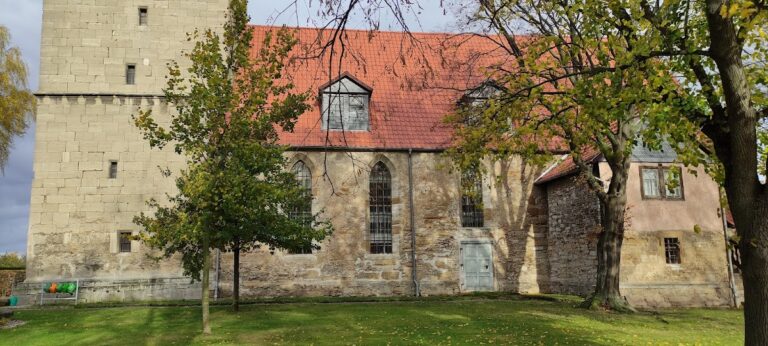
Kornmarktkirche is a long, single-nave hall church with a narrower rectangular choir. In a hall church, the nave and any aisles are broadly similar in height, creating a unified interior space. The building’s proportions and dimensions reflect the mendicant-order churches that spread through Thuringia during the thirteenth century. Its south wall runs along the full length of Kornmarkt.
The choir’s east wall contains three staggered windows. The eastern five bays of the south wall have external buttresses and tracery windows, the ornamental stone framework of Gothic windows, dating from the rebuilding after 1346–1348. The western bays and the west wall retain their earlier form without buttresses. Tall round-arched windows from the earlier chapel survive in the north wall, alongside older tracery made chiefly of circular forms and incorporating early Gothic features.
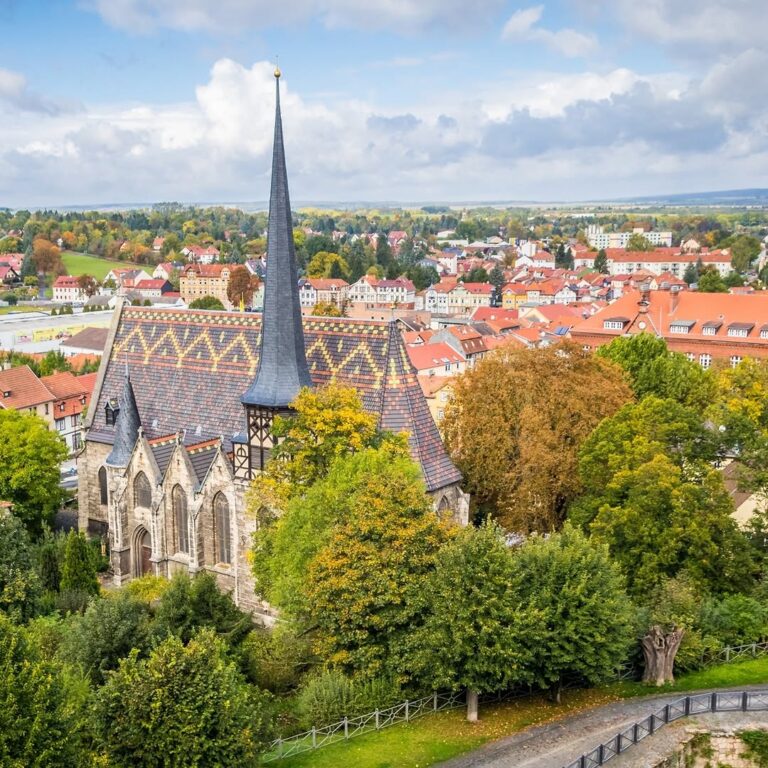
Three entrances open toward Kornmarkt. The central entrance incorporates a large window portal, joining the principal access point with a prominent opening in the facade. Above the square chapel at the southwest corner of the choir rises the tower, whose upper section is octagonal and whose cap is covered with slate.
Interior Structure and Decoration
The hall originally had a pointed barrel vault, a continuous longitudinal vault with a pointed cross-section. The nave now has a flat wooden ceiling. Restoration work revealed surviving corner shafts with diagonally placed bases, which were intended to support a ribbed cross-vault formed by intersecting vaulted compartments carried on structural ribs.
Paintings survive on the walls of both the choir and the nave. In the nave, a continuous ornamental frieze beneath the ceiling line was reconstructed in 1975. The church also contains the hereditary burial place of the Mühlhausen branch of the Lutteroth family.
Monastery Traces and Museum Features
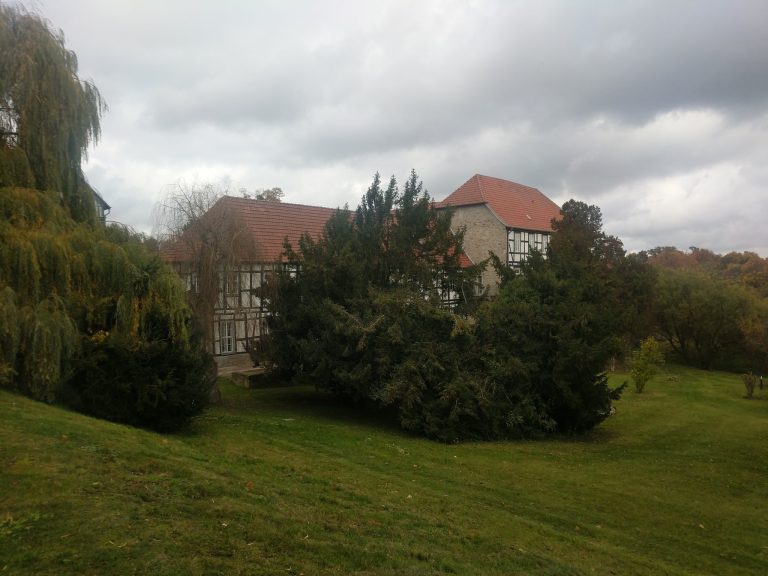
Remains of the former vaulted cloister can still be seen along the church’s north side. The associated monastery garden has been arranged according to the ideas of Albertus Magnus, the medieval scholar, and forms a permanent part of the museum presentation. These surviving elements preserve the connection between the church and the Franciscan complex that once occupied the surrounding area.
The tower houses a carillon installed in 1991. This musical instrument consists of tuned bells operated mechanically or from a keyboard, and the Kornmarktkirche carillon contains 41 bells cast by the bell founder Schilling. A Peasants’ War Column stands in front of the church, adding a modern commemorative feature to the historic setting.