Donegal Friary: A Franciscan Priory in Ireland


Site at a Glance
- Rating
- 4.4
- Popularity
- Low
- Country
- Ireland
- Primary era
- Medieval
- External website
- Open
- Eras represented
- Medieval
- Civilizations
- Irish
- Site type
- Religious
- Remains
- Monastery
On this page8 sections
History
Donegal Friary, also known as Donegal Abbey, is a ruined Franciscan priory in Ireland, founded at Donegal in 1474 by Hugh Roe O’Donnell, ruler of Tyrconnell, and his wife Finola O’Donnell, née O’Connor. The friary belonged to the Franciscan order, a Catholic religious community founded by Francis of Assisi, and became one of the order’s most influential houses in Ireland during the fifteenth and sixteenth centuries.
Foundation and early prominence
Construction may have started in 1473, but the monastery was completed and dedicated in 1474. A seventeenth-century tradition credits Finola with initiating the foundation. She travelled about 100 miles, or 160 kilometres, to Ross Errilly Friary in County Galway to seek a Franciscan house for Tyrconnell, the O’Donnell lordship broadly corresponding to present-day County Donegal. Although the Franciscans initially refused, members of the order eventually accompanied her home and began building beside Donegal’s wharf.
Finola died later in 1474, before the work was finished. Hugh Roe’s second wife, Fingalla O’Brien, continued the project and secured the completion of the monastery, church, cloisters, and associated buildings. After Hugh Roe died in 1505, Fingalla withdrew from public life and lived austerely in a small house near the friary. Hugh Roe was buried at Donegal, as was Hugh McManus O’Donnell, who had spent many years with the Franciscans and died in 1600.
The friary’s standing within the Irish Franciscan community was reflected by the meeting of the provincial chapter there in 1488. Creevelea Abbey in County Leitrim became a daughter foundation in 1508, while a related O’Donnell foundation for members of the Franciscan third order had already been established at Magherabeg.
Fire, occupation, and destruction
A fire destroyed large parts of the friary in 1536. Three years later, during the religious and political resistance that followed the Reformation, the Geraldine League met there. Rory O’Donnell, Bishop of Derry and a leading participant in that movement, was buried at the friary in 1550 wearing the Franciscan habit.
English forces attacked Donegal Friary in 1588. The guardian, Thady O’Boyle, was killed, while the other friars escaped. The English then converted the buildings into a garrison. Red Hugh O’Donnell recovered the friary in 1592 and had it repaired. By 1600, its community numbered 40 friars.
The friary was drawn into the Nine Years’ War, the major Irish conflict against English Crown expansion fought from 1594 to 1603. It hosted a meeting between rebel leaders and envoys of Philip II of Spain, the Catholic king who supported resistance to English rule in Ireland. By 1601, Donegal town was under Crown control, and Niall Garve O’Donnell, who had allied with the English, used the friary as his base.
Fighting around the friary formed part of the 1601 Siege of Donegal. On 10 August, a fire reached Niall Garve’s store of gunpowder, destroying most of the complex and killing hundreds of his soldiers, including his younger brother Conn Oge O’Donnell. The friars fled as troops approached, and the friary and town were occupied.
After the destruction
Rory O’Donnell helped the Franciscan community begin rebuilding, but the work ended after the Flight of the Earls in 1607, when leading Gaelic nobles left Ireland. The friary was never fully restored and gradually became a ruin. The Franciscans established bases at Bundrowes near Bundoran and probably at Rosfriar, followed later by stations at Barnesmore, Killybegs, and Saints Island on Lough Derg.
Between 1632 and 1636, friars associated with Donegal, including Mícheál Ó Cléirigh, Cú Choigríche Ó Duibhgeannáin, and Fearfeasa Ó Maol Chonaire, assembled the Annals of the Four Masters, a major compilation of Irish historical records extending from early Irish history into the seventeenth century. The Franciscan community was re-established at Rossnowlagh in 1946, while the original Donegal site remained in ruins.
A silver chalice made in 1633 for the Friars of Donegal records its commission by Mary, daughter of Maguire and wife of Brian Oge O’Ruairc. It identifies John O’Mullarkey as its maker and later passed into the possession of an Irish priest in Quebec.
The site’s Franciscan history also includes Concobhar Ó Duibheannaigh, a priest from Donegal who became Bishop of Down and Connor. Executed outside Dublin in February 1612, he was recognized among the 24 Irish Catholic Martyrs. Pope John Paul II beatified him on 27 September 1992, and his feast day is 20 June.
Remains
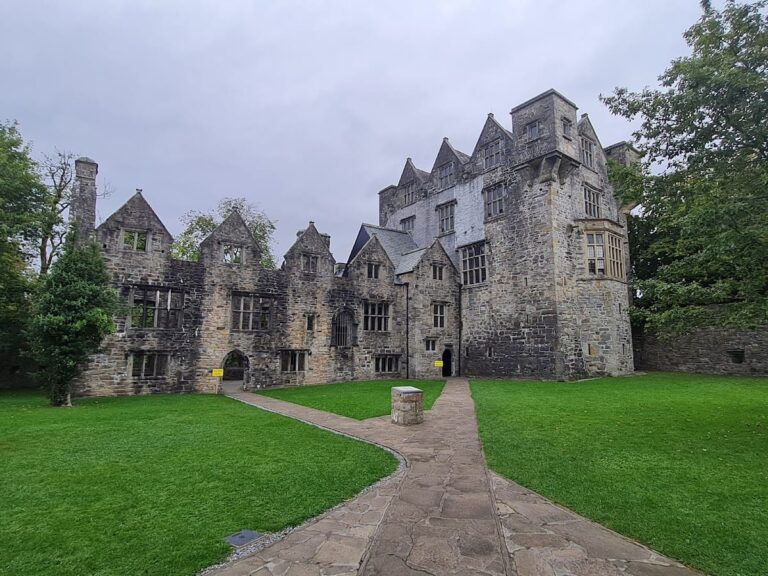
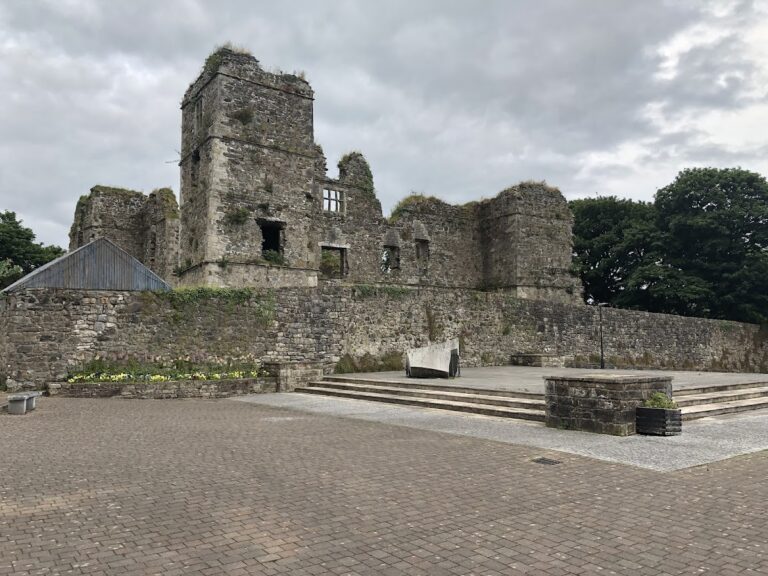
Donegal Friary stands near the harbor at the mouth of the River Eske, where it enters Donegal Bay, outside the town centre. Built beside the wharf, the original complex consisted of a church, cloisters, and a monastic garden. The 1601 destruction removed most of the buildings, leaving portions of the cloisters, church walls, choir, transept, and chapel foundations.
Surviving complex
The cloister garden lay north of the church nave and was enclosed by covered arcades, meaning roofed passageways around an open courtyard. The surviving arcades preserve different forms of support. The eastern arcade used octagonal shafts, slender vertical supports with eight sides, while the northern arcade used simpler chamfered piers, larger supports with bevelled edges.
Cloister garden
The cloister arcades are among the most substantial surviving elements of the friary. Their arrangement preserves part of the planned relationship between the garden and the church, with the cloister positioned to the north of the nave. The original design had twelve relatively narrow arcades on each side.
Church remains
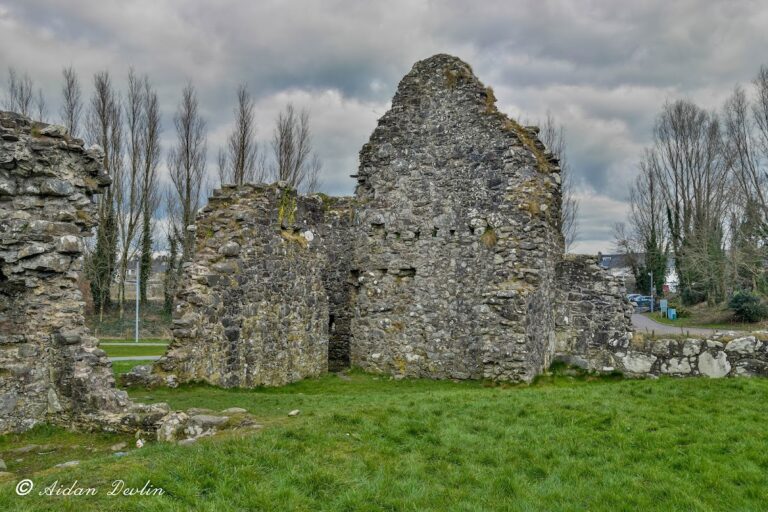
Only part of the nave’s north wall survives, together with remains associated with its south aisle, a side division running alongside the main central area of the church. Wall fragments also remain in the choir, the part traditionally reserved for clergy and singers. The south transept, the cross-arm projecting from the church, survives only as its south wall. Foundations show that a side chapel extended eastward from the south transept.
The existence of a tower remains uncertain. The surviving fabric is fragmentary and reflects the severe damage caused by the 1601 explosion and fire, followed by the incomplete rebuilding attempted after the friars’ flight.
Nearby sites