Santa Maria Maggiore Church: The Duomo of Mirandola


Site at a Glance
- Rating
- 4.6
- Popularity
- Low
- Country
- Italy
- Primary era
- Medieval
- External website
- Open
- Eras represented
- Medieval, Early Modern, Modern
- Civilizations
- Holy Roman Empire, Italian
- Site type
- Religious
- Remains
- Church
On this page18 sections
History
Santa Maria Maggiore Church, also known as the Duomo of Mirandola, is the principal Roman Catholic church of Mirandola, Italy. Built under the rule of the Pico family in the late Gothic period, its construction began in 1440 and the church was consecrated on 27 July 1491. Dedicated to the Assumption of the Virgin Mary, it stands in the historic center and belongs to the Diocese of Carpi.
Foundation under the Pico family
Francesco III and Giovanni I Pico, lords of the Duchy of Mirandola, began the church in the new district called Borgo Novo. The work was completed by Galeotto I and Antonio Maria Pico, the brothers of Giovanni Pico della Mirandola. The project had an institutional purpose as well as a religious one. It allowed the Pico family to establish Mirandola’s parish within the citadel, whose pastoral administration had previously depended on the Pieve of Santa Maria della Neve at Quarantoli.
In 1467, the Pico family obtained from Pope Paul II the creation of a collegiate church. This was a church served by a permanent college of clergy rather than by a monastic community. The college consisted of a provost, six canons, and three mansionaries, clergy assigned to particular ecclesiastical duties or services. The arrangement gave Santa Maria Maggiore an established clerical structure before its consecration in 1491.
Later ecclesiastical and architectural changes
Antonio Bernardi, a philosopher and bishop of Caserta, was buried in the church. His original tomb was dispersed in 1789, although a later funerary monument remains associated with his burial. In 1821, Santa Maria Maggiore and Mirandola’s other churches passed from the Diocese of Reggio Emilia to the Diocese of Carpi. A restoration commissioned by the parish priest Riccardo Adani in 1858 removed several side altars and funerary monuments.
The bell tower underwent repeated alterations and collapses. Work on it began in the fifteenth century, and a request to raise it was made in 1574. In 1676, builders added a gilded copper angel to the spire, the tapering upper end of the tower. Its excessive weight caused the spire to collapse on 15 February 1697, damaging the church roof, the sacristy, and granaries belonging to the nearby Santa Maria Bianca Hospital.
The tower was restored in 1749, followed by further work in 1825 and 1838 to 1839. Another major collapse occurred on 2 November 1885. A citizens’ committee raised funds to restore the structure rather than lower it, and reconstruction began on 7 July 1888. The upper part was strengthened and given its present octagonal spire and terminal cupola, a small dome-like crown beneath a cross.
War damage and earthquake reconstruction
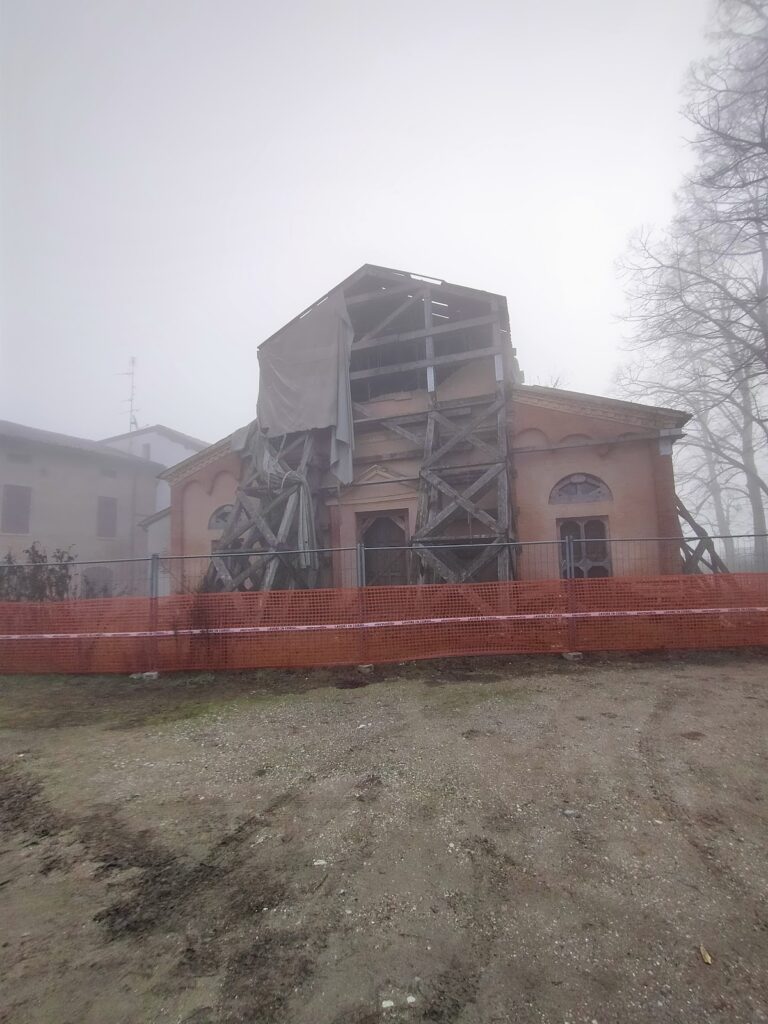
On 20 April 1945, during the final days of the Second World War, bombs exploded near the church and destroyed several stained-glass windows. The windows were replaced in 1947 by the Fanfani firm of Faenza. The bell tower survived the bombing, but the 2012 Emilia earthquakes caused extremely severe damage to both the tower and the church.
The collapse of the timber roof and its supporting trusses brought down the interior vaults. Falling debris severely damaged or destroyed much of the interior, while the bell tower lost its internal stairs. The church remained closed from 20 May 2012 until 21 September 2019. During the restoration, its seven bells were replaced in October 2012 by a digital audio system using partly archival and partly digitally reconstructed sounds. After the restoration and reopening, the bells resumed their function.
Pope Francis visited Santa Maria Maggiore on 2 April 2017 while scaffolding still enclosed the central nave. He placed flowers on the high altar in memory of those who died in the 2012 earthquake and later addressed citizens gathered in Piazza della Conciliazione. The restored church reopened for worship on 21 September 2019.
Remains
Santa Maria Maggiore is a Gothic church whose original form belongs to the late Gothic period. It stands in Piazza della Conciliazione, also known as Piazza Duomo. The present facade reflects fifteenth-century and pseudo-Renaissance work carried out during later extensions and restorations, including the rebuilding associated with 1885. The apse, the curved termination beyond the main body of the church, and the side walls belong to the fifteenth-century Gothic rebuilding phase.
Interior structure
The interior is arranged in three naves, the principal longitudinal divisions of a church. Ribbed cross vaults, strengthened by projecting stone ribs that define their intersecting sections, span the naves. They originally supported a timber roof carried by trusses. The 2012 earthquake brought down that roof system and the vaults, leaving the interior subject to extensive restoration before the church reopened in 2019.
Presbytery and high altar
Apse painting and choir
At the center of the apse was an altarpiece of the Assumption of the Virgin, painted around 1520 by Giulio and Giacomo Francia. Francesco IV, Duke of Modena, purchased the original in 1818. A copy by the Carpi painter Ippolito Bianchini Ciarlini subsequently took its place in the church. Beneath the painting is a seventeenth-century choir made of walnut.
High altar and presbytery paintings
The high altar was erected between 1771 and 1776 in polychrome marble carved by craftsmen from Verona. Its Eucharistic tabernacle was made in 1952 by Carmela Adani, a sculptor from Correggio. The presbytery, the area around the high altar reserved especially for officiating clergy, is flanked by two paintings. On the left is The Healing of the Bleeding Woman by an anonymous sixteenth-century Mantuan artist, while on the right is The Transit of the Virgin Mary by Giuseppe Andreoli.
Chapels and left nave
Chapel of the Blessed Sacrament
On the left side of the presbytery, the Chapel of the Blessed Sacrament contains a white Carrara-marble altar by the Veronese sculptor Salesio Pegrassi. Its furnishings include a nineteenth-century processional cross of carved and gilded wood. In 1983, Pietro Annigoni frescoed the chapel’s left wall with a Crucifixion commemorating his father Ricciardo, who was born in Mirandola in 1870 and died in Florence in 1944.
Baptismal font and terracotta cross
Near the side entrance at the beginning of the left nave is a seventeenth-century baptismal font made of red Verona marble. Its wooden cover dates from 1812. In the second bay, a large glass case protects a terracotta cross standing 2.37 metres high. Made by the Sorrento sculptor Marcello Aversa, the cross carries scenes from both the Old and New Testaments.
Paintings and Madonna of Pompeii Chapel
The third bay of the left nave contains Sante Peranda’s 1612 painting The Pietà Adored by Saints Francis and Charles Borromeo. Farther along is the Chapel of the Madonna of Pompeii, whose gilded wooden altarpiece was made in the seventeenth century by the Mirandola woodcarver Pietro Giacomo Guagnellini. Its two side niches hold statues of Faith and Hope, two of the theological virtues, made by Giuseppe Pisani in 1837.
Right nave and sacristy
Bernardi monument
At the beginning of the right nave stands the marble funerary monument to Antonio Bernardi, the philosopher and bishop of Caserta. The Reggio sculptor Prospero Sogari made it on commission from Bernardi’s nephew, Giuseppe.
Paintings and carved altarpiece
The right nave contains Sante Peranda’s The Martyrdom of Saint Stephen. Above the door to the sacristy is Giuseppe Andreoli’s Saint Possidonius Holding the City of Mirandola in His Hand. Saint Possidonius is identified as Mirandola’s patron. Farther along the nave is a richly carved and gilded wooden altarpiece made in 1683 at the request of Duke Alessandro II and his wife, Anna Beatrice d’Este. It is attributed stylistically to the Mirandola artist Paolo Bonelli, who lived from 1651 to 1712, and houses Lucio Massari’s The Ecstasy of the Penitent Saint Mary Magdalene.
Sacristy painting
The sacristy contains Alessandro Tiarini’s 1612 painting The Madonna Appearing to Saint Felix of Cantalice. Together with the works in the naves and chapels, it forms part of the church’s surviving collection of paintings, sculpture, gilded woodwork, marble furnishings, stained glass, and devotional objects.
Bell tower
The bell tower stands behind the southern side of the Chapel of Saint Ubaldo and rises 48 metres. Its seven bells occupy two levels: the largest is on the uppermost level, while the other six hang in the belfry below. Bells II, III, IV, and VI can be rung manually using the traditional Bolognese system.
A separate civic bell, known as the Civic Great Bell, was cast in 1737 and weighs approximately 400 kilograms. It is not included among the church’s seven bells. The tower’s present upper form, with its octagonal spire and terminal cupola beneath a cross, dates from the reconstruction begun in 1888 after the collapse of 1885. Its restored bells continue the tower’s role after the earthquake damage of 2012.