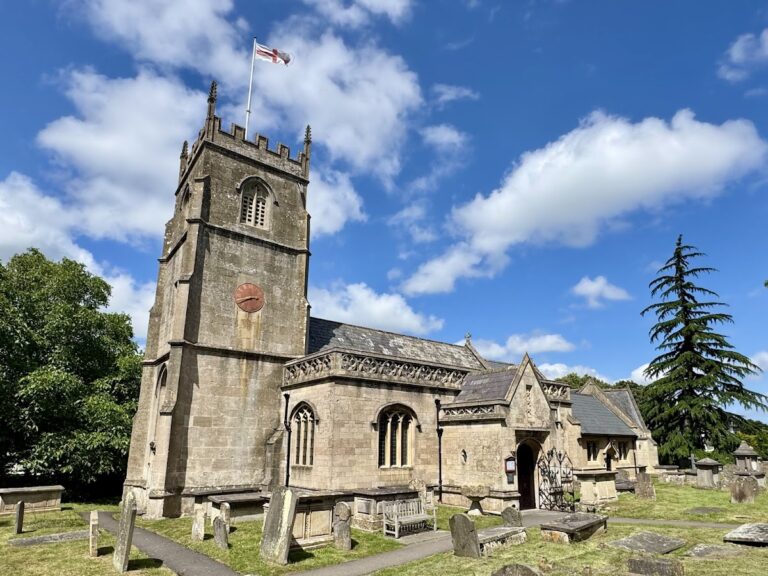
Church of St John the Baptist, Keynsham: An Anglican Parish Church


Site at a Glance
- Rating
- 4.6
- Popularity
- Very Low
- Country
- United Kingdom
- Primary era
- Medieval
- External website
- Open
- Eras represented
- Medieval, Early Modern, Modern
- Civilizations
- English
- Site type
- Religious
- Remains
- Church
On this page13 sections
History
Church of St John the Baptist, Keynsham, is an Anglican parish church in the United Kingdom, built for the townspeople around 1270. Its history reaches back to a minster at Keynsham by the ninth century and is closely connected with Keynsham Abbey, founded in the twelfth century as a place of worship for the town. The church was designated a Grade II* listed building on 27 February 1950, a status used in England for buildings of more than special interest.
A townspeople’s church and the abbey
The church built around 1270 divided responsibility between the town and Keynsham Abbey. The abbey maintained the chancel, the eastern part of the church containing the altar and traditionally reserved for clergy and choir, while the townspeople were responsible for the rest of the building. These separate obligations contributed to periodically strained relations between the abbey and the town. The arrangement ended with the Dissolution of the Monasteries, the process by which Henry VIII’s government suppressed England’s monasteries and seized their property during the 1530s and 1540s.
The south aisle and south porch were added around 1390, and the abbey’s chancel was rebuilt in 1470. After the abbey was dissolved in 1539, Sir Henry Bridges bought its site in 1552. He and his descendants held the advowson, the legal right to nominate a parish priest to a benefice, until the eighteenth century.
Seventeenth-century damage and repair
A storm in 1632 caused the spire over the north aisle to collapse into the church. A replacement bell tower was then built over the north-east corner of the nave, the main central area for the congregation, and rises above the western entrance. The tower was said to have been built with stone taken from the ruins of the abbey church. Further restoration followed between 1634 and 1655.
Thomas Codrington was vicar when the spire collapsed. After the English Civil War, the conflict of the 1640s between supporters of Parliament and King Charles I, his stipend was increased as part of a settlement imposed on Thomas Bridges, lord of the manor, because Bridges had supported the Royalist cause. Following the Restoration of the monarchy under Charles II in 1660, Codrington appears to have returned to royalist support. He persecuted local Quakers, members of the Religious Society of Friends, a Christian movement that developed in seventeenth-century England and rejected many established church practices.
Decline and Victorian renewal
The congregation declined during the eighteenth and early nineteenth centuries, while the fabric deteriorated. By 1843 the south porch was being used as a coal store and the roof was leaking. George Robinson became vicar in the 1850s and revitalised the parish. He rebuilt the vicarage for his thirteen children, founded a church school, raised money for restoration, increased the number of services, and remained in office until 1870.
The principal nineteenth-century restoration took place between 1861 and 1863, with much of the work undertaken by Benjamin Ferrey, an English architect known for ecclesiastical restoration. Box pews were removed, windows were restored, the nave arches were rebuilt, gas lighting was installed, the roof was rebuilt, and the walls were replastered. The work cost about £4,000. Joseph Gray, who succeeded Robinson in 1870, continued to develop the church and its charitable activities, both in the local area and in support of missionaries overseas. During his incumbency, the churchyard became full and a new cemetery was created.
Expansion in the twentieth century
Keynsham’s population grew during the twentieth century, partly as a result of the construction of the Somerdale Factory. Douglas Percival Hatchard, vicar from 1901, continued work on the church school and fundraising for restoration. The Keynsham Electric Light Company supplied heating from its plant beside the church.
The mission church at Chewton Keynsham remained a dependent chapel and was often served by lay readers. A memorial was erected after the First World War. During the Second World War, Vernon Graham Havergal Shaw’s pacifism brought him into conflict with the church council and churchwardens over whether prayers should be said for the troops. He left the parish in 1945.
Trevor Wright was in charge when serious problems were identified during the 1950s. Mervyn Wedgewood became vicar in 1956, as the town continued to expand. He established new classes and groups, led the construction of St Francis Church, and helped develop new parish facilities. The old church rooms were demolished in the 1960s to make way for a bypass. Compensation funded a new church hall and vicarage, and a team ministry, an arrangement in which several clergy share pastoral responsibility, was established during the 1970s.
The modern parish
The church continues its local and international charitable work as one of four churches in the Church of England Parish of Keynsham. The other churches are St Michael’s at Burnett, St Margaret’s at Queen Charlton, and St Francis Church on the Park Estate. The parish belongs to the Archdeaconry of Bath, an administrative subdivision of a diocese supervised by an archdeacon.
Later leaders included Gordon George Bradshaw, rector from 1975 to 1983, and Richard Frith, who served from 1983 to 1992. During Frith’s tenure, the Bridges Society was founded and later became Friends of St John’s. Stephen M’Caw served as team rector from 2012 to 2023, and Aidan Watson was appointed team rector in 2025.
Remains
Medieval church and later tower
The stone church consists of an eight-bay nave with north and south aisles, a south porch, a south-east vestry, and a three-stage west tower. A vestry is a room used by clergy and for storing items associated with worship. The south aisle and south porch date from around 1390, while the chancel was rebuilt in 1470. The roofs include hammerbeam structures, in which short horizontal timber beams project inward from the walls to support the roof framing. Nineteenth-century restoration added stained glass to the surviving fabric.
The tower stands over the north-east corner of the nave and rises above the western entrance. Set-back buttresses support its three stages, and the upper part has a pierced parapet with short crocketed pinnacles. Its construction followed the collapse of the earlier spire in 1632, and its fabric was associated with stone said to have come from the ruins of the abbey church.
Interior furnishings
Seventeenth- and eighteenth-century fittings
The pulpit dates from 1634, and a screen from the same period closes off the choir vestry. At the front of the church is a small font given by Harry Bridges in 1725. Three brass chandeliers hanging in the nave were given by Mrs Ann Tilly in 1717.
The pipe organ
The first documented pipe organ was installed in 1847. George Sherborne made the instrument with two manuals and fourteen stops, and it stood on the west gallery. During the 1860s it was moved to the east end of the south aisle. In the 1880s it was enlarged, its console was moved to the chancel, and its pipes were placed behind the screen. A clarinet was added in the 1920s, followed by an electric blower in 1939. Further restoration took place in the 1960s, 1986, 1991, and 2000.
A former organ is traditionally said to have been acquired by George Frideric Handel, the German-born Baroque composer and organist, around 1730 in exchange for two bells. This story remains unsubstantiated.
Bells and belfry
The bell tower contains eight bells, five of which survive from the 1632 spire collapse. The Great Bell was paid for by Nicholas St Loe in 1508. A Sanctus Bell, a small bell traditionally associated with the Eucharistic liturgy, dates from 1531 and hangs in the belfry, the part of the tower where bells are hung, but is not part of the peal, the set of bells arranged for coordinated ringing.
The present seventh bell dates from 1602, the sixth from 1607, and the fourth from 1613. The third was added around 1654, when the tower was completed after the spire collapse. The Bilbie family of Chew Stoke cast two additional bells in 1731. The smallest bears an inscription stating that Thomas Bilbie cast it, that its sound is small, and that it can nevertheless be heard among the people.
In 1987 all the bells were lowered from the tower and recast by White’s of Appleton. The Whitechapel Bell Foundry then electronically tuned them.
Later parish buildings
The church rooms demolished in the 1960s were replaced in the wider parish development by a new church hall and vicarage. St Francis Church on the Park Estate later underwent extensive modernisation between 2013 and 2015 and has two halls for community use.