Chiesa della Visitazione della Beata Vergine Maria: Parish Church of Tramuschio, Italy
Site at a Glance
- Rating
- 4.3
- Popularity
- Very Low
- Country
- Italy
- Primary era
- Early Modern
- Eras represented
- Medieval, Early Modern
- Civilizations
- Holy Roman Empire
- Site type
- Religious
- Remains
- Church
On this page7 sections
History
The Chiesa della Visitazione della Beata Vergine Maria is the Roman Catholic parish church of Tramuschio, a hamlet of Mirandola in Italy. Its parish dates at least to the fourteenth century, while the present church developed through rebuilding from the sixteenth century onward. Dedicated to the Visitation, the Christian episode in which Mary visits her relative Elizabeth, it remains the principal church of the local Catholic community.
Medieval and Early Modern Origins
The original parish church stood east of the Abetone and Brennero state road, near the former hospice of Saint Anthony the Abbot. The hospice received sick people and pilgrims, and the church was associated with this earlier religious and charitable setting.
A church was rebuilt at the site of the present building during the sixteenth century. In 1616, the inhabitants of Tramuschio demolished the older Church of Saint Anthony, which had itself been built in the sixteenth century to replace an earlier church. Repeated flooding had affected that building because it stood in a depression known as Chiavica or Pinzone. The Church of the Visitation was then constructed over its ruins and was rebuilt again at the end of the nineteenth century.
Diocesan Changes and Floods
Until 1821, the church depended on the parish church of Quarantoli. In that year it passed from the Diocese of Reggio Emilia to the Diocese of Carpi. Renovation followed between 1830 and 1840, with further restoration in 1933 and 1978.
The floods of the Po reached the church in 1832 and 1872, submerging it to approximately human height. The two water levels are still marked beside the altar, preserving a record of disasters that repeatedly affected the building and its community.
Earthquake Damage and Renewal
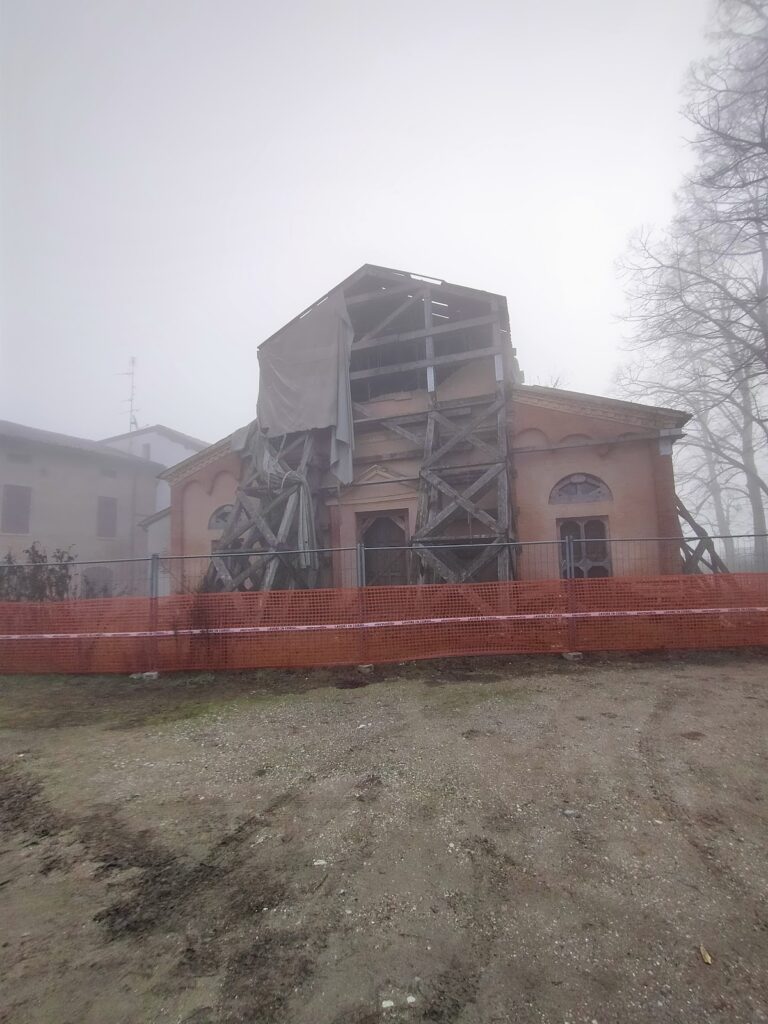
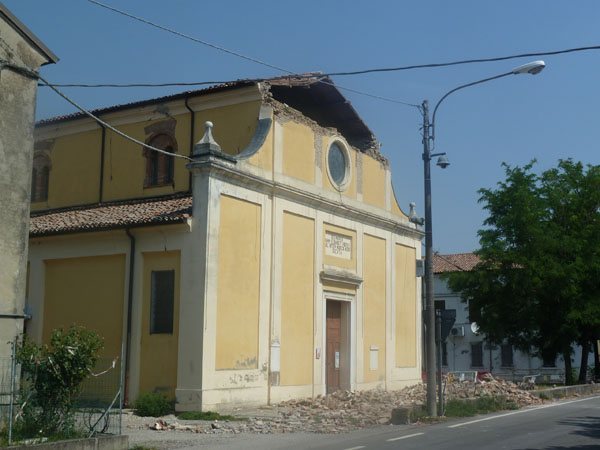
The 2012 earthquake in Emilia severely damaged the church. The facade pediment, the triangular upper section of the facade, collapsed, as did parts of the curved ceiling vaults. A restoration project was presented in February 2020, and the rectory also required rebuilding. The church reopened for worship on 21 July 2024. It belongs to Pastoral Zone 8 of the Diocese of Carpi, a grouping of parishes within the diocese.
Remains
The church has a three-aisled plan, with the surviving furnishings and architectural elements reflecting several centuries of use. Its small bell tower has a late-Romanesque form, characterized by heavy masonry and rounded arches, and resembles the bell tower of the parish church at Quarantoli.
Interior Furnishings and Images
The marble altar dates from 1883. Its rear side carries the date 1515, identified as the year of the first church erected at the present site. Beside it, the marked flood levels from 1832 and 1872 rise to approximately human height. In the choir, a framed eighteenth-century painting represents the Visitation, the dedication subject also recalled by the church’s imagery.
An organ made in 1896 by Antonio and Giosuè Battani stands on the floor of a side aisle. The church also preserves a carved wooden confessional from the sixteenth century. Artistic stained-glass windows made in Verona in 1978 depict Saint Aloysius Gonzaga, Saint Anthony the Abbot, Saint Agnes, and Saint Maximilian Maria Kolbe. Saint Aloysius was a sixteenth-century Jesuit novice associated with care for the sick, Saint Agnes was an early Christian martyr, and Saint Maximilian Maria Kolbe was a twentieth-century Polish Franciscan friar and martyr.
Bell Tower
The small bell tower is distinguished by its late-Romanesque style and its resemblance to the tower at Quarantoli. Its bell chamber contains paired arched openings, with each pair divided by a central support.