San Francesco (Deruta): Deruta’s Principal Roman Catholic Church


Site at a Glance
- Rating
- 4.4
- Popularity
- Very Low
- Country
- Italy
- Primary era
- Medieval
- Eras represented
- Medieval
- Civilizations
- Papal States
- Site type
- Religious
- Remains
- Church
On this page14 sections
History
San Francesco is a Gothic-style Roman Catholic church in Deruta, Italy, rebuilt after a violent earthquake and reconsecrated in 1388. Dedicated to Saint Francis of Assisi, the thirteenth-century founder of the Franciscan Order, it is the town’s principal church and belongs to the Archdiocese of Perugia–Città della Pieve.
Rebuilding and Franciscan connections
The church’s rebuilding followed the earthquake that damaged its predecessor, and its reconsecration in 1388 established the principal phase of the surviving medieval building. A convent beside the church was closely associated with San Francesco. Pope Urban IV, who reigned from 1261 to 1264, died there after an episode of indigestion. The convent also possessed a library that included the Missale fratrum minorum of the Master of the Deruta–Salerno Missals. The library was later lost.
A bell traditionally associated with the church is said to have been cast in 1228 to celebrate the canonization of Saint Francis of Assisi. It was brought to Deruta from a convent and remained unrecognized for centuries before being displayed again after approximately seven hundred years.
The Company of the Rosary
The Chapel of the Rosary, also called the Chapel of the Blessed Sacrament, was built in 1846. Together with the base of the polygonal bell tower, it served as the seat of the Company of Death or the Rosary. This confraternity, a lay religious association organized around devotional and ritual activities, may have descended from the Company of the Blessed Virgin mentioned in Deruta’s statute of 1465.
In 1586 the company was affiliated with the Archconfraternity of the Oration in Rome and recognized as a confraternity established at San Francesco. Its priors unsuccessfully sought permission in 1600 from the abbot of San Pietro to occupy or rebuild the parish church in Piazza. In 1606, with the bishop of Perugia’s permission, the company became affiliated with the Company of the Church of Madonna delle Piaggie.
The Company of the Rosary organized Deruta’s most prominent procession, held on Easter Monday and leading to Santa Maria di Roncione. Until the previous century, the procession was accompanied by a fair and attracted people from the surrounding countryside. The event ended after Santa Maria di Roncione passed into private ownership. During the 1930s, the company’s oratory and premises fell into ruin and were demolished with permission from the heritage authorities. Their sacred furnishings were transferred to the Church of Sant’Angelo, which was deconsecrated in 1952.
Restoration and later earthquake damage
A restoration in 1909 removed the church’s Baroque appearance and its other Baroque altars. The main altar was the sole surviving element of that phase. San Francesco became unusable after the earthquake of 30 October 2016, part of the Central Italy earthquake sequence. Religious functions moved temporarily to Sant’Antonio Abate, while San Francesco reopened on 21 May 2017.
Remains
Plan and medieval fabric
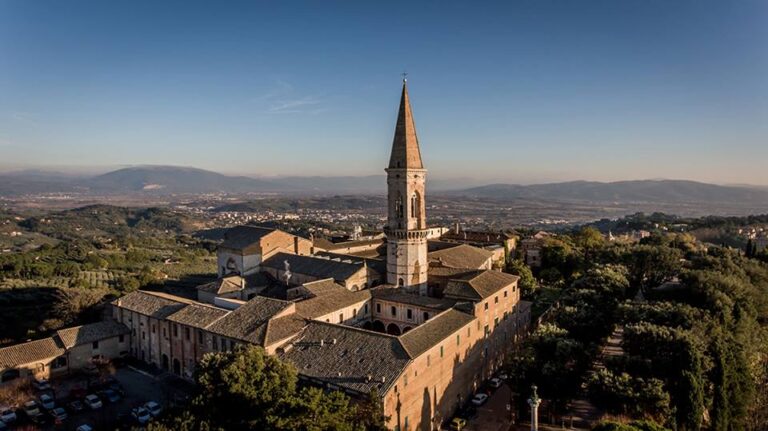
San Francesco has a simple Gothic plan formed by a single uninterrupted nave. Its pitched roof rests on timber trusses, while the apse, the polygonal termination of the church, closes the interior at the east end. The polygonal bell tower is identified as a fourteenth-century structure, and its surviving base is associated with the Company of Death or the Rosary.
The cloister adjoins the church on its right side. Two sides survive, along with very sparse fourteenth-century masonry that includes supporting pillars and sandstone blocks. Near the entrance to the former convent, fragments of fourteenth-century frescoes remain above the doorway leading into the church. They show the Madonna of Humility and a Saint, together with an architectural view containing three haloes.
Nave frescoes
Left wall
Numerous fresco traces remain on the nave walls. On the left is a niche containing the Madonna and Child between Saint Francis and Saint Bernardino of Siena, partly attributed to Domenico Alfani. Saint Bernardino was a fifteenth-century Franciscan preacher and reformer. The same side also contains Saint Jerome and Saint Anthony of Padua, partly attributed to Giovanni Battista Caporali, as well as paintings of Saint Sebastian, Saints Peter and Paul, the martyrdom of a female saint, and two scenes from the life of Saint Catherine of Alexandria.
Right wall
The right side contains a fresco of the Madonna and Child with Saints Peter the Apostle, Paul of Tarsus, Louis of Toulouse, Catherine of Alexandria, and Francis of Assisi, attributed to the Master of Santa Giuliana, an unidentified painter known by a conventional art-historical name. Other paintings show Christ in the House of Martha and Mary and Saint Anthony of Padua and Scenes from His Life, the latter set within a niche.
Apse and windows
The apse was decorated toward the beginning of the twentieth century. High on its left side is a fourteenth-century fresco of the Resurrection of Christ. The compartments of the apse vault contain a Franciscan emblem and the symbols of the four Evangelists.
The stained-glass windows are modern. The central window was produced in the 1950s by the Moretti-Caselli studio of Perugia, imitating the windows of the Basilica of Saint Francis in Assisi. The same studio made the lateral windows during the 1980s.
Altars and the Chapel of the Rosary
Main altar
The surviving main altar was commissioned in 1757 by the Company of the Blessed Sacrament. Made of fine marble, it held the relics of Saint Simplicius, Deruta’s municipal patron. Its survival gives a physical link to the church’s Baroque phase and to the devotional activities of the company that commissioned it.
Rosary chapel
The Chapel of the Rosary has a Neoclassical interior, a style drawing on ancient Greek and Roman forms. Its statue of the Virgin of the Rosary probably dates from the seventeenth or nineteenth century and is an object of particular veneration among the people of Deruta. The chapel altar was made in 1899 by the Perugian physician Angelo Micheletti. It depicts praying angels based on paintings by Fra Angelico, the fifteenth-century Italian Dominican painter. Micheletti also participated in the revival of Deruta’s ceramic production and in founding the Regional Museum of Ceramics.
Ceramic additions were installed on the chapel’s counterfacade and side walls from the 1980s onward. Beneath the statue is a maiolica panel, a tin-glazed ceramic work, depicting the Mysteries of the Rosary. It includes the Presentation of Jesus in the Temple by Cesare Teobaldo Pimpinelli and the Way to Calvary by Cesare Margaritelli, known as “Cesarino.” Painted flying angels holding a floral crown were made by Alpinolo Magnini in the 1930s and rediscovered in recent times.
Works associated with the church
Works formerly associated with San Francesco include Perugino’s Eternal Father with Saints Roch and Romanus. Perugino was the Renaissance painter Pietro Perugino. Another was Niccolò Alunno’s Madonna of the Consoles, originally the central panel of a polyptych on the main altar. A seventeenth-century canvas depicting Christ the King with the Madonna, Saint Francis, four Franciscan male saints, four Franciscan female saints, and the Souls in Purgatory was commissioned by Bernardino Venturi and came from the church’s third altar on the left. It was transferred to Sant’Antonio Abate after the Baroque altars were demolished during the early twentieth-century restoration.
A ceramic floor dating from about 1700, formerly in the Church of Sant’Angelo, is preserved in the Regional Museum of Ceramics. Its history reflects the movement of Deruta’s religious and artistic furnishings between churches and museum collections.