Ruhland Parish Church: Evangelical Town Church in Germany


Site at a Glance
- Rating
- 4.6
- Popularity
- Very Low
- Country
- Germany
- Primary era
- Early Modern
- Eras represented
- Early Modern, Modern
- Civilizations
- Electorate of Saxony, German, Holy Roman Empire
- Site type
- Religious
- Remains
- Church
On this page9 sections
History
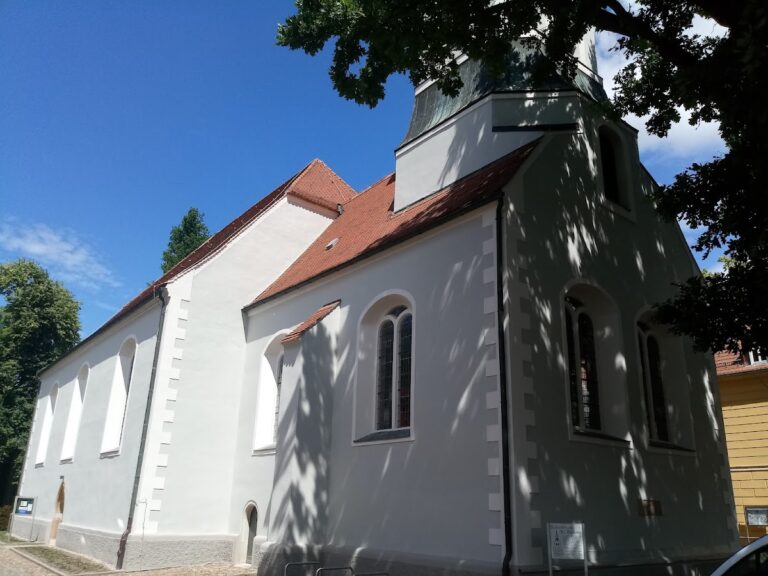
Ruhland Parish Church is an Evangelical town church in Ruhland, Germany, rebuilt between 1772 and 1774 after repeated fires destroyed earlier churches on the site. The present building belongs to the late 18th century, and its interior includes Baroque elements. It stands in the town center and is protected as a historic monument in the Oberspreewald-Lausitz district of southern Brandenburg.
Medieval predecessors and rebuilding
Several predecessor churches occupied the site during the 14th and 15th centuries. Repeated town fires caused severe damage or destruction, with the latest major fire taking place in 1768. The church was then rebuilt under the direction of Samuel Locke, a Dresden master builder who lived from 1710 to 1793.
Parish use and modern conservation
The church is used by the Evangelical Parish of Ruhland, part of the Silesian Upper Lusatia church district within the Evangelical Church Berlin-Brandenburg-Silesian Upper Lusatia, a regional Protestant church body in eastern Germany. The parish also uses the castle chapel at Guteborn.
Repairs and renovations from 1986 to 1992 addressed the building’s fabric. Fungal decay was removed from the roof timbers in 1986, and between 1987 and 1990 the roof was retiled while the church and tower were repainted. The organ underwent extensive restoration in 1996 and 1997.
Heating work in 1994 revealed several crypts, which were later built over. The tower required further intervention because the church stands on swampy ground. Alder-wood rafts had been placed about three metres below the foundation, but fluctuating groundwater caused the timber to decay. Cracks developed in the tower and between the tower and nave, and the western half of the tower began to lean. Concrete injection stabilized the foundation in 2005 and 2006.
Furnishings, memory, and interpretation
The importance of three late-medieval carved figures kept for many years in a cabinet at the north wall was recognized in 2016. Their restoration was completed by 2023. The late-medieval winged altarpiece was not made for a funerary chapel and may have been transferred to Ruhland from the monastery church at Doberlug after the Reformation. A later lower section and upper structure were created to preserve the altar. Its arrangements changed over time, including its presentation in the funerary church before 1945 and within an altar structure dating from around 1600 in a 1981 photograph.
In 2017, during celebrations of Ruhland’s seven-hundredth town anniversary, the noble gallery served as a studio and exhibition space for the Georgian painter Anatoli Riaboshenko, who made paintings and drawings of the townscape and its buildings. Memorial plaques at the north entrance commemorate inhabitants of Ruhland and of Arnsdorf, Biehlen, Guteborn, Jannowitz, Naundorf, and Schwarzbach who died in the two world wars.
The Germania Monument was erected on Ruhland’s Brauhausplatz in 1875 to commemorate local inhabitants killed in the German War of 1866 and the Franco-Prussian War of 1870 to 1871. It was moved in 1939 to its present position in front of the church because of traffic considerations. After the Second World War, the inscription “The dead of both world wars admonish us to peace” was added to the pedestal, giving the monument an additional role as a peace memorial.
Remains
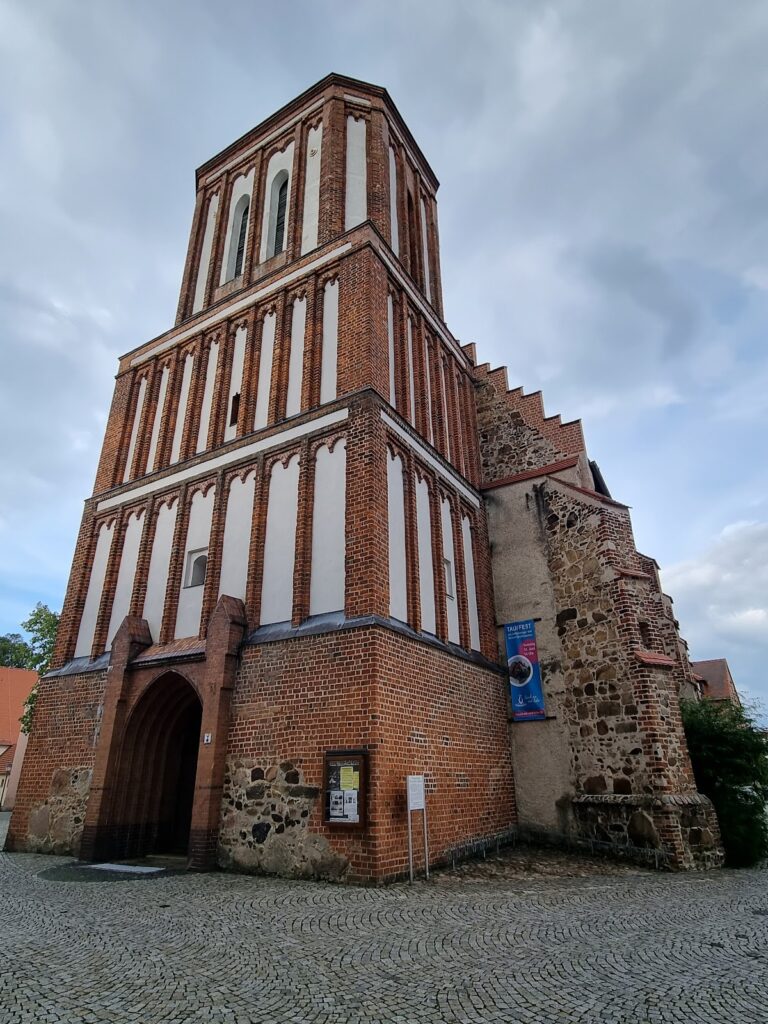
Ruhland Parish Church is a plastered hall church built from bog-ironstone, iron-smelting slag, and several types of brick. Its nave has a hipped roof, while the choir closes in a polygonal form. A square tower from the construction of the present church rises at the western end of the nave. Its upper section is octagonal and supports a copper-covered cupola with a lantern. A sacristy stands on the north side of the nave. Built before 1710, it was most recently remodeled in the 19th century.
Interior arrangement
Altarpiece and carved figures
The interior contains a baptismal font dated 1710 and a pulpit altar from around 1780. A pulpit altar combines the pulpit and main altar in one architectural composition, a form associated with Protestant church interiors. Fragments of a carved winged altarpiece from around 1510 also survive. Its central shrine, the architectural housing at the center of an altarpiece, contains a relief of the Death of the Virgin.
Three figures associated with the altarpiece date from around 1510: a Madonna of the Crescent Moon and figures of Heinrich and Sigismund. The retable, or altarpiece, was shown in a 1981 arrangement within an altar structure made around 1600. Its predella, the lower section of an altarpiece, contains small images of Jesus Christ and the Apostles. The fixed side wings bear the arms of the von Gersdorff family and of the von Bünau, von Schönberg, and von Minckwitz families. An earlier arrangement, visible in a photograph from before 1945, included an additional Gothic shrine above the retable, depicting the kneeling Mary and the twelve Apostles.
Galleries and organ
Two-storey galleries run along the north and south sides of the nave. A single-storey west gallery extends into the tower hall and has a curved balustrade. The noble gallery in the northeastern part of the nave bears the coats of arms of Ruhland’s four manorial lordships. A noble gallery was an elevated seating area reserved historically for local ruling or landowning families.
The organ stands on the west gallery. Gustav Heinze of Sorau built the present instrument in 1920 with pneumatic cone chests, two manuals, and 22 stops. A pneumatic cone chest uses air-operated controls to open valves beneath the organ pipes; a manual is a hand-played keyboard, and a stop controls a rank or group of pipes. The organ case comes from an earlier instrument installed in the church in 1854, while the organ itself was overhauled in 1996 and 1997.
Memorial features
Several commemorative plaques are fixed at the north entrance. Outside the church, the Germania Monument retains its pedestal inscription added after the Second World War, linking its original war commemoration with a later appeal for peace.