Santi Apostoli: A Historic Renaissance Parish Church in Venice


Site at a Glance
- Rating
- 4.6
- Popularity
- Low
- Country
- Italy
- Primary era
- Early Modern
- Eras represented
- Medieval, Early Modern, Modern
- Civilizations
- Venetian
- Site type
- Religious
- Remains
- Church
On this page16 sections
History
Santi Apostoli is an active Roman Catholic parish church in Venice, Italy, dedicated to the Twelve Apostles. It stands in Cannaregio, one of Venice’s traditional municipal districts, on Campo dei Santi Apostoli near the beginning of the Strada Nuova. Traditionally founded in 643, the church is regarded as one of Venice’s oldest and is especially noted for its surviving Renaissance architecture, including the Cornaro Chapel.
Early foundation and rebuilding
Tradition attributes the foundation of Santi Apostoli to Saint Magnus, Bishop of Oderzo, who was said to have established eight churches in the Venetian lagoon. In the foundation legend, the Twelve Apostles appeared to Magnus and directed him to build a church at the place where he saw twelve cranes. The church was rebuilt around 1020 or 1021, and its first documented mention dates from 1094. A fire destroyed it in 1106, after which it was rebuilt again.
Renaissance transformations
During the 1490s, the church was altered under the supervision of Mauro Codussi, a leading Venetian architect of the late fifteenth and early sixteenth centuries. This work added the Cornaro Chapel, a porch at the front, and a sacristy. The chapel became a burial place for members of the wealthy Cornaro family, including Giorgio Cornaro and his sister Catherine Cornaro, the Venetian noblewoman who became Queen of Cyprus. Catherine was buried there after her death in 1510, although her remains were transferred around 1580 to a larger tomb in San Salvador.
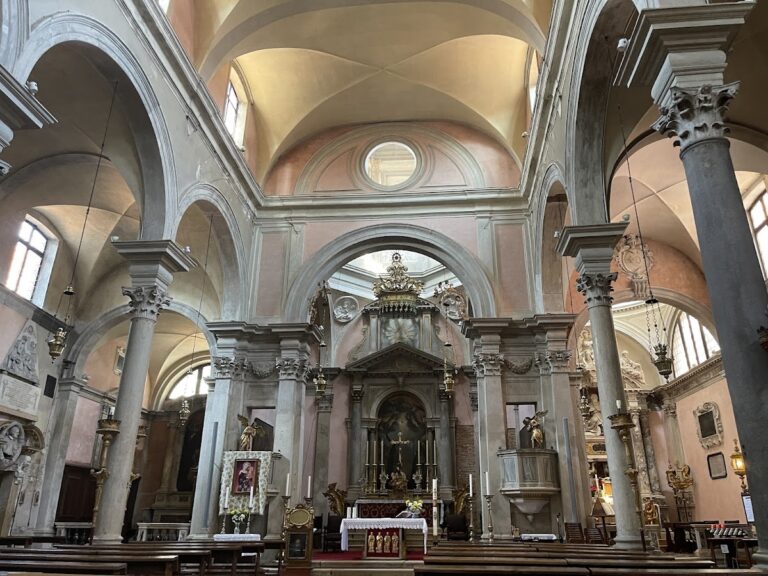
A radical rebuilding in 1549 changed the church from its earlier three-aisled basilican form to a single-aisled interior. Further modernization followed between 1570 and 1575, probably under Alessandro Vittoria, a major Venetian Renaissance sculptor and architect. The present building is principally the result of this reconstruction, while parts of the earlier church, including some frescoes and the Cornaro Chapel, were retained.
Later religious and urban changes
In the mid-sixteenth century, Santi Apostoli briefly housed the Catecumeni, a Venetian religious fraternity associated with people preparing for baptism into Christianity. The fraternity moved its permanent headquarters to San Gregorio in 1571. The church underwent another transformation in the mid-eighteenth century under Giovanni Pedolo, when additional buildings with different functions were established around it and substantially changed the surrounding urban layout.
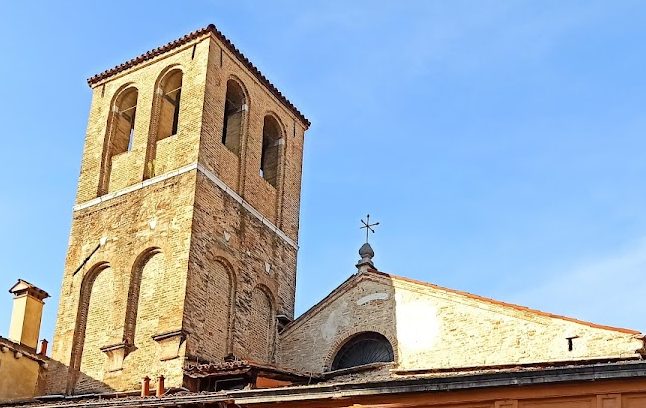
The campanile, or bell tower, was damaged by fire in 1105 and rebuilt in 1450. Francesco di Piero restored it between 1601 and 1609, but a storm destroyed it again in 1659. It was rebuilt between 1672 and 1720 under Andrea Tirali, an architect active in Venice during the late seventeenth and early eighteenth centuries. The church’s artistic furnishings were developed across these successive periods and include works by Giambattista Tiepolo, Paolo Veronese, Cesare da Conegliano, Fabio Canal, Giovanni Contarini, Sebastiano Santi, Gaspare Diziani, and Domenico Maggiotto.
Remains
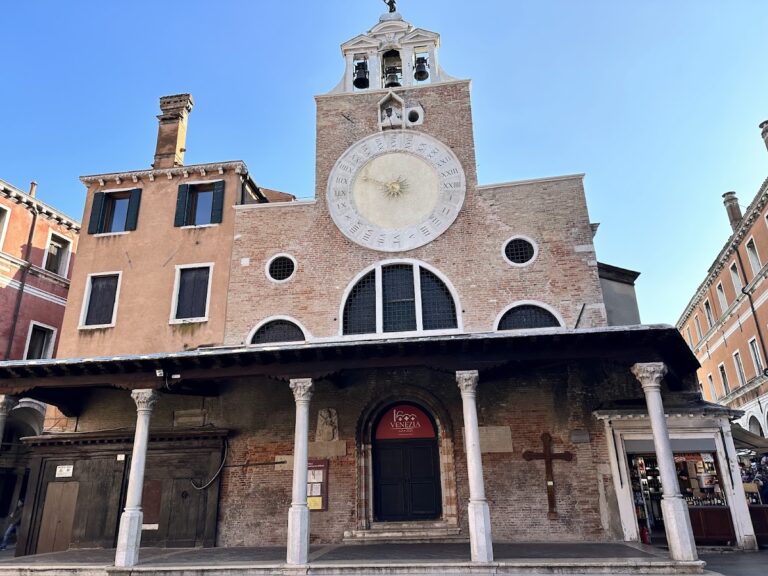
Built of brick, Santi Apostoli has a Renaissance character and a single rectangular nave. Its sixteenth-century interior layout survives with two rows of columns and a series of altars placed against the walls between pilasters. The austere main facade remains unfinished. A small building belonging to the Scuola degli Apostoli stands on its right, residential buildings extend along the church’s right-hand wall, and the fifteenth-century Cornaro Chapel occupies the space between them.
Nave and facade
Nave furnishings and ceiling
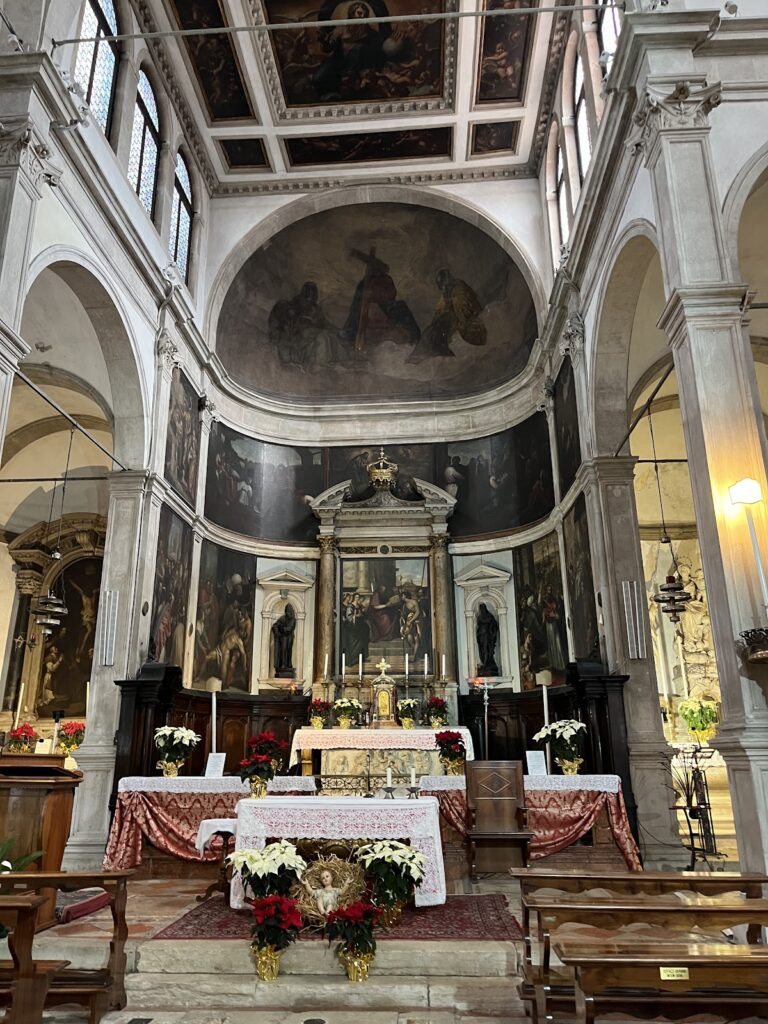
The flat nave ceiling carries Fabio Canal’s frescoes Communion of the Apostles and Exaltation of the Eucharist, together with four oval frescoes representing the Evangelists. The altars display works including Giovanni Contarini’s Birth of the Virgin, Gaspare Diziani’s The Virgin and Child with Saint Joseph, Saint John the Baptist, and Saint Anthony of Padua, Domenico Maggiotto’s Saint Catherine of Alexandria, Saint Anthony Abbot, Saint Jerome, and Saint John Nepomuk, and Sebastiano Santi’s Christ Appearing to the Apostles in the Upper Room, painted in 1828. A baptismal font and a pulpit stand between two of the altars, while the pulpit bears a relief of the Descent of the Holy Spirit.
Entrance furnishings
The inner wall of the facade contains eighteenth-century organs made by Nachini. Near the entrance are two holy-water stoups, vessels or basins used for holy water. The stoup on the right depicts Saint John the Baptist and was made by Giovanni Battista Piazzetta in 1698. The one on the left depicts Saint Peter and was made by Heinrich Meyring in 1714.
Cornaro Chapel
The Cornaro Chapel opens from the nave through a Renaissance arch. It has a square plan and a hemispherical dome supported by four columns at the corners, with a lead-covered exterior and marble decoration inside. Its principal altar contains Giambattista Tiepolo’s Last Communion of Saint Lucy, also known as Communion of Saint Lucy, painted around 1747 or 1748. Funerary monuments associated with the Cornaro family remain in the chapel, and its relief carvings were restored with funding from Save Venice.
Presbytery and side chapels
Presbytery
The presbytery contains a high altar with a tabernacle, the liturgical container or architectural receptacle used to reserve the consecrated Eucharist. Made by Francesco Lazzari in the early nineteenth century, it takes the form of a small round temple. Marble statues of Saint Peter holding keys and Saint Paul holding a sword flank it; Giuseppe Torretta made these statues in 1711. Two large canvases decorate the presbytery: Cesare da Conegliano’s The Last Supper, painted in 1583, and Manna Falling from Heaven, attributed to the workshop of Paolo Veronese and dated around 1580 to 1585.
Eucharist Chapel
The Eucharist Chapel on the right side of the presbytery contains a black-marble altar transferred from the Jesuit monastery in 1828. Its right wall preserves fragments of fourteenth-century frescoes with Byzantine influences, including The Deposition of Christ from the Cross and The Entombment of Christ. The chapel also contains Tullio Lombardo’s relief of the head of Saint Sebastian, made in the early sixteenth century.
Chapel of the Guardian Angel
On the left side of the presbytery, the Chapel of the Guardian Angel contains the fourteenth-century sculptural group Madonna between the Trees by Niccolò di Lamberti. Its altarpiece, The Guardian Angel, is by Francesco Maffei, and its walls contain nineteenth-century funerary monuments.
Sacristy and campanile
Sacristy
The sacristy contains Fabio Canal’s sketch for the nave fresco Communion of the Apostles. Its altarpiece, Christ in the Tomb with Marys and Saint John, was painted by Francesco Montemezzano. It is flanked by The Risen Christ by Giovanni Battista Mariotti and The Agony in the Garden by Francesco Polazzo.
Campanile
The campanile rises 47 metres and includes an elegant belfry chamber, the section of the tower that houses the bells. Its later architectural detailing, including an onion-shaped dome, was designed by Andrea Tirali. The tower has an electromechanically operated set of bells.