San Canciano: A Baroque Parish Church in Venice


Site at a Glance
- Rating
- 4.5
- Popularity
- Low
- Country
- Italy
- Primary era
- Early Modern
- Eras represented
- Early Modern
- Civilizations
- Venetian
- Site type
- Religious
- Remains
- Church
On this page15 sections
History
San Canciano is a Roman Catholic church in Venice, Italy, whose Baroque appearance incorporates the basic fabric of a sixteenth-century rebuilding. It stands in the Cannaregio district overlooking Campo San Canciano and serves a parish that includes the easternmost part of Cannaregio and the island of San Michele. The church belongs to the Patriarchate of Venice and is dedicated to the Aquileian martyrs Canzio, Canziano, Canzianilla, and their tutor Proto.
Origins and medieval rebuilding
Venetian tradition places the church’s foundation in 864, attributing it to refugees from Aquileia who fled barbarian or Hun invasions. This early foundation remains undocumented. The first indication of a church on the site dates to around 1040. Fire destroyed the earlier building in 1105, after which it was rebuilt immediately.
From about 1330, the church underwent a complete renewal. Marco Bianco, bishop of Jesolo, consecrated the rebuilt church on 20 May 1351. Between 1200 and 1451, San Canciano was under the jurisdiction of the Patriarchate of Grado, a major ecclesiastical jurisdiction in the Venetian region headed by a patriarch.
Sixteenth-century reconstruction
A further rebuilding took place in the fifteenth century, followed by restoration in the sixteenth century, including work recorded for 1550. In 1498, the Venetian patrician Nicolò Morosini commissioned the restoration of the bell tower. The sixteenth-century reconstruction established the core of the church that later interventions reshaped but largely retained.
The church’s religious associations center on Canzio, Canziano, Canzianilla, and Proto, Christian martyrs associated with Aquileia who were killed for their faith near present-day San Canzian d’Isonzo in 304. San Canciano is also connected with the cult of San Massimo of Cittanova, a Christian bishop associated with Cittanova in Istria. His physical remains are preserved and venerated in the church as relics.
Baroque transformation
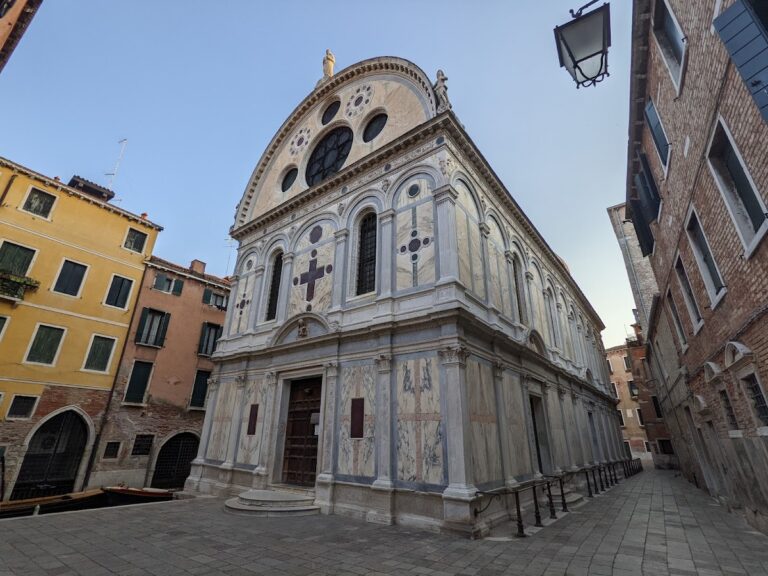
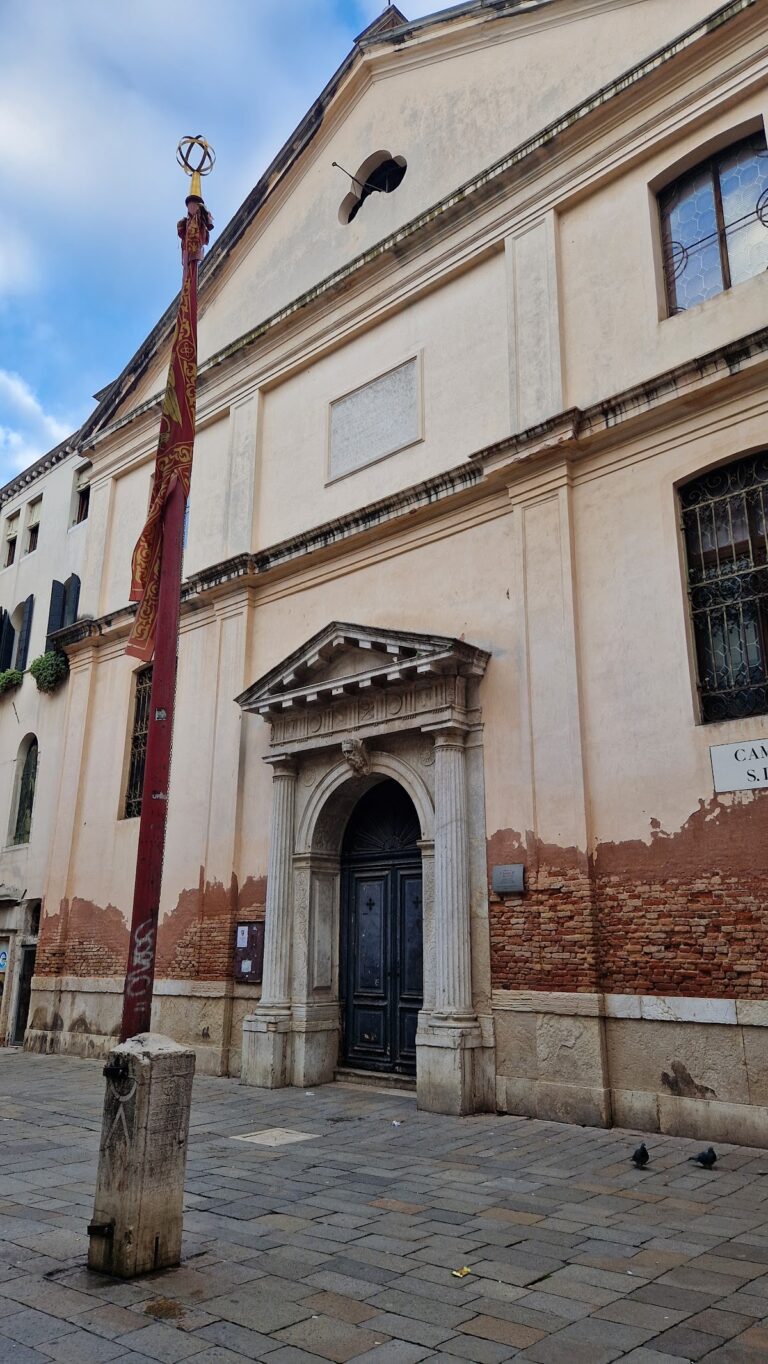
The early eighteenth century brought a new facade designed by Antonio Gaspari. The work was financed by a bequest of 2,000 ducats from Michele Tommasi, a parishioner commemorated by the bust above the entrance. Between 1760 and 1763, Giorgio Massari carried out a major interior renovation. He respected the sixteenth-century structure while raising the nave and the lantern over the main chapel to improve the church’s natural lighting.
San Canciano once had strong economic and transport connections with the northern lagoon because gondolas from Murano arrived nearby. Later construction of Strada Nova and other street improvements placed the church in an area with relatively little through traffic. Behind the building, the Sottoportego del Traghetto preserves the association with the regular ferry service to Murano.
The parish death register known as the Liber Mortuorum records the death of the Venetian Renaissance painter Titian on 27 August 1576. Titian had lived near the church. San Canciano’s history therefore combines medieval religious foundations, repeated rebuilding, Venetian parish life, and the later Baroque reshaping of an older structure.
Remains
Building and lighting
Plan and exterior
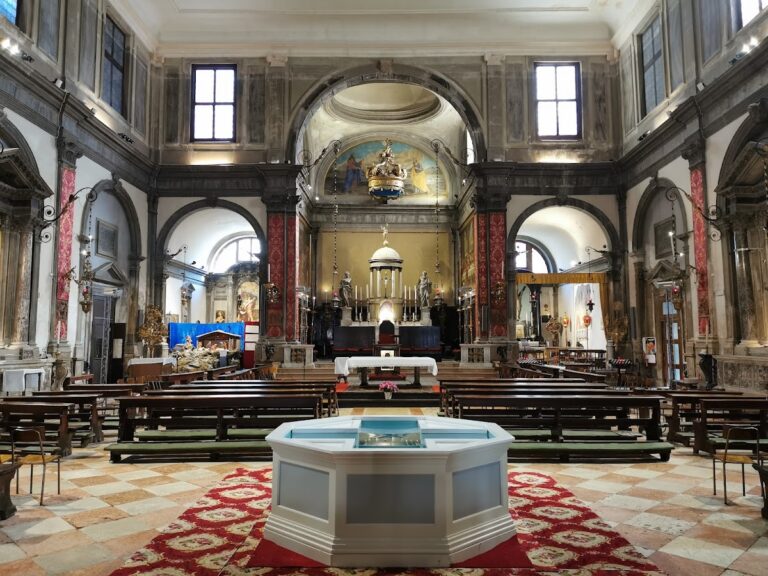
San Canciano is a small basilical building with three aisles and a relatively simple exterior. Six slender Corinthian columns divide the interior, including two columns made from ancient African granite. The presbytery, the area around the main altar reserved for the clergy, is flanked by two side chapels, while four additional altars line the lateral walls. The surviving sixteenth-century core has a Tuscanizing appearance beneath the later alterations.
Nave and lantern
Massari raised the central nave as far as Gaspari’s facade allowed and covered it with a lowered vault divided into groin-vaulted sections. Eight lateral windows were opened in correspondence with the existing arches. Above the main chapel, he added a windowed lantern, or tiburium, a raised structure that admits light. He also opened a slightly oval oculus above the triumphal arch. The facade oculus was blocked, directing most of the natural light toward the presbytery and down from above.
Bell tower and choir loft
The sixteenth-century campanile, or bell tower, rises approximately 21 metres. Three of its oldest bells were cast by the De Poli foundry around 1850, while a fourth dates from 1897. Above the entrance, Giorgio Massari’s broad choir loft contains an eighteenth-century organ. Its shutters carry painted figures of San Canciano and San Massimo by Giovanni Contarini.
Altars and chapels
Lateral altars
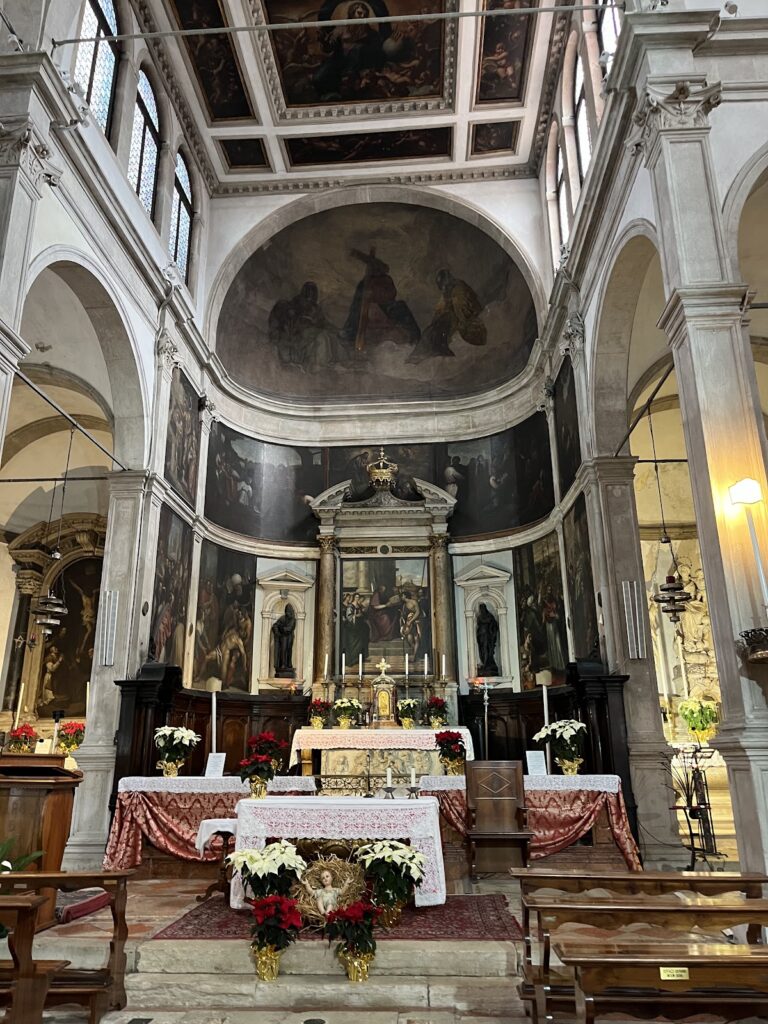
The first and second altars on the right contain Bartolomeo Litterini’s Madonna del Carmine and Madonna Addolorata con il Sacro Cuore di Gesù. On the left, Litterini’s Immacolata and Giuseppe Angeli’s Assunta occupy two further altars. The main altarpiece, Santi Canziano e Massimo con il Padre Eterno in Gloria, is traditionally attributed to Paolo Zoppo, although that attribution is considered unlikely.
Presbytery
The presbytery side paintings, La Probatica Piscina and La Moltiplicazione dei pani e dei pesci, are by Domenico Zanchi. Giovanni Segala painted the ceiling work Glorificazione di San Massimo, which was moved after the rebuilding to the area above the illuminated lantern. The two pulpits beside the presbytery were added later by Bernardino Maccaruzzi, Massari’s pupil and assistant. Maccaruzzi also created the crowning element above the seventeenth-century structure of the high altar.
Widmann chapel
The right-hand chapel formerly belonged to the Widmann family. Its elaborate Baroque altar contains the remains of San Massimo and sculptures by Clemente Molli. Rich marble and stucco decoration is associated with the Widmann family. A modern Pietà by Ernani Costantini, dated 1951, hangs on the right-hand wall outside the chapel.
Rinaldi chapel
The left-hand chapel formerly belonged to the Rinaldi family. Its altarpiece, by Nicolas Régnier, shows Saint Philip kneeling at the feet of the Blessed Virgin. Seventeenth-century busts of Antonio and Sebastiano Rinaldi occupy the side walls. Beside the chapel, above the entrance to the sacristy, are a 1728 bust of the parish priest Giovanni Maria Grattaruol and a Neoclassical cenotaph dedicated to Angelo Comello. Antonio Bosa made the cenotaph in 1814; a cenotaph is a commemorative monument that does not contain the remains of the person commemorated.
Sacristy and baptismal furnishings
The sacristy contains San Romualdo, attributed to Jacopo Marieschi, and Madonna con Bambino e i Santi Canciano e Massimo, attributed to Andrea Celesti and dated 1680. It also holds a modern Via Crucis by Ernani Costantini, dated 1960.
An ancient baptismal font dates from the end of the sixteenth century and bears seventeenth-century bas-reliefs. Its round arches, made around 1660, contain representations of the Virgin Mary and Christ. Together with the chapels, altars, paintings, bell tower, and altered lighting system, these furnishings form a surviving arrangement that combines the basilical body, the sixteenth-century reconstruction, and Massari’s eighteenth-century intervention.