Wallfahrtskirche Maria Trost: A Baroque Pilgrimage Church in Bavaria


Site at a Glance
- Rating
- 4.5
- Popularity
- Low
- Country
- Germany
- Primary era
- Early Modern
- External website
- Open
- Eras represented
- Early Modern
- Civilizations
- Holy Roman Empire
- Site type
- Religious
- Remains
- Church
On this page12 sections
History
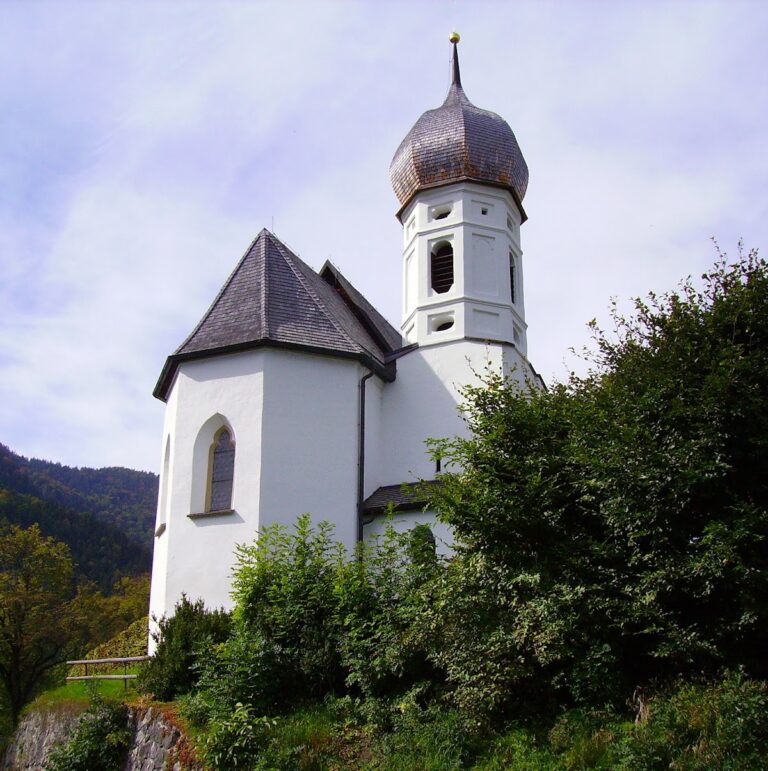
Wallfahrtskirche Maria Trost is a Catholic pilgrimage church in Germany, situated above Nesselwang in Bavaria. The pilgrimage began in 1633 after a painting of the Virgin Mary was found undamaged beneath debris from a fire. The church that developed around devotion to this miraculous image belongs chiefly to the Baroque period, an artistic style known for dramatic forms and rich decoration.
The Marian image and the beginning of the pilgrimage
Argula von Grimming, the wife of the chief district official in Regen, exchanged the smoke-blackened painting and placed it in her castle chapel. After her death, her son Rudolph von Grimming inherited the image. He first took it to his estate at Müllegg near Salzburg, then displayed it publicly on the Plainberg in 1652, where devotion to it began to grow.
A copy was made for the Plainberg while Rudolph carried the original on journeys, including a pilgrimage to Einsiedeln, a major Marian pilgrimage destination in Switzerland. Drawn by the Allgäu landscape, he settled as a hermit, a religious recluse devoted to prayer, on the Wankerberg. The later pilgrimage church above Nesselwang grew from this settlement. The revered original image is now kept at Maria Plain, a major Marian pilgrimage site near Salzburg.
The image belongs to a group of four Marian images associated with the period of Rudolph von Grimming’s foundation of the pilgrimage. Repeated overpainting made the images resemble one another and improved their appearance, but each developed its own form rather than becoming an exact duplicate of another.
From wayside shrine to pilgrimage church
Growing pilgrim numbers led to the erection of a wooden wayside shrine in 1658. It was enclosed by a wooden chapel, which was replaced by a masonry chapel in 1659. A sacristy was added at the same time, and these early structures now form the church’s choir. The first Mass was celebrated there in 1662.
In 1663, opposition and interventions by other pilgrimage sites led to Rudolph von Grimming’s expulsion from the territory. The original image came under the care of the Nesselwang parish and remained at the Salzburg episcopal ordinariate from 1665 to 1676. From 1668, Salzburg Archbishop Max Gandolf planned to move it to a newly built church on the Plainberg.
During the War of the Spanish Succession, a conflict that affected European dynastic and territorial politics, the number of pilgrims visiting Maria Trost above Nesselwang increased. Donations rose with the pilgrimage, providing the funds to extend the sanctuary with its present nave from 1704 onward. Bishop Alexander Sigismund, Count Palatine of Neuburg, consecrated the completed church in 1725.
Decoration and later history
A visitation record from 1740 described the “miraculous Mother of God” and the sanctuary on the high mountain. At that time, the church’s assets amounted to 5,500 gulden. Pope Benedict XIV granted privileges to the high altar in 1745, including indulgences for the dead.
The interior was completed between 1759 and 1770 with ceiling frescoes, stucco side altars, and a pulpit. The church’s greatly increased assets financed this work. A two-storey hermitage was added in 1769 and 1770, continuing the association between the sanctuary and religious retreat.
Wallfahrtskirche Maria Trost has undergone two renovations without structural rehabilitation. The most recent renovation was ceremonially completed on Ascension Day in 2019. The church is legally protected as a historic monument.
Remains
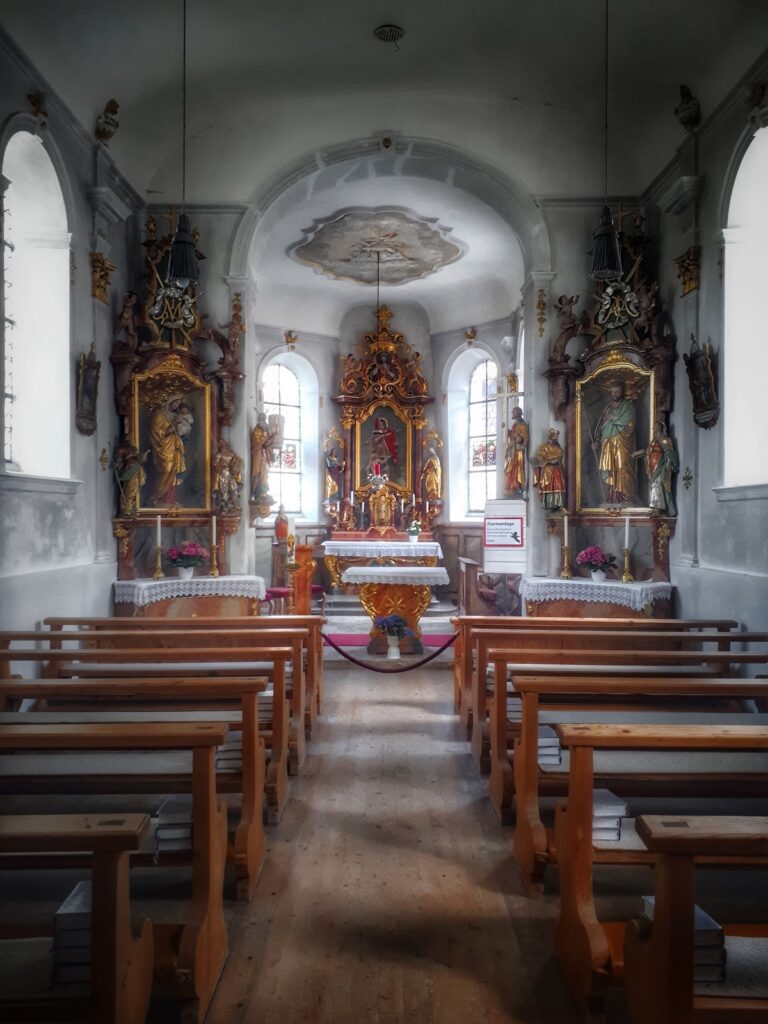
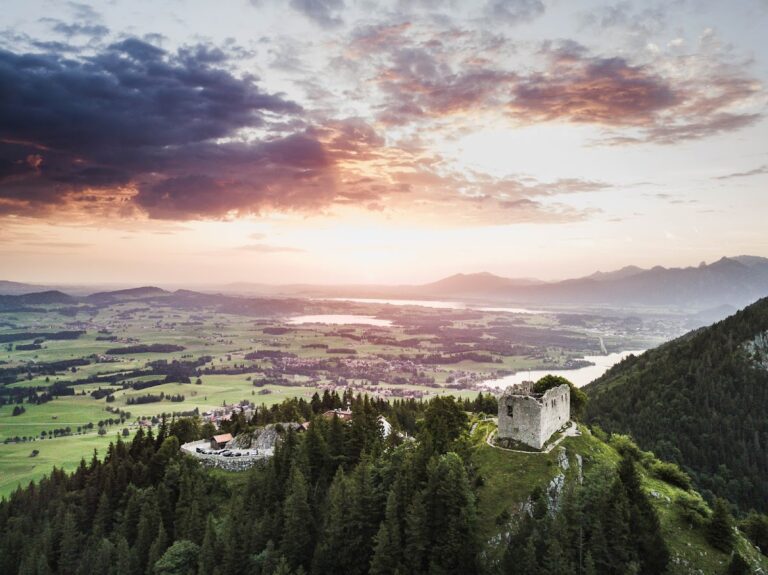
The church stands in a forest clearing at an altitude of 1,123 metres on the northeastern slope of the Alpspitz. Reached only on foot, it has a Baroque interior organized around the early masonry choir and the nave added from 1704. The flat ceiling of the nave is covered throughout by painted scenes, while the furnishings combine seventeenth-, eighteenth-, nineteenth-, and twentieth-century work.
Choir and ceiling paintings
The choir and high altar
The early masonry chapel and its sacristy make up the present choir. The high altar was carved in 1710, and its reverse carries a date written by Georg Unsin, who served as sacristan and hermit. Johann Georg Schall of Nesselwang painted its brightly coloured Assumption of Mary in 1717. Two further paintings by Schall are recorded in Regensburg.
The altar’s finish may have followed the example of Maria Plain. Six twisted columns flank its retable, the main decorated panel behind the altar. Above them rises a superstructure with a shell-shaped vault and a sculptural group of Jesus in the Temple. The altar was reconstructed in its original arrangement in 1982.
The nave frescoes
The nave ceiling carries a Marian programme of high quality. In the central scene, the four continents represent the whole world venerating the Virgin as Queen of Heaven, who stands on a globe. An angel presents her with a view of Nesselwang on a sheet, while the Christ Child in her arms blesses the town.
The eastern painted field shows angels presenting the miraculous Maria Trost image within a finely painted domed interior. In the western field, another domed interior contains Joachim and Anna asking for a child as the Immaculate Virgin appears to them. The Immaculate Virgin is Mary understood through the doctrine of the Immaculate Conception. A monochrome grisaille painting, designed to resemble sculpture, occupies the transverse band toward the central field and displays the arms of Joseph, Landgrave of Hesse-Darmstadt and Bishop of Augsburg, Nesselwang’s territorial lord from 1740 to 1768.
Side altars and pulpit
The two side altars are dedicated to Saint Joachim on the right and Saint Anne on the left. Their stucco Rococo superstructures, a lighter and more delicate form of eighteenth-century decoration, include Classicist elements, putti heads, putti, and volutes. Their columns are ornamental rather than structural.
Plaster figures were placed in the altar niches for the bicentenary in 1859. In 1982, Armin Luda of Nesselwang carved two replacement figures in the style of the second half of the eighteenth century and donated them to the church. Margot Luda painted their finishes and designed the mensae, or altar tables, while Winfried Bernegger of Lechbruck renewed the stucco finishes in consultation with the monument-protection authority. The Anne altar was converted into a sacrament altar by inserting a tabernacle, the cabinet used to reserve consecrated Eucharistic elements.
The high-quality pulpit is elaborately decorated with stucco. Its ornament contributes to the unified eighteenth-century character of the interior.
Sculpture and devotional objects
A figure of Christ in Prison stands in a niche in the entrance porch. Johann Georg Hirsch of Günzburg carved it around 1910, using an eighteenth-century figure now in private ownership as its model. A crucifix with the mourning Virgin hangs on the north wall and was made around 1650 by an unidentified sculptor.
Another mourning Virgin came from a Crucifixion group in Nesselwang’s old parish church and is probably associated with the workshop of Nikolaus Babel. The two thieves from that group were transferred to the chapel in Thal in 1942. An inscription on the Good Thief states that Georg Straub Böck commissioned the image in 1704. Figures of the Virgin Mary and Christ Salvator, meaning Christ the Savior, were probably carved by Ignaz Erdt at the beginning of the eighteenth century.
The church has 38 votive paintings from the late eighteenth and early nineteenth centuries. Votive works are offerings made in response to a prayer or devotion. For security reasons, photographic reproductions of the paintings are displayed in the pilgrimage church, together with two additional votive hands made of wax. The parish archive preserves a miracle book from 1753.
Additional furnishings and bells
Two glass cases in the choir contain votive works in silver and wax as well as convent handicrafts dating from the eighteenth to the twentieth century. The Way of the Cross has 15 stations commemorating episodes traditionally associated with Christ’s Passion. The fourteenth station is signed “L. C. Weiss pinx 1846.” An earlier Way of the Cross in the Nazarene style, signed “Dolci 1869,” was replaced by the present series in 1935.
The pews were made by the Pöllath firm in 1934 and 1935. An expert assessment identified larch wood in their side panels and related them to original patterns. The north-portal door was made by the Nesselwang master carpenter Schön.
The small bell weighs 75 kilograms and was hung in the turret in 1671 during the episcopate of Johann Christoph von Freiberg. It bears the inscription “Otto Sartor of Kempten cast me” and is decorated with a Crucifixion group, the Veil of Veronica, the Virgin in a halo of rays, and the bishop’s coat of arms.
A larger bell cast in 1869 was requisitioned during the First World War. The Andreas Hirt foundry in Kempten cast a 150-kilogram replacement in 1928 with the inscription, “In danger of soul and body, Mary, remain my comfort!” That bell was requisitioned during the Second World War and replaced in 1952 by a bell cast by the Gebhard foundry in Kempten.
Organ and hermitage
The church’s organ was installed in 1913 by the Gebrüder Hindelang firm of Ebenhofen. Its stops are Saliconal 8 feet, Gedackt 8 feet, Oktav 4 feet, and Subbass 16 feet, with a pedal coupler and a small mixture. Zellhuber of Altstädten repaired the instrument in 1982.
The two-storey hermitage added in 1769 and 1770 forms part of the site’s surviving association with religious retreat. Rudolph von Grimming established that association when he settled as a hermit on the Wankerberg, and Georg Unsin later combined the roles of sacristan and hermit at the church.