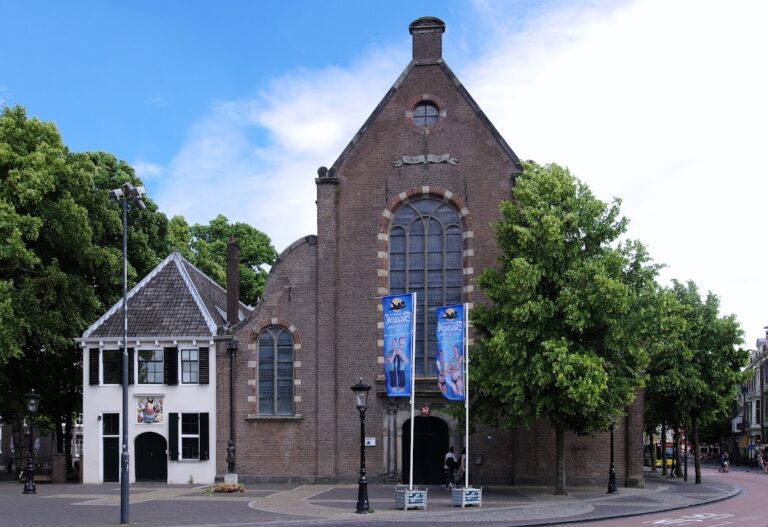
Buurkerk: Utrecht’s Medieval Parish Church


Site at a Glance
- Rating
- 4.7
- Popularity
- Very Low
- Country
- Netherlands
- Primary era
- Medieval
- Eras represented
- Medieval, Early Modern
- Civilizations
- Habsburg, Holy Roman Empire
- Site type
- Religious
- Remains
- Church
On this page9 sections
History
Buurkerk is a former medieval parish church in Utrecht, the Netherlands. Probably founded in the tenth century, it developed into an early Gothic cruciform basilica after the city’s fire of 1279 and became the oldest of Utrecht’s four medieval parish churches. Dedicated to Mary and officially known as Maria Minor, it stood in Stathe, a trading district between the Oudegracht and Zadelstraat that remained the city’s social and economic center for centuries.
Origins and medieval expansion
The church was closely connected with civic and economic life in Utrecht. Numerous guilds maintained altars there, and the city council had its own chapel. Urban fires destroyed the church in 1131, 1173, 1253, and 1279. After the last of these disasters, a new early Gothic basilica was built with a cross-shaped plan. The Buurkerk later became Utrecht’s largest and wealthiest parish church. In 1569, approximately 8,000 communicants, members of the congregation who received Holy Communion, were associated with it in a city of about 30,000 inhabitants.
Its religious community also included Berta Jacobsdochter, remembered as Suster Bertken. In 1457, a permanent enclosed cell was built for her in the church. As an anchoress, a religious recluse devoted to prayer and contemplation in a sealed cell attached to a church, she lived there for 57 years, until her death in 1514 at the age of 87. She was buried in the cell, while her poetry and prose helped preserve her memory.
Reformation and civic conflict
The church was affected by iconoclasm in 1566 and 1579. Iconoclasm involved the destruction or removal of religious images and decorations during the Protestant Reformation. Buurkerk was subsequently assigned to Protestant worship, and its medieval wall decorations were covered with whitewash. During the siege of Vredenburg Castle in 1577, when Utrecht’s citizens attacked the fortified stronghold, cannons were placed on the church tower.
In 1586, the entire choir was demolished because it obstructed traffic that had long passed directly through it. Choorstraat was then laid out across the former choir. The outline of the demolished section was once marked in the street paving, but it was not restored after repaving in November 2016.
Later use and preservation
A severe summer storm in 1674 destroyed the church’s large medieval roof. The nave of Utrecht Cathedral also collapsed during the same storm. Buurkerk received three lower replacement roofs. During the French occupation of 1672, part of the building was used as an oat store. After the French occupation that began in 1795, it served as a hay store, field bakery, and stable.
As the number of worshippers in Utrecht’s church-filled city center declined, Buurkerk ceased to be used for religious services in 1975. A thorough restoration followed between 1975 and 1984, and in 1984 the building became the home of Museum Speelklok, a museum devoted to self-playing musical instruments. Buurkerk is protected as a Dutch national monument under monument number 18353.
Remains
Buurkerk stands on Buurkerkhof, with its entrance on Steenweg, and is largely enclosed by surrounding houses. The surviving building is constructed from brick and natural stone. Its present form brings together the early Gothic church begun after 1279, later medieval enlargements, the surviving tower, historic furnishings, wall paintings, bells, burials, and museum galleries.
Church layout and medieval fabric
The post-1279 church was an early Gothic cruciform basilica, with a central nave and lower side aisles arranged around a cross-shaped plan. Between 1434 and 1456, it was extensively enlarged into a three-aisled hall church, in which the nave and aisles were of broadly similar height. Willem van Boelre was appointed as the first master builder for this work. Around 1460, the Third Buurkerk Alley was created near the church, running from the Zoudenbalch house to Buurkerk.
Further building continued between 1500 and 1520, when the church received a new three-aisled choir and a second south aisle. The second north aisle was completed in 1540, leaving the nave partly five-aisled. The final building phase ended around 1553 and included a new sacristy, the room used for worship vessels, vestments, and related objects, with a spiral staircase. The former choir occupied the area now formed by Choorstraat, where a memorial stone near number 25 marks the former location of Suster Bertken’s cell.
Tower and civic bells
The tower was begun around 1370 and dates from 1388. It survives at approximately 55 meters high. It was intended to rise farther and carry an octagonal lantern, a raised windowed structure crowning a roof or tower, like the one planned for Utrecht Cathedral. That design was not completed, and a provisional roof or termination remains in place.
Six church bells hang in the tower alongside two unconsecrated civic bells. The civic bank bell, cast by Steven Butendiic in 1471, has a diameter of 165.5 centimeters and weighs 2,600 kilograms. It announced public matters, including council decisions and verdicts. The watch bell, made by Jan Tolhuys in 1541, signaled when the city gates were to open and close. The four largest named church bells are the large Maria, made by Jan Tolhuys in 1534; Andreas, made by him in 1556; the small Maria, made by Antonis van der Borch in 1559; and Bertken, made by Petit & Fritsen in 2004. Poncianus & Agnes and Catharina-Amalia were added to the peal in 2018.
Interior furnishings and paintings
The interior was embellished between 1456 and 1499 with a church organ and a copper choir screen, which separates the choir from the main congregational space. Several fifteenth- and sixteenth-century wall paintings remain, preserving evidence of the building’s earlier religious function. The present organ was built by Johan Frederik Witte and inaugurated in 1883. It has 40 stops on three manuals and pedal, and was enlarged and restored in 1984.
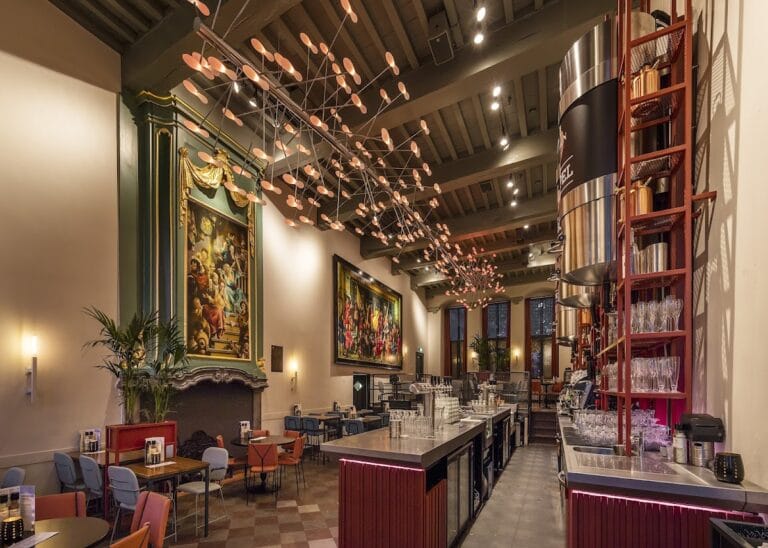
Museum Speelklok’s galleries now occupy the interior. These insertions have largely obscured the original spatial effect, but they were constructed without damaging the building and could be removed if necessary.
Burials and memorials
Burials in the church are associated with the seventeenth-century Utrecht painters Joachim Wtewael, Paulus Moreelse, Hendrick ter Brugghen, Dirck van Baburen, Jan Both, and Herman Saftleven, although their graves can no longer be located. The eighteenth-century landscape painter Dirk van der Burg lies in the family grave. The clockmakers Egbert Jans van Leeuwarden and Simon Lachez were also buried in the church. A memorial stone in Choorstraat identifies the former position of Suster Bertken’s cell.