Helmarshausen Abbey: A Benedictine Monastery and Medieval Art Center in Germany


Site at a Glance
- Rating
- 4.1
- Popularity
- Very Low
- Country
- Germany
- Primary era
- Medieval
- External website
- Open
- Eras represented
- Medieval
- Civilizations
- Holy Roman Empire
- Site type
- Religious
- Remains
- Monastery
On this page16 sections
History
Helmarshausen Abbey is a former Benedictine abbey in Germany, now part of Bad Karlshafen in northern Hesse. Count Ekkehard and his wife Mathilde probably founded the monastery around 987, building on a royal court recorded at Helmarshausen in 944. The foundation belonged to the medieval Romanesque period and was dedicated to the Virgin Mary, Christ the Savior, and Saint Peter.
Royal privileges and Paderborn control
Before 997, Emperor Otto III and Pope Sylvester II confirmed the abbey and granted it immunity, a status that placed a monastery directly under imperial authority rather than under an intervening territorial lord. Helmarshausen received rights equivalent to those of Corvey, including the privileges to hold a market, mint coins, and collect customs. Several coins minted at Helmarshausen survive.
The founder’s heirs protested after losing their former rights. At the Diet of Leitzkau in 1017, Emperor Henry II placed the monastery under Bishop Meinwerk of Paderborn. One of the affected heirs, Thiermar, brother of Duke Bernard II of the Billung dynasty, raided Paderborn territory in opposition to the decision. A final settlement followed in 1024.
Meinwerk consecrated the abbey church in 1011. Helmarshausen then became a proprietary monastery of the bishops of Paderborn, meaning that the bishops controlled and protected it while directing its religious life according to Benedictine principles. The counts of Northeim and later the counts of Winzenburg held the monastery’s secular advocacy, the office of protecting and representing a religious institution, before that role passed to Henry the Lion, the Welf duke of Saxony and Bavaria.
Relics, pilgrimage, and expansion
Under Abbot Thietmar II, who led the abbey from 1080 to 1112, Helmarshausen acquired important relics. The most influential were the remains of Saint Modoald, a bishop of Trier whose relics became associated with the abbey’s religious cult alongside those of Saint Peter. Thietmar also brought relics of the Trier bishop Abrunculus. His journeys to Trier are described in the contemporary Translatio Modoaldi.
The relics attracted pilgrims who sought miraculous healing, and their offerings helped increase the abbey’s prosperity. Regional nobles, including the counts of Reinhausen, Poppenburg, Schwalenberg, Dassel, and Ziegenberg, as well as the lords of Malsburg, Eberschütz, and Padberg, granted Helmarshausen extensive possessions. Records in the Helmarshausen Traditions Codex preserve evidence of lay donations that provided the material basis for enlarging the abbey church.
During this period Helmarshausen became a Paderborn archdeaconry, an ecclesiastical district governed by an archdeacon. Its religious importance was accompanied by major artistic growth, and after Thietmar II’s death the abbey’s writing workshop and craft workshops became especially renowned.
The manuscript and goldsmiths’ workshops
Between about 1120 and 1200, the abbey’s scriptorium, a workshop for writing and producing books, created charters and illuminated manuscripts. During the twelfth century, Helmarshausen displaced Corvey as the leading center of book production in northern Germany. Contacts with the Rhineland and the Meuse region introduced western Romanesque illumination, the manuscript-decorating style of medieval western Europe before Gothic forms spread, into Saxony around 1120 to 1130. Some figurative decoration was produced through cooperation with other monasteries.
The workshop’s patrons increasingly came from Saxony after about 1150, and laypeople became more frequent customers. In the last quarter of the twelfth century, commissions from Henry the Lion encouraged another revival. The scriptorium produced large, richly decorated psalters for lay patrons, including Henry’s duchess Mathilde, and created the Gospels of Henry the Lion around 1180. In its own period, the manuscript was regarded as unsurpassed in the luxury and quality of its decoration. Manuscripts such as the Gniezno Gospels were also sent to distant patrons.
Production of luxury manuscripts ended around 1200. Competition from scriptoria in episcopal cities, including workshops partly run by laypeople and located nearer to the book market, contributed to the decline. The abbey’s dispute with the bishops of Paderborn over the restoration of its imperial immediacy also weakened its position. The later Trier Gospels reveal a division of labor within the scriptorium. Although Helmarshausen moved away from earlier Romanesque traditions, its school did not develop a connection with Gothic illumination.
Conflict over independence
After Henry the Lion lost the advocacy of Helmarshausen in 1180, together with the Saxon tribal duchy, the abbey became involved in the territorial expansion of regional powers. Relations with Paderborn had already deteriorated during the second half of the twelfth century. Under Abbot Conrad II, documents were forged to support the abbey’s claim to independence, while Pope Alexander III reaffirmed its subordination to Paderborn around 1160.
The dispute reached a peak in 1191. Pope Celestine III confirmed Helmarshausen’s possessions and privileges, but the newly elected Abbot Thietmar III rejected investiture, the formal appointment to a church office, by Bishop Bernard II of Paderborn. Bernard responded by excommunicating him, excluding him from the sacraments and the institutional community of the Church.
Archbishop Engelbert I of Cologne used the conflict to extend Cologne’s power through Westphalia toward the Weser. Around 1220, the abbey transferred half of the town of Helmarshausen to Cologne in exchange for protection. The town was then fortified, and the Krukenburg was built to protect the abbey. Helmarshausen became one of Cologne’s principal outposts in the Weser region.
Decline and dissolution
Cologne’s defeat at the Battle of Worringen in 1288 reduced the archbishops’ influence in the Weser region. Paderborn recovered control, and by 1326 Bishop Bernard V held the abbey’s spiritual supervisory rights. He also acquired Cologne’s half of Helmarshausen and the Krukenburg. Abbot Reimbold subsequently established links with the archbishopric of Mainz, and half of the part of the town that still belonged to the abbey was sold to Mainz.
The monastery’s finances then deteriorated. Its income no longer covered its needs, and growing numbers of its possessions were pledged or sold. After the Mainz-Hesse War ended in a Hessian victory in 1427, the landgraves of Hesse brought more of Mainz’s regional possessions under their control. In 1479, the abbot also placed himself under Hessian protection.
The Reformation led to the dissolution of Helmarshausen Abbey in 1538. Following a prolonged legal dispute, the Bishopric of Paderborn relinquished all rights to the monastery in 1597. Landgrave Philip I of Hesse established a tithe office in the former abbey complex, and noble families received the former monastic possessions as fiefs.
The abbey church partly collapsed in 1604, and its stones were reused in 1749 for a large tithe barn. The town of Helmarshausen took over the surviving monastic buildings in 1848, after which they served as a school. Since 1965, the complex has housed an evangelical kindergarten and a youth center. The medieval legacy of the abbey survives in the Gospels of Henry the Lion, the Gniezno Gospels, works associated with the goldsmiths’ workshop, and the record that Thietmar, Margrave of the Saxon Ostmark, was buried there.
Remains
Surviving abbey complex
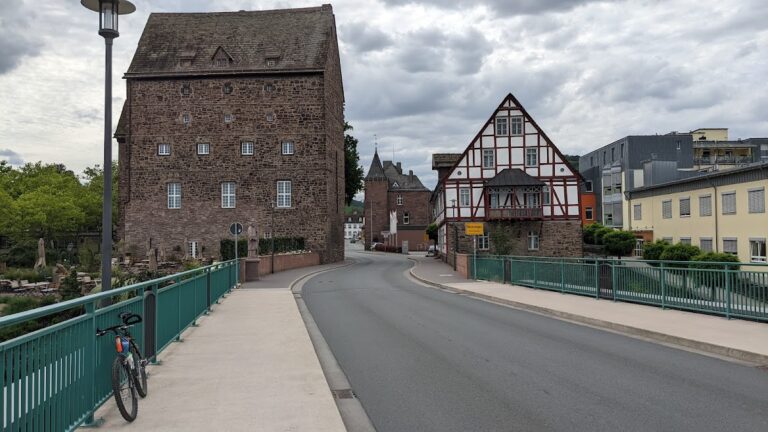
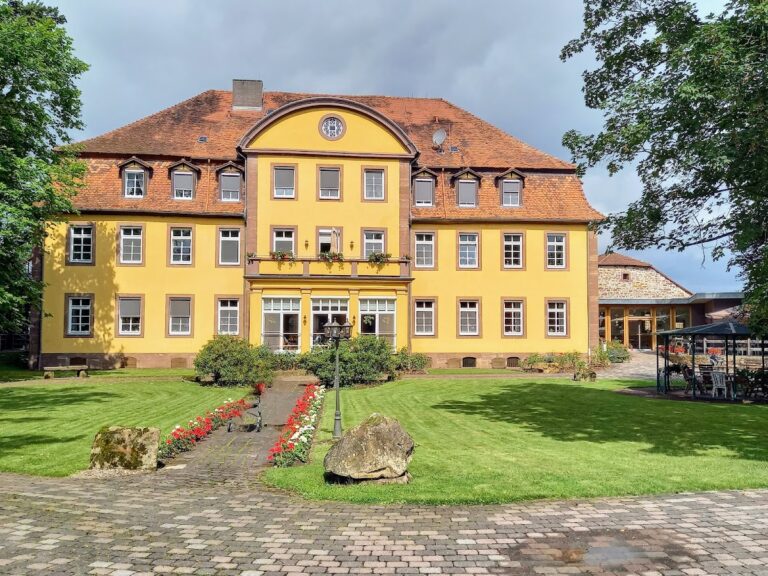
Only the east wing of the former abbey complex and one chapel survive. The remaining buildings are used for parish purposes, including a youth facility and a kindergarten. Their survival preserves part of the monastic layout, while the former church and much of the medieval complex are represented by later fabric and reused stone.
Church and Krukenburg
Abbey church
The abbey church was consecrated in 1011 and later enlarged with wealth derived from aristocratic gifts and offerings made by pilgrims. It partly collapsed in 1604. Much of its stone was incorporated into the large tithe barn built in 1749, linking the surviving material of the medieval church with the post-Reformation administration of the former monastic estate.
Krukenberg chapel
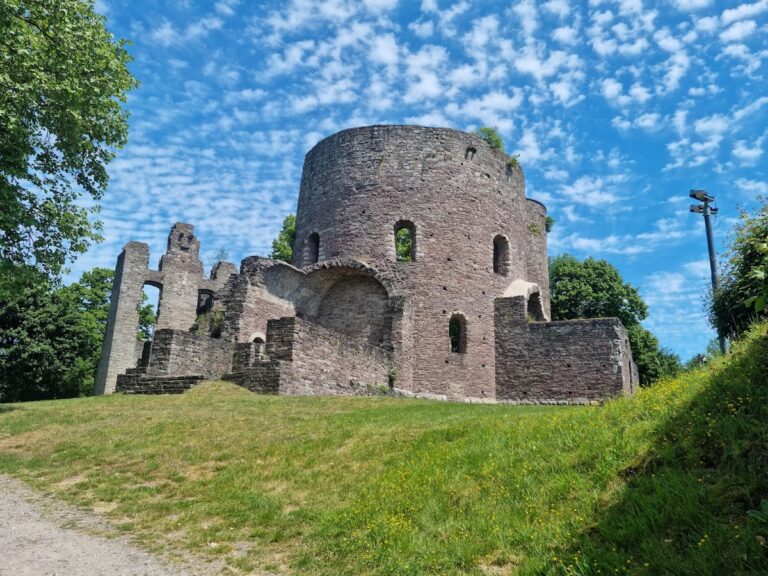
The chapel on the nearby Krukenberg was built under Bishop Henry II of Paderborn. Its design followed a model associated with Wino, the abbey’s second abbot, who had previously traveled to Jerusalem. First mentioned in 1107, the chapel was modeled stylistically on the Church of the Holy Sepulchre.
Krukenburg fortification
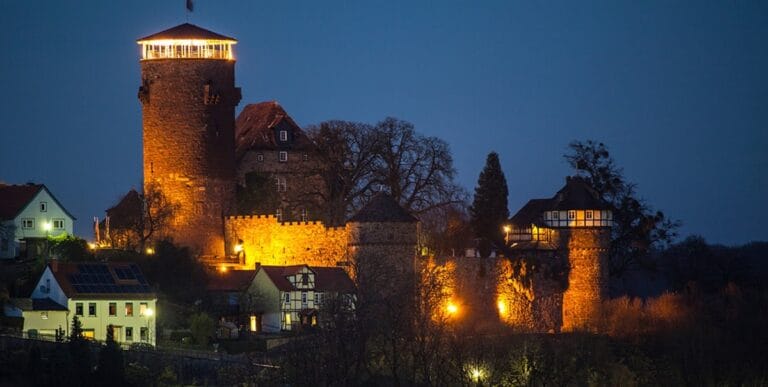
The Krukenburg was built around 1220 as part of the fortification created after Cologne received half of Helmarshausen and guaranteed the abbey’s protection. Its purpose was to defend the monastery within the political and military arrangement that made Helmarshausen a Cologne outpost in the Weser region.
Metalwork and manuscript production
Goldsmiths’ workshop
Helmarshausen’s gold- and silversmiths made crucifixes, small bronzes, liturgical and ornamental goldwork, jewelry, portable altars, reliquary crosses, and decorated book bindings. A portable altar was a consecrated altar small enough to move, while a reliquary cross was designed to contain or display relics. The workshop’s activity between 1107 and 1130 included portable altars, reliquary crosses, and valuable bindings.
Two portable altars now in the Diocesan Museum of Paderborn probably came from Helmarshausen. The priest-monk Roger of Helmarshausen may have headed the workshop, although his own work as a goldsmith cannot be established. He is also associated with a move from Stavelot Abbey to Helmarshausen in 1107.
Gospels of Henry the Lion
The Gospels of Henry the Lion, an illuminated book containing the four Gospels, were produced at Helmarshausen between approximately 1176 and 1188. The monk Herimann is named as the scribe, and Henry the Lion commissioned the manuscript for Brunswick Cathedral. A facsimile is displayed in the local museum. The original was sold at Sotheby’s in London on 6 December 1983 for £8,140,000, making it the world’s most expensive book until the Codex Hammer was sold in 1994.
Other books and records
The Gospels associated with Gniezno formed part of Helmarshausen’s manuscript production for distant patrons. The Helmarshausen Traditions Codex, now in Marburg, preserves records of lay donations that supported the abbey’s development. Surviving coins minted at Helmarshausen likewise preserve evidence of the monastery’s former right to operate a mint.