San Nicolò dei Mendicoli: A Medieval Parish Church in Venice


Site at a Glance
- Rating
- 4.8
- Popularity
- Low
- Country
- Italy
- Primary era
- Medieval
- External website
- Open
- Eras represented
- Medieval, Early Modern
- Civilizations
- Venetian
- Site type
- Religious
- Remains
- Church
On this page18 sections
History
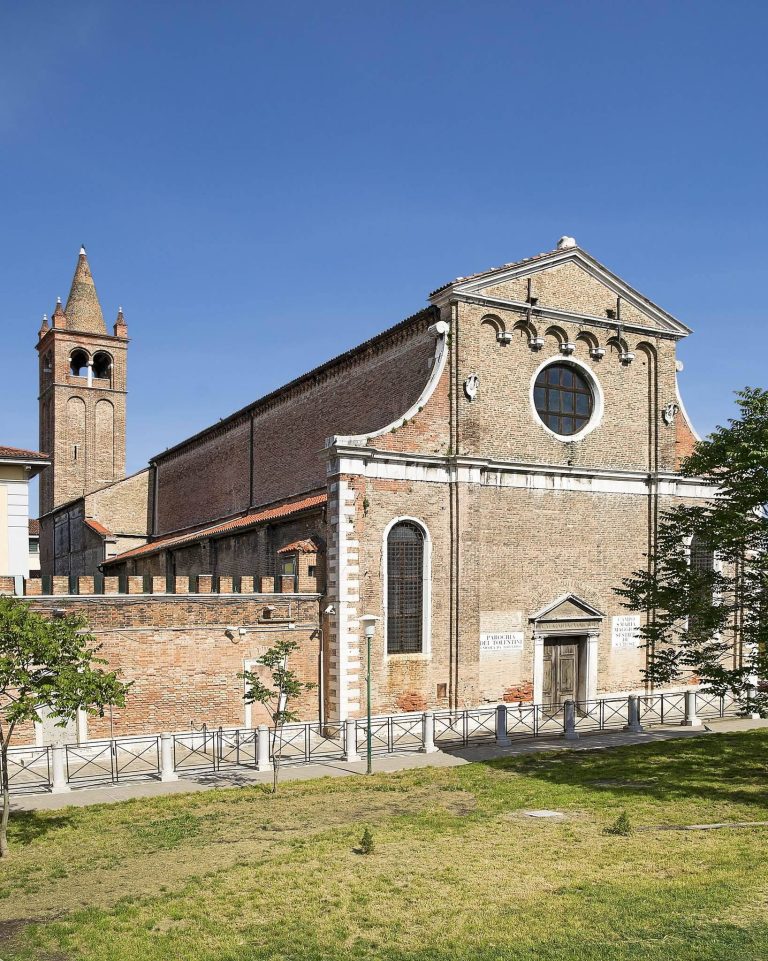
San Nicolò dei Mendicoli is a medieval Roman Catholic parish church in Venice, Italy, in the Dorsoduro district. Built in the Venetian-Byzantine tradition during the twelfth or thirteenth century, it is dedicated to Saint Nicholas of Myra, the fourth-century bishop associated with charity and the protection of sailors. The church remains under the Patriarchate of Venice, the Roman Catholic jurisdiction responsible for diocesan administration, and belongs to the parish of San Nicola Vescovo, also known as San Nicolò dei Mendicoli.
Early church and medieval rebuilding
The area around San Nicolò dei Mendicoli is regarded as one of Venice’s oldest settlement zones. A local tradition holds that refugees from Padua, escaping the Lombard invasions, established an earlier church dedicated to Saint Lawrence in the seventh century. Fire destroyed that building in 1105, after which a replacement church was built. The present structure belongs broadly to the medieval rebuilding of the site, although its precise construction date is uncertain. By the late twelfth century, the dedication had changed to Saint Nicholas.
The name “dei Mendicoli,” meaning “of the beggars,” has two recorded explanations. It may refer to the poor fishermen, artisans, and families who lived on the island, or it may preserve the earlier name Mendigola. The inhabitants became known as the Nicolotti, giving the church and its surrounding community a distinctive social identity.
The church was restored between 1361 and 1364 and then substantially rebuilt from 1553 to 1580. These interventions shaped the building that later generations inherited while preserving its medieval plan. Between 1750 and 1760, a new stone portal was added to the side facade, probably by the architect Paolo Posi.
The Nicolotti community
The Nicolotti were historically associated with a fierce rivalry with the Castellani, workers connected with Venice’s Arsenal. Their contests developed into fights in streets, canals, and on bridges, until the doges prohibited them because of their violence. In 1705, after the Nicolotti failed to answer the fire bells while engaged in a fight, they turned to public feats such as forming human pyramids and walking on wires above Saint Mark’s Square.
San Nicolò dei Mendicoli also reflects the social history of ordinary Venetians. The six children of the painter Gabriele Bella were baptized there, an association connected with their commoner origins. The church continues to function as an active parish and retains its Roman Catholic and Latin-rite affiliation.
Flood damage and conservation
Venice’s flood of 4 November 1966 seriously damaged the church. From 1967, the British foundation Venice in Peril organized conservation that continued through major campaigns in the 1970s. The work included replacing the roof covering, protecting the structure from damp, conserving paintings and crucifixes, raising the floor, and installing heating and lighting between 1972 and 1980. The floor had previously been 30 centimetres below the level of the adjacent canal.
The medieval campanile was also restored during the 1970s after damage caused by an accidental bomb during the Second World War. Further restoration in 2002 and 2003, supported by the special Salvaguardia di Venezia legislation, recovered architectural elements that earlier interventions had left neglected. The church and its interior also gained wider public attention when Nicolas Roeg used them for several scenes in the 1973 film Don’t Look Now. That publicity probably helped focus attention on both the building and the conservation campaign.
Remains
San Nicolò dei Mendicoli retains a Romanesque, brick-built basilica plan, meaning that its central nave rises above two side aisles. The medieval structure includes a presbytery, a semicircular apse as wide as the central nave, and chapels beside the apse. Excavations during the second half of the twentieth century revealed a thick wall of Istrian stone beneath the floor. It runs across the aisles toward the presbytery, and the columns of the present church rest on it.
Facade and bell tower
Brick facade and entrances
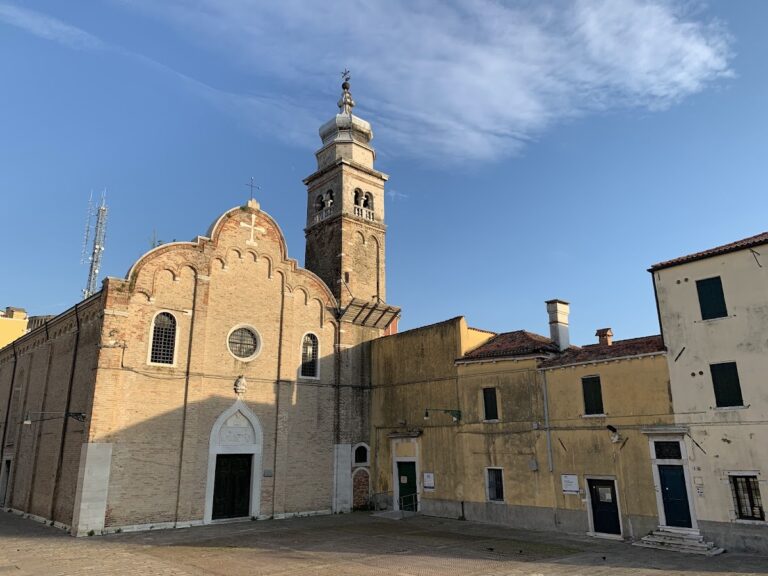
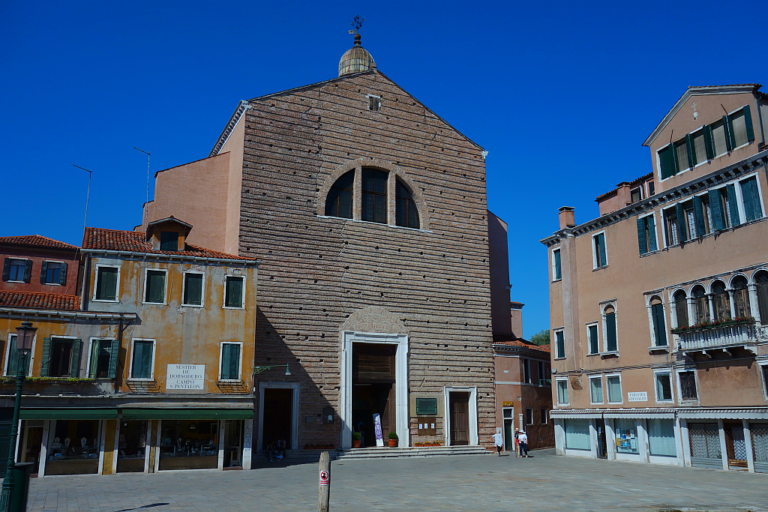
The plain brick facade is accompanied by a small fifteenth-century porch at the north entrance, which opens on the right side of the nave. Restoration in 1896 to 1898 uncovered a small twelfth-century biforium, a two-part arched window divided by a central support, within the facade wall. A thirteenth-century relief of Saint Nicholas remains above the entrance, with traces of its original paint still visible.
Medieval campanile
The square medieval campanile, or bell tower, stands about 26 metres high. Its construction date is uncertain but falls broadly in the twelfth or thirteenth century. Vertical lesenes, narrow raised strips of masonry, run over the full height of its walls and end in a shallow cornice. The bells are operated manually. A clock was installed in 1764, and the north side bears a clock face with the Latin inscription “Lethi vive memor, fugit hora,” an erroneous form of “Vive memor lethi, fugit hora.”
Nave and presbytery
Columns and painted cycle
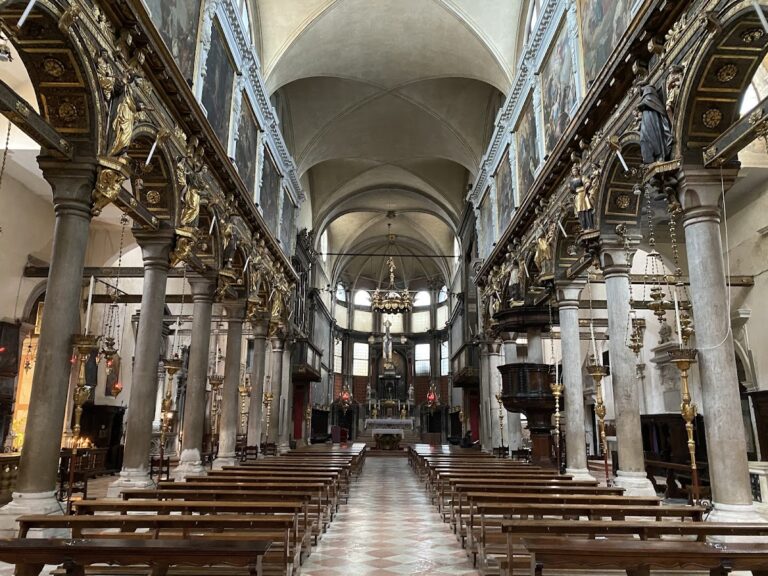
Two rows of columns divide the central nave from the side aisles. Their capitals date from the fourteenth century and have been described as Corinthian-like. Their hooked forms derive from the coats of arms of patron families. Sixteenth-century statues of the twelve apostles stand above the capitals.
The upper nave walls carry a cycle of scenes from the life of Christ. It includes the Nativity, the Adoration of the Magi, the Circumcision, the Baptism of Christ, Christ in the Garden of Gethsemane, the Kiss of Judas, Christ before Pilate, the Flagellation, Christ and Veronica, the Crucifixion, the Entombment, and the Resurrection. The cycle contains works by painters of the Veronese school, a sixteenth-century Venetian-area tradition known for richly colored and scenographic religious compositions, including Alvise Benfatto.
Apse and high altar
The presbytery apse has walls covered with damaged frescoes. A large niche in the main altar contains a fifteenth-century polychrome wooden statue of Saint Nicholas, dated to 1457 and attributed to the workshop of Bartolomeo Bon. Another image of the saint, holding three golden spheres, refers to the legend that Nicholas gave money to save three young women from prostitution.
Rood screen and ceiling
A rood screen, a partition between the nave and the presbytery that supports a crucifix, stands between the central nave and the chancel. A large wooden crucifix rises above it, accompanied by figures of Mary, Saint John, and two angels. Conservation work in the 1970s brought the crucifix and the statue of Saint Nicholas to light.
The flat ceiling contains three sixteenth-century paintings. Francesco Montemezzano painted the central panel, Saint Nicholas in Glory. The side panels, Saint Nicholas Felling a Tree Erected by Pagans and Saint Nicholas Saving Sailors, are by Leonardo Corona.
Chapels and furnishings
Right-hand chapel
The chapel on the right contains a statue of Saint Anthony of Padua set within a niche. Its vault carries a 1630 fresco of the Assumption, which is in poor condition.
Left-hand chapel
The chapel on the left contains a small painting of the Virgin Mary set against a relief of Two Adoring Angels. The relief is a sixteenth-century imitation of the Lombard school.
Chapel of Saint Nicetas
The Chapel of Saint Nicetas has a Renaissance marble altar with a reliquary of the saint. Sixteenth-century paintings show episodes from his life, and the church preserves the body of Saint Nicetas, identified as a Gothic martyr.
Chapel of the Blessed Sacrament
The Chapel of the Blessed Sacrament was rebuilt in the seventeenth century. Stucco and frescoes decorate its vault and lunettes.
Organ and later works
Above the main portal, a nineteenth-century organ associated with the Bazzani firm stands on a sixteenth-century music gallery. Italian specialists removed it for restoration and later reinstalled it. The church also contains a Pietà made in 1968 by the South Tyrolean sculptor Guido Anton Muss and a baptismal font.