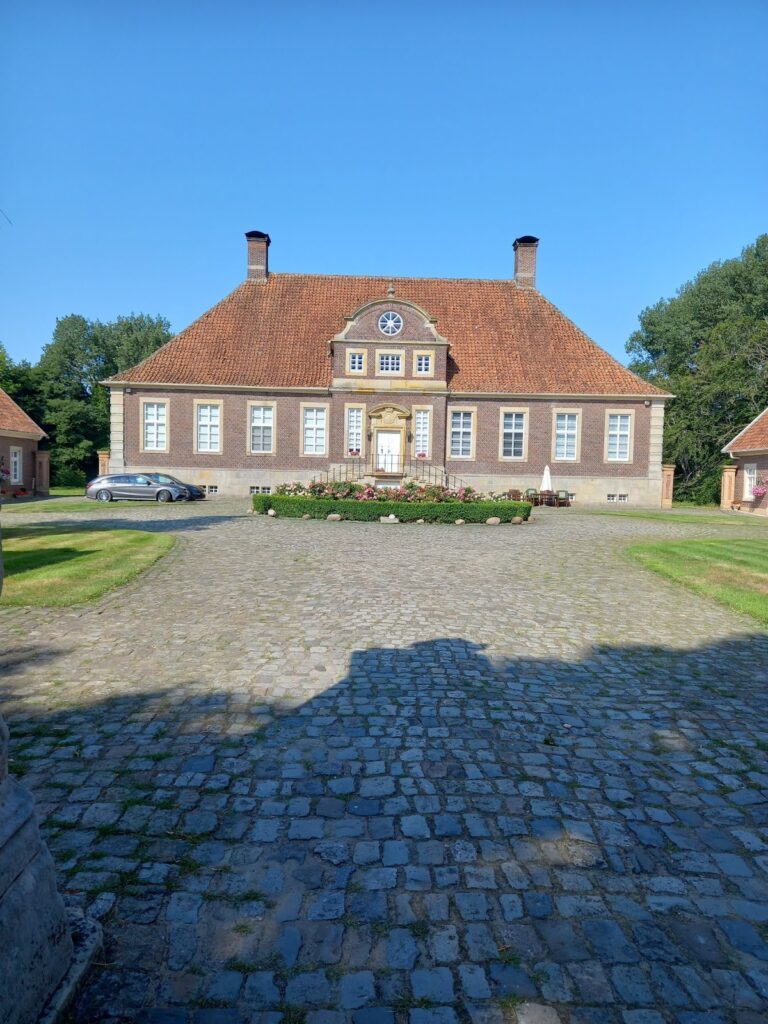
Kloster Bentlage: A Former Crosier Monastery and Cultural Centre in Germany


Site at a Glance
- Rating
- 4.5
- Popularity
- Medium
- Country
- Germany
- Primary era
- Medieval
- External website
- Open
- Eras represented
- Medieval, Early Modern
- Civilizations
- Holy Roman Empire
- Site type
- Religious
- Remains
- Monastery
On this page11 sections
History
Kloster Bentlage is a former Crosier monastery and later castle residence in Germany, north of Rheine beside the Ems. Its main historical development began in 1437, when the Order of the Holy Cross established a late-medieval religious house on land transferred by the Prince-Bishopric of Münster.
Early chapel and foundation
The place was recorded as Binutloga in the register of Werden Abbey in 890 and as Buntlagi in the eleventh century. During the eleventh century, the land belonged to the Saxon Billung family, a powerful noble lineage with influence across northern Germany. The property was assigned to support a proprietary church, and a chapel dedicated to Saint Gertrude was built at Bentlage with a small cemetery.
The chapel never became an independent parish. The surrounding farming communities were not assigned to it, while Rheine grew in importance and its Dionysius Church was rebuilt on an imposing scale from about 1400. Opposition from the priest of that church probably contributed to the chapel’s decline. In 1437, the chapel, its land, and the rector’s house passed to the Prince-Bishopric of Münster, an ecclesiastical principality whose bishop held both religious and territorial power.
On 5 March 1437, the property was conveyed to the Crosiers, or Canons Regular of the Order of the Holy Cross, a Catholic order combining communal religious life with pastoral and charitable work. Pope Eugene IV confirmed the foundation on 24 April. Bentlage became the third Crosier monastery in Westphalia. Johannes ter Borch of Cologne served as its first prior, and the first brothers came from Cologne and the region of present-day Wuppertal.
Growth and economic foundations
The Crosiers received rights to produce salt on their lands and to fish in the Ems. These privileges provided the community’s initial economic base. The brothers first lived in the former rector’s house, but it burned down in the year after the foundation. Relations with Rheine’s parish priest were initially competitive, and agreements in 1459 and 1473 later defined the respective districts of the monastery and the parish church.
To secure enough land for a substantial monastery, the Crosiers purchased the neighbouring Niederbentlage farm from the Prince-Bishopric of Münster. The purchase, combined with inexperienced financial administration, created serious difficulties. A creditors’ assembly reorganized the monastery’s finances in 1445, and donations from supporters enabled the community to recover gradually.
Construction of the major four-wing complex began in 1463. Four monks from Bentlage founded the Crosier monastery at Ter Apel in 1465, making Bentlage its mother house. The east wing was built between 1463 and 1466, the monastic hall church between 1468 and 1484, a monastery school was established in 1484, and the north wing was completed by 1504. The west wing followed in 1645. Craft workshops also operated under the monastery’s control.
Bentlage reached its greatest expansion between 1490 and 1500. More than 50 monks lived there, and the monastery owned 21 landed estates and farms. A gradual decline began in the early sixteenth century. By 1631, only seven canons remained at Bentlage.
Destruction, recovery, and secularization
On 21 September 1647, Swedish troops commanded by Hans Christoph von Königsmarck attacked Bentlage during the Thirty Years’ War, the European conflict of 1618 to 1648 shaped by religious, dynastic, and territorial struggles. They looted and burned almost the entire monastery. The kitchen and bakery, smithy, two barns, a stable, and the gatehouse survived. Reconstruction continued until 1662.
After the rebuilding, the community gradually recovered. About twelve Crosiers again lived at Bentlage during the later seventeenth century, and the monastery possessed enough resources for further expansion, renovation, and artistic embellishment during the following century and a half. A renewed decline began in the second half of the eighteenth century. Secularization, the early nineteenth-century dissolution of many ecclesiastical institutions and transfer of their property to secular owners, ended the Crosier community at Bentlage in 1803.
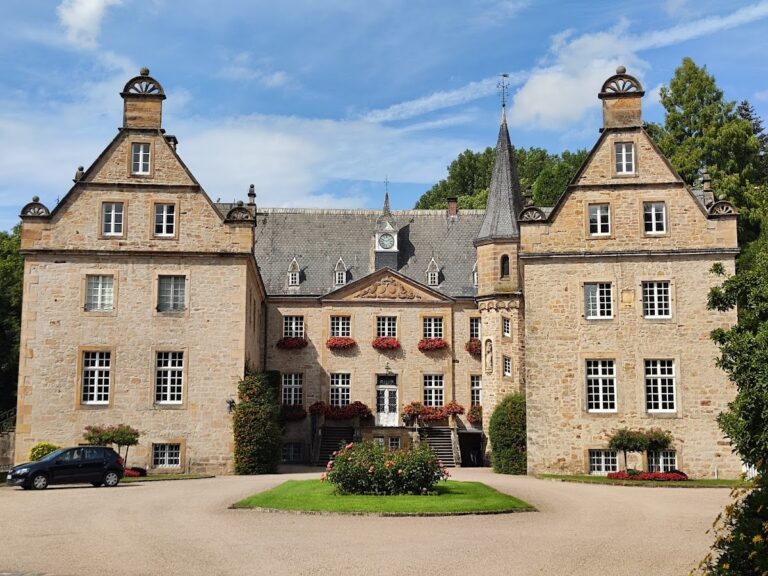
The former monastery first became part of the small state of Rheina-Wolbeck. In 1806, it passed to the noble Looz-Corswarem family, which converted it into a castle residence. The complex remained with that family until 1946, when it passed by inheritance to Baron von Boegaerde-Terbrügge and his heirs. The monastery church was demolished in 1828.
Municipal ownership and cultural use
The city of Rheine acquired the buildings and surrounding land in 1978. Reconstruction and renovation carried out from 1990 to 2000 produced numerous finds that enriched historical research and made the complex publicly accessible. Rheine now operates Kloster Bentlage as the cultural institution Kulturelle Begegnungsstätte Kloster Bentlage.
The former monastery houses a museum of Westphalian art and cultural history from the Middle Ages to the present, as well as the Westfälische Galerie, which presents modern art from Westphalia since 1900. Temporary exhibitions, concerts, family programs, and adult education are also held there. The European Fairy-Tale Society, founded at Bentlage in 1956, maintains its administrative headquarters and a specialized library in the north wing. An artists’ graphic workshop operated by the Bentlage Print Association provides facilities for lithography, etching, screen printing, and relief printing.
Kloster Bentlage, the Gottesgabe saltworks, and Bentlager Wald together form the Bentlager Dreiklang, a cultural project of the city of Rheine realized through Regionale 2004.
Remains
Kloster Bentlage stands beside the Ems within the several-thousand-year-old cultural landscape of Bentlager Wald. Its grounds and gardens form part of the surviving setting. The monastery was planned as a large four-wing enclosure around a central complex, with the church forming its southern closure. The buildings incorporated religious, residential, educational, agricultural, and craft functions.
Monastery buildings and setting
East wing
The east wing, constructed between 1463 and 1466, is part of the late-medieval core of the complex. Its displays include objects used by the former inhabitants and material associated with their daily life. The attic contains the Westfälische Galerie, with modern Westphalian art including works by the expressionist artists Wilhelm Morgner, Peter August Böckstiegel, and Carlo Mense.
North wing
The north wing was completed by 1504 and remains part of the monastery complex. It contains the specialized library of the European Fairy-Tale Society, whose headquarters have been at Bentlage since the organization was founded there in 1956.
Former church and service buildings
The monastic hall church was built between 1468 and 1484 as the southern closure of the four-wing plan. It was demolished in 1828, but its ground plan has been reconstructed and marked out on the site, making the former extent of the building visible. The original complex also included a monastery school, rector’s house, gatehouse, kitchen, bakery, smithy, barns, stable, and craft workshops.
The fire of 1647 destroyed almost all the monastery buildings. The kitchen and bakery, smithy, two barns, stable, and gatehouse survived and became part of the complex reconstructed by 1662. The west wing, completed in 1645, belongs to the later phase of the monastery’s architectural development.
Reliquaries and sacred objects
Two late-medieval reliquary shrines are preserved and displayed at Bentlage. A reliquary shrine is a container made to house and present relics. The older skull shrine was completed around 1499, while the younger shrine dates to around 1520. Their condition and extent of decoration are described as unique in the German-speaking region.
The shrines contain more than 200 artistically decorated relics associated with numerous saints, including the apostles Peter, Paul, Matthew, and Andrew, Mary Magdalene, Saint Helena, and the martyrs Agnes and Lawrence. They also hold contact relics, objects believed to have been physically associated with a saint or sacred figure, together with objects connected to places where Jesus and the saints were active.
Nuns from the Cistercian convent of Bersenbrück decorated the shrines in the form of medieval “paradise gardens.” In this type of reliquary, relics and ornamental elements are arranged as a symbolic garden using flowers, foliage, and other decorative materials. The shrines preserve this elaborate presentation within the former monastery’s surviving cultural and architectural setting.
Nearby sites