St. Peter and Paul Church in Senftenberg: A Late Gothic Parish Church


Site at a Glance
- Rating
- 4.4
- Popularity
- Very Low
- Country
- Germany
- Primary era
- Medieval
- External website
- Open
- Eras represented
- Medieval, Modern
- Civilizations
- Holy Roman Empire
- Site type
- Religious
- Remains
- Church
On this page13 sections
History
St. Peter and Paul Church in Germany is Senftenberg’s oldest church, a protected historic monument probably built during the second half of the thirteenth century in the Late Gothic period. Dedicated to the apostles Peter and Paul, it stands beside the town’s historic market and has served as an important religious building through repeated fires, reconstruction, and wartime destruction.
Medieval origins and growth
The church was probably erected in the second half of the thirteenth century. Comparisons with St. Nicholas Church in Luckau, the Protestant town church in Calau, and churches in Cottbus support this dating. A square sacristy was added on the northeastern side at the end of the fifteenth century. By the beginning of the sixteenth century, the building had acquired its present overall form.
Before the Reformation, the church contained six altars. Alongside the high altar, they included altars dedicated to the Virgin Mary, Saint Andrew, and Saint Nicholas. The late medieval high altar, first recorded in 1503, had a carved figure of Mary in its central section and figures of Peter and Paul in the side sections.
Fires, the Reformation, and renewal
Several major town fires damaged the church. The fires of 1509, 1641, and 1717 destroyed the tower and bells at different times, while the bells were also lost in the fire of 1670. Residents of Senftenberg contributed donations, and tax exemptions granted by the Saxon elector helped finance rebuilding after each disaster.
The present cellular vault with bent ridge ribs was probably installed after the 1509 fire. A cellular or net-rib vault is a ribbed ceiling whose intersecting ribs create a network of cells. This construction was used earlier in secular buildings, including Albrechtsburg in Meissen, and is described as unique among church buildings in Saxony and Brandenburg.
The Reformation, the sixteenth-century movement that established Protestant traditions across much of German-speaking Europe, was introduced in Senftenberg in 1539. A separate Wendish Church was first mentioned in 1540. Its sermons were delivered in Sorbian, a West Slavic language spoken by Sorbian communities in eastern Germany. In distinction from that congregation, St. Peter and Paul Church was also known as the German Church.
The church was renewed during the seventeenth and eighteenth centuries. Its former low gabled roof was replaced during a comprehensive renovation in 1891 and 1892, carried out according to plans by the architect Zieetz of Eutin. The work created a pointed-gabled tower structure with a clock, bringing the tower to approximately 60 metres. It also introduced a new heating system, window glazing by C. Türcke and Company of Zittau, a stained-glass altar window based on a painting by Karl Gottfried Pfannschmidt, and Neo-Gothic seating and gallery.
War damage and reconstruction
Artillery fire during fighting on 20 and 21 April 1945 severely damaged the church. The tower cap was destroyed, and the tower, church roof, and nave were completely burned out. Emergency securing and a temporary roof followed in 1946. Reconstruction took place from 1951 to 1958, and General Superintendent Günter Jacob formally handed the restored church over on 28 September 1958.
The tower had no roof until a hipped roof was added in 1985 and 1986. Its form recalls the original shape of the tower. The cross and orb were installed on 16 October 1986 by the Winter company of Schirgiswalde.
Restoration in 2012 and 2013 reopened a doorway between the sacristy and nave that had been walled up in 1890 and 1891. The work also recovered the sacristy’s hand-moulded brick floor and wall niches, which were intended for storage.
Organs and bells
The church’s organ history reaches back to 1504. Christian Koch, an organist and organ builder from Großenhain, made a new organ in 1635. The painter Füllkrug of Königsbrück decorated it in 1690, and the organ builder Familius added basses in 1730. In 1765, the Senftenberg organist Christian Schechner installed a small organ without pedals.
The 1891 and 1892 renovation included a new organ by Schlag and Söhne of Schweidnitz, but it was destroyed when the church burned during the Second World War. The present main organ was inaugurated on the first Sunday of Advent in 1960. The current bells were cast in 1955 by Meister Schilling at the foundry in Morgenröthe-Rautenkranz and consecrated in 1956.
Remains
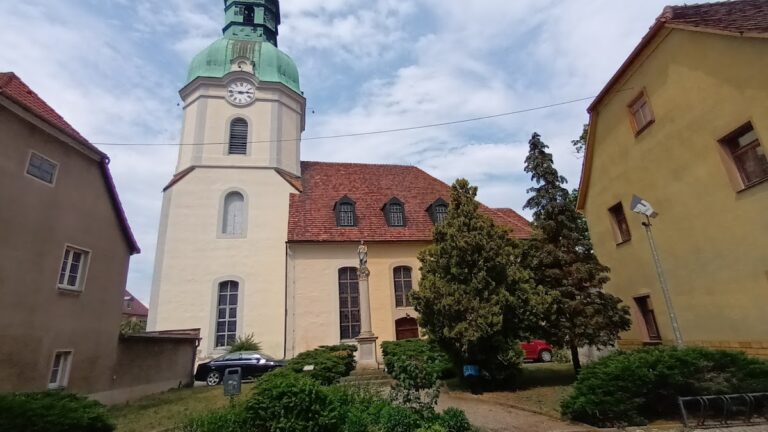
St. Peter and Paul Church stands on Kirchplatz immediately northeast of Senftenberg’s market. It is a three-aisled Late Gothic hall church of brick and fieldstone. A hall church has a nave and side aisles of approximately equal height, creating a unified interior space. The building is 44 metres long and 18 metres wide, while the nave rises 14 metres high. The interior is simply furnished and brightly whitewashed.
Building and vaulted structure
The nave contains three structural bays, and the choir has two. A bay is a repeated structural division formed by supports or vaulting. The central nave bays are transversely rectangular, while those in the side aisles are longitudinally rectangular. Ten freestanding octagonal piers support the nave’s cellular or net-rib vault. The choir and nave have two-stepped buttresses.
The western tower is transversely rectangular and has three storeys. Its upper storey changes into an irregular octagon. The base storey has a smooth exterior, while the upper levels are richly articulated with paired blind panels. The tower is 28 metres high, or 32 metres including the cross and orb.
The choir follows the principles of the Lusatian school, a regional tradition of Late Gothic church architecture in Lusatia. In the final bay, the belt arch, a transverse arch supporting or dividing a vaulted bay, runs slightly obliquely toward the eastern wall pier. This arrangement creates the impression of an ambulatory, a passage around the sanctuary or choir. The square sacristy has a cross-vault with pear-shaped ribs.
Interior furnishings
Altars and pulpit
The late fifteenth-century high altar was removed during the 1891 and 1892 renovation and sold to Dobrilugk Monastery in 1905. Its Neo-Gothic replacement was destroyed along with the rest of the interior during the Second World War. The present sandstone altar is plain apart from a large wooden cross.
A wooden pulpit was made in 1618 at the expense of Mayor Ambrosius Handt, who paid 300 thalers. The present lectern pulpit bears a key and a sword, symbols associated with Peter and Paul. Parts of a Baroque altar stand on the church’s north side. Abraham Jäger of Finsterwalde made the altar in 1682 for the Wendish Church. It was intended for installation in St. Peter and Paul Church after that church was destroyed, but the plan was not carried out. The altar was dismantled in the late 1960s, deteriorated for more than two decades, and was later installed in the church.
Baptismal font
The baptismal font was made in Dresden by Zacharias Starke, who was born in Senftenberg. A long-standing tradition holds that Hans von Polenz, the landvogt of Lower Lusatia, was buried beneath it. A landvogt was a high-ranking territorial official who administered a district on behalf of a higher ruler.
Organs
The present main organ was made by Eule Orgelbau Bautzen. It has 2,222 pipes, three manuals, a pedal, and 29 stops, and is installed with an organ gallery. Its couplers are II/I, III/I, III/II, I/P, and II/P. A small choir organ built around 1970 by W. Sauer Orgelbau of Frankfurt an der Oder has three stops: Gedackt 8′, Rohrflöte 4′, and Principal 2′.
Commemorative sculpture
A sculpture beside the right-hand central column commemorates the long-standing partnership between Senftenberg and the municipality of Leersum in the Netherlands.
Tower bells
The tower contains three current bells made of hard-cast iron. The large Peace Bell has a diameter of 1,250 millimetres, weighs 920 kilograms, and sounds the pitch g’. It was donated by church elder Wilhelm Hausmann and bears the inscription, “Do not throw away your confidence, which has a great reward,” from Hebrews 10:35.
The middle Prayer Bell measures 1,110 millimetres in diameter, weighs 690 kilograms, and sounds the pitch a’. It was donated by the Senftenberg Protestant Women’s Aid and carries the words, “Rejoice in hope, be patient in tribulation, persist in prayer,” from Romans 12:12.
The small Baptismal Bell has a diameter of 990 millimetres, weighs 430 kilograms, and sounds the pitch h’. Many members of the congregation donated it. Its inscription reads, “Be reconciled to God,” from 2 Corinthians 5:20.