Santo Stefano, Venice: A Gothic Church and Monastic Complex


Site at a Glance
- Rating
- 4.6
- Popularity
- Low
- Country
- Italy
- Primary era
- Medieval
- External website
- Open
- Eras represented
- Medieval, Early Modern, Modern
- Civilizations
- Italian, Venetian
- Site type
- Religious
- Remains
- Church
On this page24 sections
History
Foundation and Gothic rebuilding
Santo Stefano is a Roman Catholic church in Venice, Italy, founded by Augustinian hermits in 1294 and completed in 1325. The Augustinian hermits were members of a Catholic religious order following the rule attributed to Saint Augustine of Hippo. Their church and monastery were dedicated to Saint Augustine and Saint Stephen the Protomartyr, the Christian tradition’s first martyr. Santo Stefano became one of Venice’s major Gothic churches and has continued to serve a local parish community.
The church was rebuilt during the fourteenth century and substantially enlarged in the fifteenth century. Early in the fifteenth century, the presbytery, the part of a church reserved for the altar and clergy, was extended across the Santo Stefano canal. A further reconstruction took place in 1743, adding another major phase to the building’s long architectural development.
Repeated reconsecrations
During its first 250 years, Santo Stefano was reportedly reconsecrated six times after bloodshed within the church. The first such ceremony followed the wounding of the monk Fra Francesco Basadonna by Girolamo Bonifazio during a religious celebration in 1348. Similar incidents occurred in 1556, 1561, 1567, 1583, and 1594. These episodes formed an unusual part of the church’s early religious history and repeatedly interrupted its consecrated use.
From monastery to parish church
In 1810, the suppression of religious orders separated Santo Stefano from its monastery. The church then became a parish church served by secular clergy, meaning diocesan priests rather than members of a religious order. It absorbed the parish functions of Sant’Angelo, San Vidal, San Maurizio, and San Samuele, and became part of the Vicariate of San Marco-Castello, an administrative subdivision of the Patriarchate of Venice. It remains one of the principal churches of the Marciana community and preserves relics of Saint Stephen.
The church has also retained associations with Venetian civic and cultural life. Campo Santo Stefano, beside the church, was formerly used for bullfights, with the last recorded fight taking place in 1802. Funeral ceremonies for the composer Baldassare Galuppi were held here in 1785. On 11 May 1990, funeral ceremonies for the composer Luigi Nono took place at Santo Stefano before his coffin was carried by gondola to San Michele for burial.
The monastery, artists, and preservation
The former monastery had two cloisters, one of which was rebuilt in 1529 by Scarpagnino after a fire. Its decoration included frescoes by Pordenone, three detached sections of which are now preserved at the Giorgio Franchetti Gallery in the Ca’ d’Oro. The monastic buildings are now occupied by the Ministry of Finance. They also housed Antonio Canova’s first Venetian studio. The church’s artistic history includes works associated with Jacopo Tintoretto, Bartolomeo Vivarini, Pietro Lombardo, Tullio Lombardo, Paolo Veneziano, Antonio Canova, and other Venetian artists.
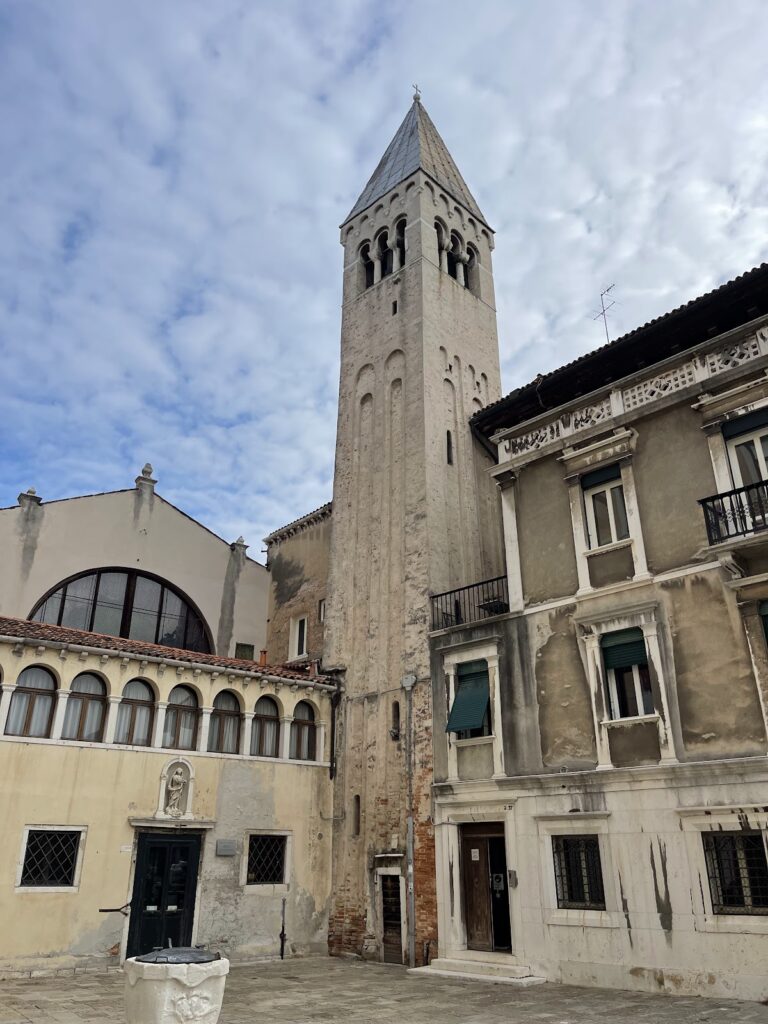
The campanile, a bell tower, was built in 1544 in a late Renaissance form and altered during the seventeenth and eighteenth centuries. Lightning struck it on 7 August 1585, collapsing its upper section, damaging neighboring buildings, and melting the bells. Replacement bells were brought from England. Subsidence and increasing inclination led to reinforcement between 1902 and 1906, including consolidation by the engineer Crescentino Caselli in 1904. A 2005 restoration added new monitoring systems, while the tower’s stability has continued to be watched.
Remains
Church layout and exterior
Plan and setting
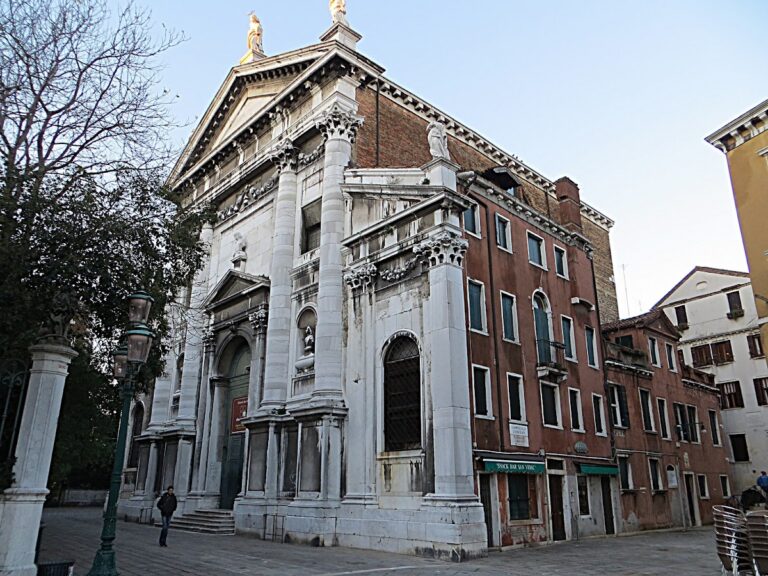
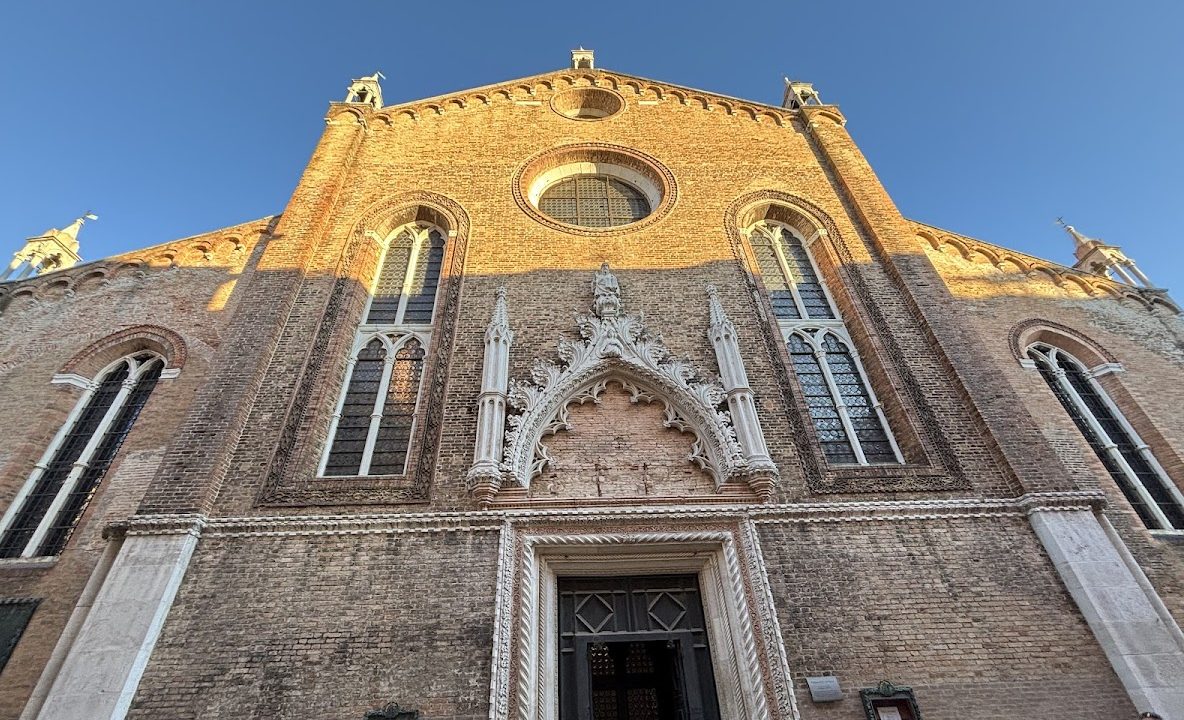
Santo Stefano stands at the northern end of Campo Santo Stefano in Venice’s San Marco district. Its brick facade faces northwest toward the narrow Calle dei Frati, while the southern side faces the campo. The basilica-plan church has a central nave, two side aisles, and three apses. The nave has a distinctly trapezoidal form, narrowing markedly toward the apse. Its deeply extended presbytery crosses the narrow Rio di Santo Stefano on a bridge, allowing a navigable canal to pass beneath the church and below the main altar at low tide.
Brick facade and side entrance
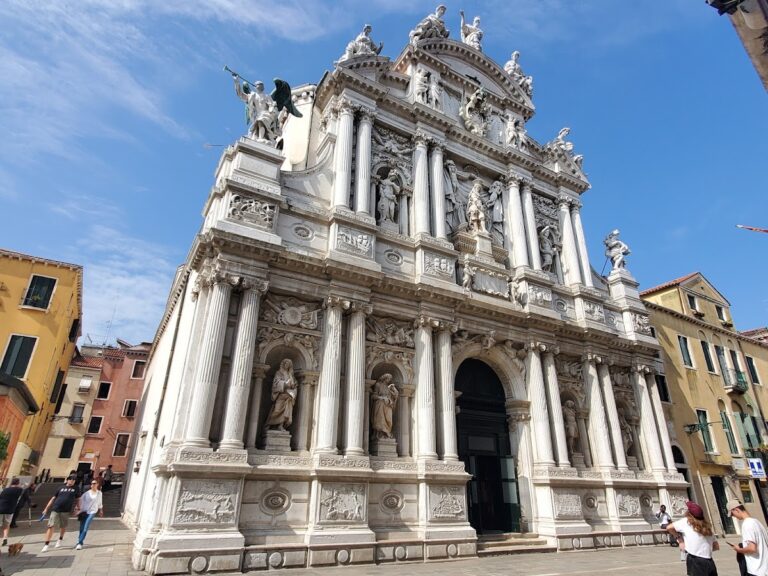
The brick facade combines late Gothic and later decorative elements. Its lower portal, made by Bartolomeo Bon and dated 1442, has a carved entrance with an empty lunette, an angel holding a scroll above the arch, two slender octagonal pinnacles, and a marble statue of Christ Pantocrator above the arch. Higher on the facade are a central rose window, two Gothic biforate windows divided into pairs of openings, and additional arched windows with ornamental frames. The side facing Campo Santo Stefano contains pointed single-light windows and a lateral portal with a carved marble cornice.
Interior and presbytery
Nave and aisles
Columns divide the interior into three aisles, with six pointed arches on each side. The columns alternate between white Greek marble and red Verona marble, and their capitals are painted and gilded in a fourteenth-century style. The walls carry polychrome painted decoration resembling brickwork, with leaf and acanthus-leaf patterns. The floor is also polychrome and coordinated with the interior colors. Above the central nave is a richly decorated Venetian ship-keel roof with a five-lobed profile. It was probably constructed from a ship’s keel made in the Venetian Arsenal, the historic shipbuilding and naval complex of the Republic of Venice, and is reinforced by beams and brackets about eight metres above the floor.
Presbytery and altar
The raised presbytery ends in a polygonal apse and is enclosed by a marble screen. It contains fifteenth-century wooden Gothic choir stalls. The high altar was made in the seventeenth century by Antonio Puzo and Angelo Panizza, with marble decoration by Giovanni Buora. The bridge beneath the presbytery and the canal below the altar form part of the church’s distinctive physical arrangement.
Funerary monuments
Entrance monuments
Near the entrance is the large stone-and-bronze tomb slab of Doge Francesco Morosini, made in 1694 by Antonio Gaspari and Filippo Parodi. Morosini, a seventeenth-century Venetian doge and military commander, was presented by the monument as the subject of a funerary memorial, although he was buried in the church of Tolentini. Above the inner side of the entrance stands the monument to the Venetian general Domenico Contarini, erected by his descendants around 1650. Its tripartite design has a central triumphal-arch element with paired columns and a pediment, flanked by narrower sections. The center holds a wooden equestrian statue of Contarini, while the side sections contain a bust of Angelo Contarini and an empty space prepared for another bust.
Monuments in the aisles
To the left of the entrance is the funerary monument of Senator Antonio Zorzi, who died in 1588. It includes a marble bust from the school of Alessandro Vittoria. On the right is the Lombard-style arcosolium, a tomb recess capped by an arch, of Giacomo Surian, who died in 1488. The left aisle contains the monument of the condottiero Bartolomeo d’Alviano, a professional military commander in Renaissance Italy who died at Ghedi in 1515. His soldiers brought his remains to the church. The same aisle also contains the tomb of the composer Giovanni Gabrieli. The church is further associated with the violinist Biagio Marini, whose tomb no longer survives.
Sacristy, chapels, and sculpture
Paintings and sculpture in the sacristy
The sacristy, the room where liturgical objects and vestments are kept, contains four paintings by Jacopo Tintoretto: The Resurrection, The Last Supper, Christ Washing the Disciples’ Feet, and The Agony in the Garden. Works by Bartolomeo Vivarini include Saint Nicholas of Bari and Saint Lawrence, while Pomponio Amalteo is represented by The Baptism of Christ. Other works include The Crucifixion by Giuseppe Angeli, The Martyrdom of Saint Stephen by Sante Peranda, and The Trinity with Saint Augustine and Saint Clare by Pietro Liberi. Paintings by Gaspare Diziani and Giovanni Agostino da Lodi, two portraits by Antonio Triva, two marble statuettes attributed to Tullio Lombardo, and a painted Crucifixion by Paolo Veneziano complete this group.
Altars and baptistery
The side altars contain Madonna with Saint John Nepomuk and Saint Lucy by Jacopo Marieschi, Saint Augustine Expelling the Heretics by Giustino Menescardi, and an eighteenth-century Madonna and Child by Girolamo Brusaferra. They also include a sixteenth-century Coronation of the Virgin from Tintoretto’s school and Madonna of the Girdle with Saints Augustine, Monica, Stephen, and Nicholas of Tolentino by Leonardo Corona. The baptistery contains a memorial stele to Giovanni Falier made by Antonio Canova in 1808. Funerary sculpture associated with Falier is also preserved in the cloister.
Campanile
Structure and repairs
The campanile is a leaning tower about 66 metres high. Its bell chamber has three arches and an octagonal drum. The upper section was rebuilt after the lightning strike of 1585, but the original spire was not restored. The tower inclines approximately two metres from the vertical. Its base was enclosed and reinforced with additional supports on a broader foundation platform. During the reinforcement work of 1902 to 1906, the bells were temporarily taken out of use and a small bellcote, a structure designed to hold bells, was erected above the sacristy.
Bells and bellcote
The campanile now contains three electrically operated bells cast by the De Poli foundry of Ceneda in 1879 and tuned to a major scale beginning with D3. The middle bell was replaced in 2008, while the cracked original is preserved inside the church. Santo Stefano also preserves a bell from the former church of San Vidal, cast by Salvatore da Venezia in 1417, and a smaller bell cast by Sigismondo Alberghetti in 1753. The bellcote above the sacristy was designed by Giovanni Sardi in Venetian Gothic style and bears the inscription Donec major silet, meaning “Until the greater one is silent.”
Cloisters and detached works
Main cloister
The cloister rebuilt in 1529 has a central wellhead and a portico with Ionic columns supporting an architrave. Pordenone frescoed its facades with scenes from the Old and New Testaments. Three detached sections of these frescoes are now held at the Giorgio Franchetti Gallery in the Ca’ d’Oro. A second, smaller cloister lies beyond the main cloister, which is situated outside Campo Sant’Angelo. The former monastery retains remnants of its decoration, including stairs, corner elements, and stonework details.
Saint Jerome polyptych
A former Saint Jerome polyptych, an altarpiece made from several connected panels, was created by Antonio Vivarini and Giovanni d’Alemagna in 1441 in oil on wood. Once located beside the entrance, it is now displayed at the Kunsthistorisches Museum in Vienna.
The church and campanile were repeatedly depicted by the English artist J. M. W. Turner, including in his painting The Church of Santo Stefano, Seen from the Rio del Santissimo.