Wengenkirche: St. Michael zu den Wengen Parish Church in Ulm


Site at a Glance
- Rating
- 4.6
- Popularity
- Very Low
- Country
- Germany
- Primary era
- Modern
- External website
- Open
- Eras represented
- Medieval, Early Modern, Modern
- Civilizations
- Holy Roman Empire
- Site type
- Religious
- Remains
- Church
On this page14 sections
History
Wengenkirche, also known as St. Michael zu den Wengen, is a Roman Catholic parish church in Ulm, Germany. Its history reaches back to an Augustinian monastery founded in 1183, and the present church reflects successive medieval, Baroque, postwar, and modern transformations.
From pilgrim hospital to monastery
The first Wengen monastery and church stood on Michelsberg, on a slight elevation north of Ulm near the initial rise of the Swabian Jura. The institution served mainly as a hospital for pilgrims travelling along a heavily used route between the Danube and Neckar regions. Augustinian canons from Marbach Abbey, members of clerical communities following the Rule of Saint Augustine, were assigned to care for these travellers. The name “zu den Wengen” means “in the meadows.”
The Michelsberg site frequently lacked enough drinking water, so the monastery and church were moved in 1215 closer to Ulm’s centre. The new location was an island between several branches of the Blau, near the level of today’s Bundesstraße 10 and Hindenburgring. The move ended the institution’s original pilgrim hospital and hospice role. Instead, the canons used the water power of the Blau to operate mills and hammer works. The relocated Wengen Minster was consecrated in 1250 as a substantial three-aisled church.
Buildings remained on Michelsberg for centuries after the relocation. The first St. Michael church there was demolished in 1539, while its tower survived until 1634.
Relocation inside Ulm
After Holy Roman Emperor Charles IV besieged Ulm in 1376, important buildings outside the city walls were gradually brought within the fortified city. The Wengen monastery was moved again in 1399, and this relocation established the foundation of the present St. Michael zu den Wengen complex. The canons received Ulm citizenship and, with an average of eight residents, also undertook pastoral work among the city’s inhabitants.
The church associated with this phase was a three-aisled, flat-roofed hall church with a recessed, vaulted choir. At the end of the Middle Ages, it became closely associated with Ulm’s painters, printers, and sculptors. Martin Schaffner, Hans Schüchlin, Niklaus Weckmann, Bartholomäus Zeitblom, and other artists belonged to a St. Luke guild, an artists’ association placed under the patronage of Saint Luke. The guild’s altar stood in Wengenkirche.
Around 1440, Provost Ulrich Strobl of Langenau commissioned a 22-metre-long Dance of Death in the cloister. This late-medieval theme shows people from different social ranks being summoned to death. At Wengen, the mural contained 24 dancing pairs accompanied by verses.
Reformation and Catholic survival
The Reformation, the sixteenth-century religious movement that produced Protestant churches and transformed Catholic institutions, led to the closure of the Augustinian monastery in Ulm. The city’s iconoclastic movement, which involved the removal or destruction of religious images and furnishings, brought the removal of multi-winged altarpieces. The church was damaged and fell into disrepair.
In 1546, the church was converted into a single-room hall. The monastery was returned to the canons on 18 July 1549, and they were given responsibility for the small Catholic population that remained in the predominantly Protestant imperial city. Catholic weddings could not be held there and had to take place outside the city walls. The canons were also forbidden to conduct burials.
Despite these restrictions, the foundation grew and maintained a broad institutional life. It operated a school and theatre, developed a library of about 10,000 volumes covering many fields of knowledge, and sustained substantial church-music activities. The number of canons eventually rose to 15. During the second half of the eighteenth century, the musician and composer Father Joseph Lederer served as music director of the foundation.
Baroque transformation and secularization
Wengenkirche underwent a Baroque transformation between 1628 and 1635, when early-Baroque wall piers were inserted. Rococo decoration followed between 1738 and 1766. Franz Martin Kuen of Weißenhorn created extensive ceiling frescoes intended to heighten the apparent space of the interior. In 1786, a substantial office building was erected south of the church. It now serves as the Catholic parish office of St. Michael zu den Wengen.
Following the defeat at the Battle of Elchingen, a military defeat that formed part of the upheavals ending Ulm’s free-imperial-city status, secularization transferred ecclesiastical property and institutions to secular authorities. The monastery passed to the Bavarian electors in 1802. The church closed again during the secularization of 1803, while parts of the monastery buildings were later used as a barracks. The monastery library and many works of art were sold or transferred to state collections.
On 2 March 1805, Wengenkirche became Ulm’s first Catholic city parish church and a full parish for the Catholic population, which had grown again since the Reformation. This change gave the church a new civic and pastoral role after the end of its medieval monastic status.
War damage and modern parish use
A substantial part of the monastery and church complex was destroyed during the Second World War, particularly in the major air raid of 17 December 1944. Fire destroyed almost all of the church’s remaining works of art, with only a few exceptions. Reconstruction in 1953 and 1954 altered both the orientation and internal arrangement. The former east-facing chancel became a side chapel, effectively turning the church around.
The Gothic western gable and its painted relief showing the laying of the foundation stone survived the destruction. The austere postwar building was nicknamed “God’s factory hall” by Ulm residents, and Wilhelm Geyer created a Way of the Cross for the reconstructed interior. In 1998, Hermann Geyer fundamentally redesigned the church and created its artistic stained-glass windows.
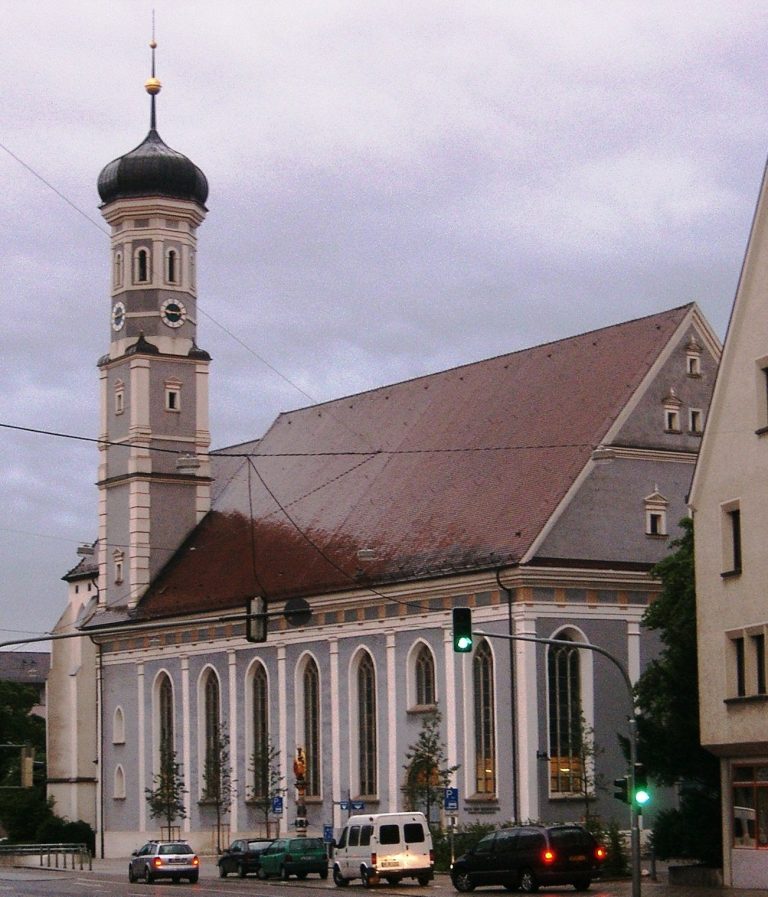
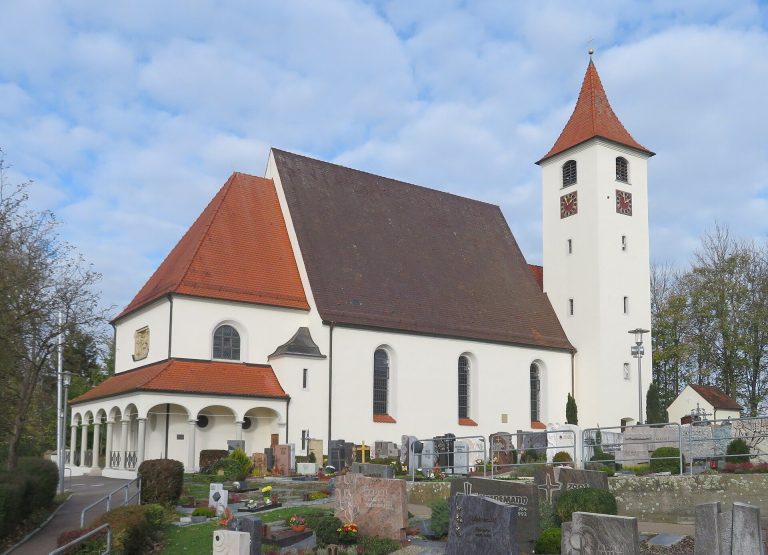
Today, St. Michael zu den Wengen is the only Roman Catholic parish church in Ulm’s old town. It is also used as a concert venue. Its red-brick tower remains visible across the old-town area. Structural deterioration led to a dispute over whether the tower should be raised and given a proper spire. After an architectural design by Gottfried Böhm caused conflict between the local dean and a specially founded tower-building association, the tower remained unchanged.
Remains
Setting and surviving church fabric
Wengenkirche occupies the old-town blocks at Wengengasse and Walfischgasse. The present complex preserves evidence of several building phases, although its postwar arrangement differs from the medieval church. The rebuilt church retains the Gothic western gable and its painted foundation-stone-laying relief, while the former east-facing choir now functions as a side chapel. The interior also contains Wilhelm Geyer’s Way of the Cross, created for the postwar building.
Church tower
The tower was rebuilt in red brick and forms a visible element of the complex across Ulm’s old-town area. Its structural condition prompted proposals for raising it and adding a proper spire. The design associated with Gottfried Böhm did not lead to alteration, and the tower remains in its existing form.
Parish office
The substantial building erected south of the church in 1786 now houses the Catholic parish office of St. Michael zu den Wengen. It forms part of the surviving institutional complex connected with the parish church.
Earlier buildings and cloister remains
The relocated Wengen Minster consecrated in 1250 was a three-aisled church. The later church connected with the 1399 move was also three-aisled, with a flat roof over the hall and a recessed choir covered by a vault. Its cloister contained the 22-metre-long Dance of Death, painted as a fresco with 24 pairs of figures and accompanying verses. The murals were whitewashed in 1810, badly damaged during the bombing of 1944 and 1945, and the remaining fragments were destroyed when the ruins were demolished in 1952 and 1953.
Artistic and musical features
Surviving artwork and stained glass
A surviving historical work associated with Wengenkirche is a Crucifixion group attributed to Niklaus Weckmann. Its connection with the church is uncertain. It may have belonged to the St. Luke altar, or it may have entered the church by another route. The reconstructed church also contains artistic stained-glass windows created by Hermann Geyer during the 1998 redesign.
Organs
The main organ stands on the north gallery. E. F. Walcker & Cie. of Ludwigsburg built it in 1961 as opus 4082. It is a slider-chest instrument with 25 stops distributed across two manuals and pedal. Its key action is mechanical and its stop action electrical. The couplers are II/I, I/P, and II/P, with two free combinations and a fixed Organo pleno combination.
The former choir, now known as the small Wengenkirche, contains a movable choir organ made by the Link company of Giengen. Its couplers are II/I, II/I 16′, I/P, and II/P.