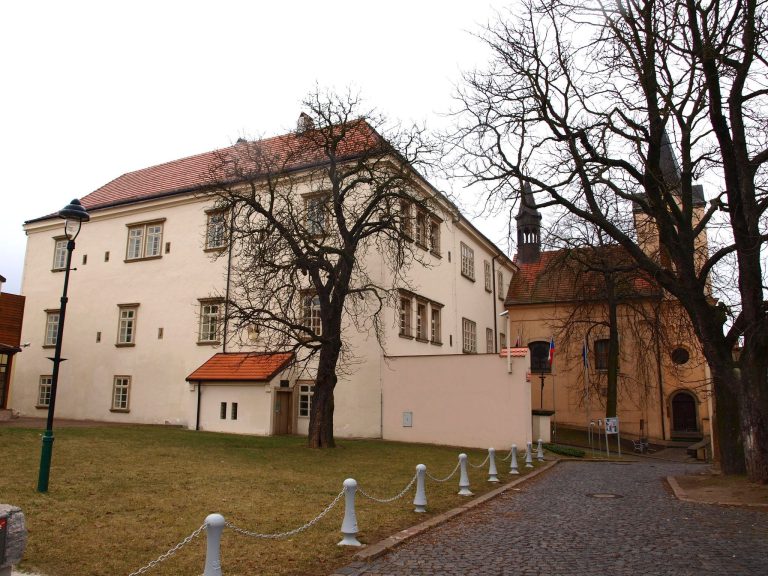
Church of Saint Wenceslaus (Stará Boleslav): A Pilgrimage and Chapter Church in Czechia


Site at a Glance
- Rating
- 4.7
- Popularity
- Low
- Country
- Czechia
- Primary era
- Medieval
- External website
- Open
- Eras represented
- Medieval, Early Modern
- Civilizations
- Duchy of Bohemia, Habsburg, Holy Roman Empire, Kingdom of Bohemia
- Site type
- Religious
- Remains
- Basilica
On this page11 sections
History
The Church of Saint Wenceslaus (Stará Boleslav) is a Roman Catholic chapter church in Czechia, built by the Bohemian dynasty in the Romanesque period after 1039. It stands on the site traditionally identified as the place where Duke Wenceslaus, the principal patron saint of Bohemia, was murdered by his brother Boleslaus I on 28 September 935, although an alternative tradition gives the year as 929. The association made Stará Boleslav an important pilgrimage centre and the setting for the National Saint Wenceslaus Pilgrimage.
Foundation and Early Medieval Development
After 1039, Duke Bretislaus I founded the present church and the Collegiate Chapter of Saints Cosmas and Damian. The foundation was understood as penance imposed by Pope Benedict IX for Bretislaus’s military expedition to Poland, during which he brought the relics of Saint Adalbert, a tenth-century bishop and missionary, to Bohemia. According to the Chronicle of Cosmas, Prague Bishop Šebíř consecrated the church on 19 May 1046.
The earlier Church of Saints Cosmas and Damian was incorporated into the new building. Its position is represented by the Romanesque crypt beneath the raised presbytery, while the new church retained the earlier ground-plan arrangement. In the early Middle Ages, it ranked among the largest sacred buildings in Bohemia. Alterations in the mid-twelfth century enlarged the crypt and modified the church’s structure.
Gothic, Hussite, and Renaissance Phases
During the reign of Charles IV, the fourteenth-century king of Bohemia and Holy Roman Emperor, the church received Gothic modifications. Charles IV visited Stará Boleslav repeatedly and established a foundation for a sung mass at the altar of Saint Wenceslaus. The southern pointed portal, whose jambs have finely worked profiles, is the principal surviving architectural element from this phase.
The Hussite Wars caused substantial damage, but worship continued in the church. Basic repairs followed in the mid-fifteenth century. At the end of the sixteenth century, a major Renaissance rebuilding introduced new vaults over the side aisles and external buttresses, reshaping the building while preserving its older core.
War, Fire, and Baroque Rebuilding
Swedish troops occupied Stará Boleslav with a military camp in 1639–1640 during the Thirty Years’ War, the seventeenth-century conflict that involved religious and political struggles across central Europe. The northern tower was demolished, and the church was set on fire as the troops withdrew.
The Collegiate Chapter began rebuilding immediately. Work continued after the war in the Early Baroque style, and new furnishings were installed before the church was consecrated in 1691. Further Baroque additions were made toward the end of the eighteenth century, including objects transferred from churches and monasteries dissolved in Prague.
Chapter and Modern Restoration
The Collegiate Chapter of Saints Cosmas and Damian was founded with the church after 1039. A collegiate chapter is a community of clergy established to maintain a church, conduct its liturgy, and carry out pastoral or commemorative duties. The chapter’s original responsibilities included caring for the place associated with Wenceslaus’s martyrdom and encouraging devotion to him. It later became the guardian of the Palladium of the Czech Lands, a highly venerated Marian image kept in the Church of the Assumption of the Virgin Mary in Stará Boleslav. The chapter is described as the oldest institution of its kind in the Czech lands.
A major restoration preceded the 1929 celebrations of the millennium of Saint Wenceslaus’s martyrdom, supported largely through the efforts of the chapter administrator Monsignor Jan Pauly. Angelo Giuseppe Roncalli, the papal legate who later became Pope John XXIII, attended the celebrations. The facades were restored again in the 1960s. A new campaign began in 2002 with ground adjustments and paving intended to reduce damp, followed by structural restoration from 2007 to 2017. A later campaign supported by the European Union restored the interior and facades, and the basilica was ceremonially reopened on 28 September 2021.
The church remains under the administration of the Stará Boleslav parish and the Collegiate Chapter of Saints Cosmas and Damian. The chapter also oversees restoration connected with the churches of Saint Wenceslaus and Saint Clement and their surroundings, and participates in the National Saint Wenceslaus Pilgrimage held in Stará Boleslav each 28 September. Pope Benedict XVI visited the chapter church on the feast of Saint Wenceslaus on 28 September 2009 and venerated the saint’s relics at the traditional site of his murder. He then celebrated a service in Stará Boleslav with 600 priests before more than 50,000 worshippers. A bust of Benedict XVI was unveiled outside the church precinct on 29 September 2019.
Remains
Plan and Romanesque Structure
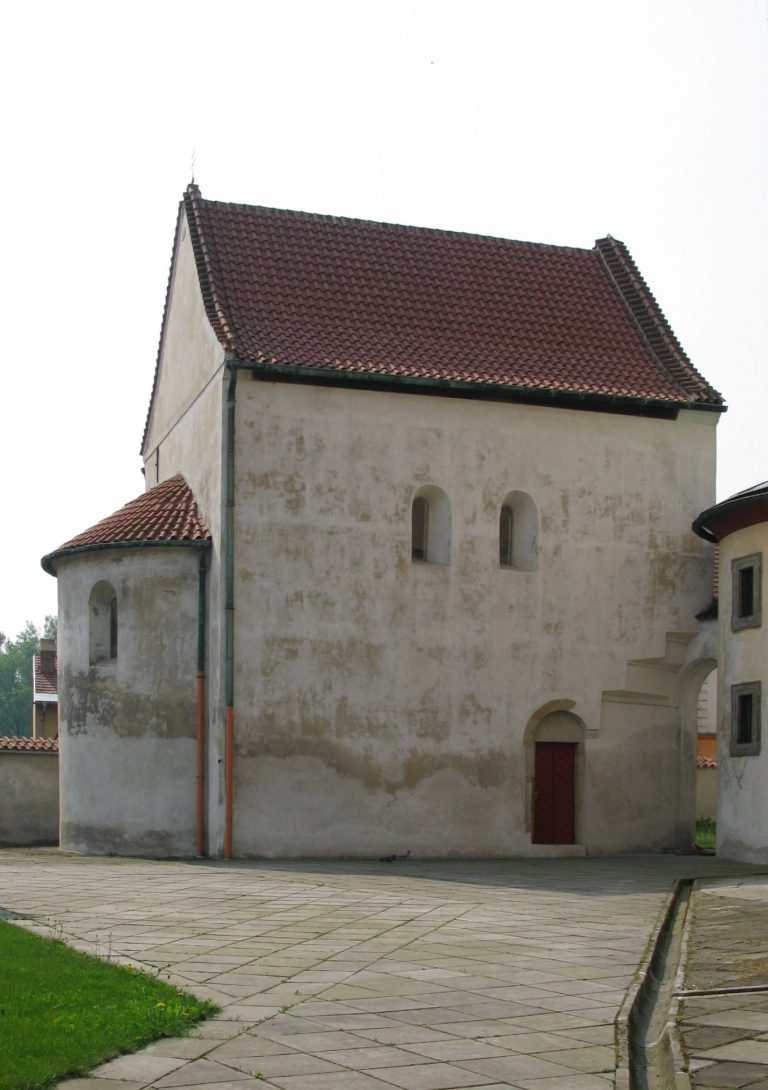
The church is fundamentally Romanesque, although Renaissance, Gothic, and Baroque changes shape its present appearance. Its basic plan is a three-aisled basilica, a church with a central nave flanked by lower or narrower side aisles. The side aisles have irregular terminations, and a single tower rises on the western facade. The altar is oriented towards the east. The late-sixteenth-century rebuilding gave the side aisles new vaults and added external buttresses, while the main nave later received a barrel vault during the Early Baroque reconstruction. The tower was completed with an onion-shaped roof and lantern after the post-war restoration.
Crypt and Martyrdom Site
Below the raised presbytery lies a Romanesque crypt dedicated to Saints Cosmas and Damian. A crypt is a chamber beneath a church that may serve burial, relic, or memorial functions. The eastern part probably dates from the eleventh century, while the western section, with five aisles, was extended towards the west in the mid-twelfth century. The crypt contains the place associated with the martyrdom of Saint Wenceslaus and a location regarded by Christian tradition as his original tomb. The earlier Church of Saints Cosmas and Damian was incorporated into the present building, probably in the area linked with the northern chapel.
Portals, Chapels, and Baptismal Font
The southern pointed portal survives from the church’s Gothic alteration and has finely profiled jambs. At the end of the northern side aisle, the rectangular Princely or Vrábská Chapel contains a Baroque altar dedicated to Saint Catherine. Before the martyrdom site stands a sculptural group of the Murder of Saint Wenceslaus from the workshop of Matthias Bernard Braun, connected with the crypt. Above it is a wooden relief showing Saint Wenceslaus leading the Blaník Knights. The southern side aisle ends in the Chapel of the Five Brothers, which contains a stone baptismal font dating from the sixteenth century.
Presbytery Furnishings
The main altar at the eastern end is dedicated to Saints Cosmas and Damian, patrons of the Collegiate Chapter. The principal altar in the presbytery dates from the beginning of the eighteenth century and was made by František Maxmilian Kaňka and Dominik Rapa. It was transferred from the Church of Saint Wenceslaus at Zderaz in Prague. Its central painting presents Saint Wenceslaus between two angels and copies a celebrated work by Karel Škréta. Canon stalls decorated with busts of Czech patron saints date from 1729, while the confessionals came from the Clementinum college in Prague.
On the northern side of the presbytery stands a Rococo pulpit decorated with sculptures of the Church Fathers, transferred from Prague’s Church of Saint Martin. Two smaller altars beside the stairs to the presbytery are dedicated to Our Lady of Sorrows and the Holy Cross. These furnishings, together with the earlier altar and stalls, represent the successive Baroque and Rococo campaigns that equipped the church after its seventeenth-century rebuilding.
Nave and Painted Decoration
Six statues of regional patron saints stand on the pillars of the main nave. They depict Saints Norbert, Adalbert, John of Nepomuk, Sigismund, Vitus, and Ivan, and originally came from the Jesuit residence in Prague’s Lesser Town. Rectangular paintings dated 1677 form a cycle of scenes from the life of Saint Wenceslaus. Two paintings on the choir gallery show Boleslaus I’s unsuccessful assembly at Tursko and the Bohemian army’s victory at the Battle of Kressenbrunn in 1260. Several paintings from a Passion cycle hang in the side aisles; they are reduced copies of Karel Škréta’s cycle from the Lesser Town Jesuit college in Prague.